
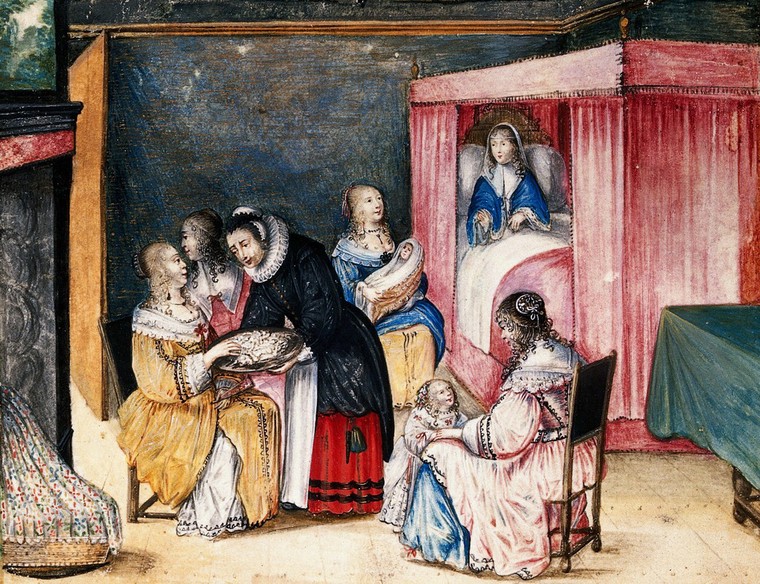
Giving birth was high risk in Austen’s day, claiming the lives of approximately one in 18 women. Four of Austen’s sisters-in-law died childbirth. (Did this have anything to do with Austen’s decision not to marry? Some scholars say yes.) This month, let’s explore childbirth in Regency England (and then feel very grateful for modern medicine).
Was there birth control?
According to one study, an aristocratic woman had her first child around age 21, then had a child every 2-3 years until she was 39. That’s an average of 8 children. This is just one study, however. I read about another woman—Catherine Tothill—who birthed 33 children! So…was there birth control?
Sort of. There was abstinence. There was also prolonged nursing, which delayed future pregnancies. There were coitus interruptus and the rhythm method, but the lack of information about a woman’s cycle made the latter method fallible. Married couples may have been conflicted, too, because the Catholic Church opposed any form of birth control.
Condoms, made from animal intestines or of linen soaked in chemical solutions, were unpopular, as they were connected to vice and prostitutes.
And then there was the sponge. Popularized in France, this method involved soaking a sea sponge in water or brandy and inserting it into the women’s body. A string was attached for easy removal. Richard Carlile, an English journalist (1790-1843), noted this method was common among the European aristocracy. He mentions an “English Duchess… who never goes out to a dinner without being prepared with a sponge. The French and Italian women wear them fastened to their waists, and always have them at hand.”

Did women know childbirth was a risk?
Yes. Many upper class women updated their wills and wrote farewell letters before their births.
Where did the upper class give birth?
London was the “it” place to give birth. Couples rented apartments—or stayed in their town homes—and received visits from friends and family. Straw was scattered outside the front door to quiet the carriages wheels and to announce the birth.
Quieter births in the country were also common, especially after the first child, and friends and family were invited to visit.
Within the house, a mother often gave birth in a separate room (not her bedroom) in her lying-in bed. These were specially designed beds that were lightweight and transportable with easy-to-change linen. They were often passed down from one mother to another.
In a separate room, the family collected to wait. They sat around drinking caudle, a hot, spiced wine that was believed to ease labor pains. The birthing mother was not allowed any, as it might harm her or the baby. So everyone else drank her wine while she labored away. Family—gotta love ‘em.
What happened to the midwives?
Before 1780, midwives attended births. People felt women had more knowledge of birthing, and it was improper for males to be present. This shifted when medicine became defined as science—a discipline that did not welcome women. Physicians waged campaigns against midwives, labeling them witches. They further argued that medical instruments, especially forceps, were necessary for difficult births, and only men were trained to use forceps. In this way, midwives and their centuries of knowledge were pushed out of the birthing room.
The upper class began hiring accoucheurs, or man-midwives. This was a surgeon who had taken some medical school classes and studied under other accoucheurs. And it was a switch that led to a spike in maternal mortality.

So what went wrong in labor?
Pre-labor: Both midwives and accoucheurs recommended a lying-in period. This meant that a woman lay on a bed for a month or more before the labor, often in a stuffy room with a fireplace running and all the windows closed, while she was bled regularly. The mother was also told to adopt a lighter diet of broth, gruel, and tea. This made for a lot of weakened women who could not help with the labor.
During labor: If the baby was turned wrong, the labor was considered high risk. In other cases, the baby was too large for the pelvis. Accoucheurs had those forceps! But if the forceps could not bring the baby out, either the child or mother would die.
Post labor: Puerperal fever was the leading cause of death in childbirth, setting in roughly three days after labor. This infection, caused by poor hygiene, was less common with female midwives—and this is one of the main culprits of maternal death rising with accoucheurs. Because accoucheurs moved from one mother to the next—or from an autopsy to a birthing mother—infection spread. The cause of the infection was still unknown, however, although accoucheurs had noticed they passed it from one birthing mother to another. Washing the instruments was not enough, and doctors were only beginning to experiment with using heat or chlorine to sterilize their instruments.
Another post partem complication was when a portion of the placenta stayed in the woman’s body, causing gangrene. Other problems included hemorrhaging, those dang leeches, eclampsia (high blood pressure), and too many pregnancies.
What do we think of those forceps?
They were controversial! And kind of scary looking. At first, there was a push not to use them, because they seemed to be causing more deaths, and common practice was to let the woman labor naturally. In fact, Thomas Denmam (1733-1815), a popular accoucheur, recommended avoiding the use of the forceps until the woman’s contractions had ceased for six hours. This was probably better than yanking the baby out (which was also done). On the flip side, a woman who labored for days or longer became weak, making the labor higher risk.
An incident with Princess Charlotte of Wales (1796-1817) influenced this debate. Heir to the British throne, she died after 50 hours of labor, her son stillborn. The country mourned the beloved princess, with some businesses closing for two weeks. Blame fell on her physician, Dr. Richard Croft, who was criticized for not using the forceps early enough. Princess Charlotte’s father and husband disagreed, saying the doctor had done all he could. Three months later, when one of Dr. Croft’s patients died in a similar way, he committed suicide, and the incident created a push for the use of forceps.

What about Cesarean sections? Or anesthesia?
Alas (or maybe thank goodness?), Cesarean sections were only performed after the mother had died.
Anesthesia was not used in labor until the 1840s—not until Scottish physician James Simpson decided to invite some friends to experiment with inhaling chemicals. He passed out from inhaling chloroform, and when he awoke, he thought, “I’m onto something here.”

Simpson began successfully using chloroform on birthing mothers. One mother was so thankful, she said is said to have named her baby “Anesthesia.” Do you love that story? It’s actually a myth. Her daughter was named Wilhelmina. (Probably best.)
People were understandably nervous about this new treatment, and there were deaths from chloroform. Others opposed it on religious grounds, reasoning that God had cursed Eve with labor pains. But then Queen Victoria used it during the birth of her son and declared it “delightful beyond measure.” And everyone felt that if the Queen liked it, then God couldn’t possibly object.
It actually is dangerous. It causes organ damage and cancer and all sorts of bad things. We have better anesthetics, now. But I get it. If someone were about to cut me open and handed me a strip of leather and said, “Here, bite on this,” I’d probably go for the chloroform too.

What happened after the labor?
Post delivery, women were again kept in those stuffy rooms, fireplaces burning, no open windows or even much light. They were to lie in bed for nine to twenty days to recover. Considering the high post-birth mortality rates, this prescription makes sense. But it also led to baby blues and post partem depression, and those hot, airtight rooms increased chances of infection.
But she finally got the caudle.
Conclusion
When I was pregnant with my first, the doctors explained to me that the backup plan was to use a method developed during the time of Julius Ceasar. And I thought, “Uh, really?”
But I retract. I’m now super grateful that my doctors did not go to the local pond to extract parasitic worms to put on my naked body. That, friends, is progress.
Remember that stat of one in 18 women dying in childbirth? Today in the United States, that number has reduced to one in 5000 women. We are lucky indeed.
What are your thoughts?
I have loved writing this blog. Thank you, Regina, fellow Always Austen authors, and readers!

Some websites that helped me write this post: Regency birthing, chloroform, the sponge method, the study on women and childbirth, Regency contraceptives, and another on Regency birthing. There is also Elaine Owen’s Always Austen post on midwives, if you’re interested in reading further.
More Austen reading:


Leave a Reply to GlynisCancel reply