

Given that this is one of the few posts a year that can step beyond the boundaries of the Regency time, I took full advantage of it.
The lore of witches, those with mystical learned skills or powers, are mentioned in tales of old, centuries before any sect of the Christian religion was formed. “In Homer’s Odyssey (c.800 BC), Circe—who turns men into animals—is described as a witch, and Plutarch refers to witchcraft in his treatise On Superstition (c.AD 100). Illicit magic features heavily in Roman law statutes, some of which are passed down to the Christian world.” –A JOURNEY INTO WITCHCRAFT BELIEFS
It took centuries more for the concept of a witch to take a particular form from the spirits, sorcery, elves, and other creatures of myth. It took on the shape of an older, impoverished woman, the uglier, the more perfect, for she is just the sort of outcast to seek acceptance in an otherworldly being, particularly of a demonic nature. But one thing they all had in common was a familiar (yes, usually a cat) to watch others or even carry out their deeds. It is clear to me that ignorance played a significant role in the history of witches. All who understand animals know that cats own the human, not that the humans own the cat, or so many of us cat lovers say as they go about their day without any interference from us at all.

Unfortunately, the history is as gruesome for England as it is in every country that conducted witch trials. Still, there is beauty in magic, for so many have a natural want to help others that I love finding the bits of hope that are part of what is passed down through the years.

Should you like to fact-check blogs, some of the sources have a notation that the content is not suitable for all ages and all readers. I will not include those gruesome details here. The witch trials in England were conducted from the 15th through the 18th centuries. The most intense period was from the mid-16th century through the early 17th century. They were as brutal as you imagine, perhaps more so.
Photo: https://upload.wikimedia.org/wikipedia/commons/5/5b/Matthewhopkins.png
Frontispiece from Matthew Hopkins’s The Discovery of Witches (1647), showing witches identifying their familiar spirits
It is not my intention to list the ways they were tortured or how many in every place, but everyone recognizes that some witches were burned alive at the stake. However, there is one particular tale of lore that catches my imagination. “The most famous execution was of Margaret Read, who was found guilty of witchcraft in 1590 and burned alive. Legend has it that whilst being consumed by flames, Margaret’s heart jumped from her body and hit the wall opposite, leaving a permanent burn on the brick, which is still marked today.” –Witchcraft and Witch Trials in England.

For those who love nature and wish to pass on knowledge and understand the healing and harming properties of those plants and alchemical ingredients around them, the wisdom is encompassing and should be lauded. Yet, throughout time, it is feared. In recognizing the important part of these men and women (yes, mostly women) of wisdom as a rich part of the history in Britain, both good and bad, Historic England asked those in England to locate and send in pictures of Witches Marks. And they are, in a word, stunning.


The wisdom of the sciences was lost, the abilities to heal were lost, and the loss of lives was tragic. But the knowledge they shared, the love of what was around them, and the celebration of the seasons is something that millions share with them on this night of all night.
On this night when the veil is thinnest between the dead and the living, at least it is according to some, I say again and to you, “Blessed be.”
Sources for Blessed Be this All Hallow’s Eve
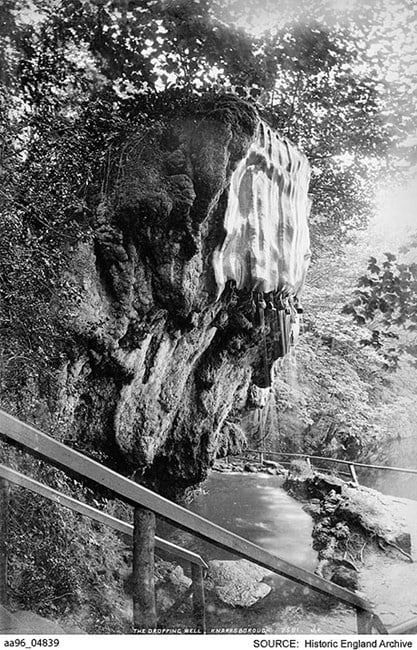
Staple Photo: The cave of Mother Shipton who was believed to have been a Yorkshire witch and oracle. © Historic England Ref AA96_04839
Historic England “Witchcraft and Witch Trials in England” Historic England Witchcraft and Witch Trials in England | Historic England
Castelow, Ellen “Witches in Britain” Historic UK, May 29, 2015 https://www.historic-uk.com/CultureUK/Witches-in-Britain/
Purkiss, Diane “A JOURNEY INTO WITCHCRAFT BELIEFS” English Heritage A Journey into Witchcraft Beliefs | English Heritage (english-heritage.org.uk)
Wikipedia “Witch trials in England” Witch trials in England – Wikipedia
Dr. Nelson, Jessica “An examination of witches in the 17th century” The National Archives, April 8, 2021, An examination of witches in the 17th century – The National Archives blog
Molyneux, Nicholas “Discovering Witches’ Marks” Historic England Discovering Witches’ Marks | Historic England
Historic England “Witches’ Marks Discovery ‘Largest in Britain’” Historic England February 16, 2019 Witches’ Marks Discovery ‘Largest in Britain’ | Historic England


Leave a Reply to cindie snyderCancel reply