
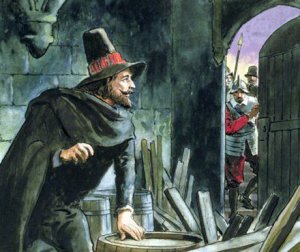
Next week will be Guy Fawkes Day, a holiday celebrated mainly in Great Britain, especially in England. It’s surprising we don’t celebrate it in the United States, since fireworks, food, and rebellion are a point of national pride. But then again, we usually cheer for successful rebellions. 🙂
For those of you who may not know about Guy Fawkes Day, here is where you can find out more. In short, a group of rebels tried to blow up Parliament in 1605, but their plot was discovered and foiled at the last moment. Ever since then, the 5th of November has been a day to set off fireworks, light bonfires, burn Guy Fawkes in effigy, eat and drink with friends, and in general celebrate everything English. As Austen might have said: Long live the King!
Jane Austen most likely did not celebrate Guy Fawkes Day. In her time it was a rowdy, politically tinged event, heavily laced with anti-Catholic sentiment, and beneath the dignity of a clergyman and his family. The Austen family probably stayed inside and watched the goings on from a window, or perhaps ventured outside just long enough to enjoy the pyrotechnics from a safe distance. Austen doesn’t mention it in any of her books or letters.

But what if she had? What if Elizabeth Bennet, her sisters, and the rest of the Longbourn residents took a more active role in the festivities? After all, the younger Bennets, at least, would not hesitate to join in loud, rowdy activities, and Elizabeth might be roped in as a chaperone. Imagine her, then — pen in hand, describing the chaos of a Meryton bonfire and her sharp-eyed observations of a certain proud gentleman from Derbyshire.

Longbourn, November 6th
My Dearest Aunt,
You will laugh, I think, to hear of our grand village celebration last night — nothing less than the annual commemoration of Guy Fawkes, who, having failed to blow up the Houses of Parliament, is now doomed to be blown up himself every fifth of November. It is a curious way of showing loyalty to one’s government: to gather all one’s neighbors, light a great fire, and nearly set the town alight in the process.
The entire population of Meryton turned out — soldiers, tradesmen, and every Bennet who could be persuaded to go. Mama was in raptures, Lydia and Kitty in shrieks, and even Mary condescended to moralize upon the wickedness of conspiracies while enjoying the fireworks with great seriousness. Jane, I am sorry to say, complained of a sore throat and had to stay inside. I confess I enjoyed myself exceedingly, though perhaps not in the manner most approved by polite society.
The village boys had constructed a most dreadful effigy of poor Guy Fawkes, which they paraded through the street with such zeal that I feared for the man’s straw limbs. The figure, when placed upon the fire, bore more than a passing resemblance to Mr. Collins — the same unbending posture and air of humble consequence. Charlotte nearly wept with laughter.
Mr. Bingley, amiable creature that he is, was everywhere at once — handing out cakes to the children, admiring the sparks, and declaring the whole affair “capital fun.” But his friend Mr. Darcy stood apart, looking as if every firework were a personal insult. I do not know whether he disapproves of fireworks, bonfires, or simply the existence of people who enjoy them. When a rocket burst rather near his boots, he stepped back with such gravity that one might have believed he feared for the dignity of his coat.
I attempted to draw him into conversation, but he answered so stiffly that I gave it up. Perhaps he finds noise incompatible with superiority. In fairness, he did not depart until the final spark was extinguished, though I could not tell whether from politeness or paralysis.
Afterward, Mama declared the whole evening “most romantic.” I cannot imagine what she found romantic in a crowd of smoke, sparks, and shouting men, unless it was Denny’s assistance in rescuing her shawl from the flames. Still, it was diverting to see the company illuminated by firelight — vanity and virtue alike revealed by the same blaze.
I should tell you, dear Aunt, that I find myself both amused and puzzled by Mr. Darcy. He is clearly proud, yet not without some claim to pride; disagreeable, yet not without intelligence. He puzzles me more than the fireworks did — though, unlike them, I doubt he will ever burst into open display.
Your affectionate and occasionally singed niece,
Elizabeth Bennet
How do you think Mrs. Gardiner would answer this letter from Elizabeth? What would Jane think of Guy Fawkes Day? Would she choose to actively participate, or simply enjoy Elizabeth’s description the next morning? Please tell me what you think! Thank you in advance for your comments!


Leave a Reply to cindie snyderCancel reply