
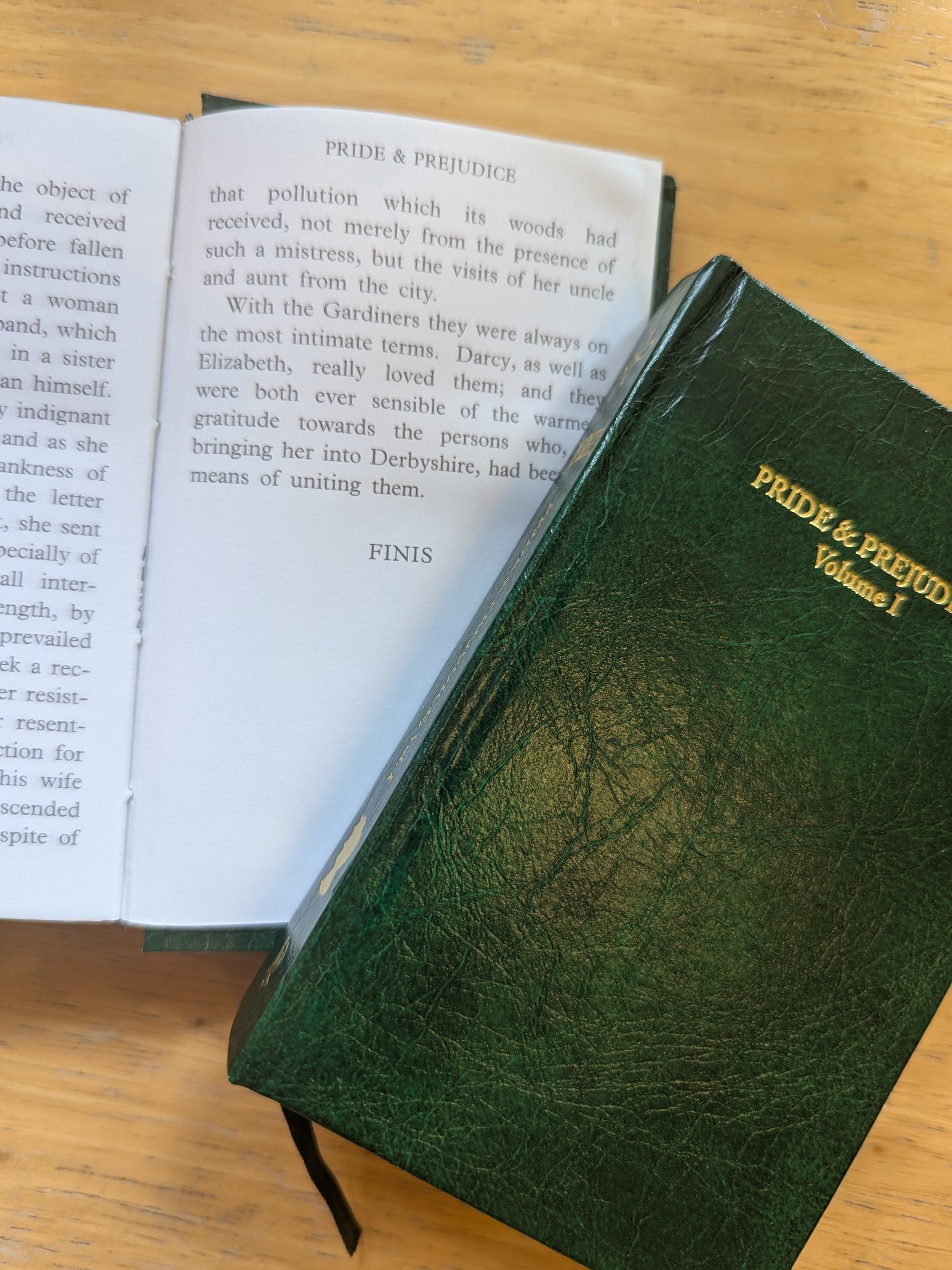
We all know the feeling. We close the novel and then wonder, but what happens next? Does Kitty make a match with one of Bingley’s friends? Does Mary make a match with…anybody? It turns out that Jane wondered about her characters too—and talked about their stories with her family. In his Memoir of Jane Austen, Jane’s nephew, James Edward Austen-Leigh, wrote that Jane Austen “would, if asked, tell us many little particulars about the subsequent career of some of her people.”
Did she, James? What did she say??
Below are the little tidbits Jane dropped about what happened to her characters after the last page.
Pride and Prejudice
What happened to Kitty? Austen-Leigh tells us that “Kitty Bennet was satisfactorily married to a clergyman near Pemberley.”
A clergyman! She really did become sensible after Lydia left, and she must have been happy to settle near Elizabeth.
Austen-Leigh also shares Mary’s story: “Mary obtained nothing higher than one of her uncle Philip’s clerks, and was content to be considered a star in the society of Meriton.”
Mary, star of Meryton! She got her small scale recognition, after all.

Mansfield Park
Jane’s reveal for this novel is the amount of the “considerable sum” Mrs. Norris gives Fanny’s brother William.
In case you forgot the context, when Fanny’s brother William receives a promotion in the Navy, Mrs. Norris gives him money, and she is very proud that she gives him “something rather considerable.” Here’s the passage from Mansfield Park where Lady Bertram discusses Mrs. Norris’ generosity:
“I am glad you gave him something considerable,” said Lady Bertram, with most unsuspicious calmness, “for I gave him only £10.”
“Indeed!” cried Mrs. Norris, reddening...“It is amazing,” said she, “how much young people cost their friends, what with bringing them up and putting them out in the world! They little think how much it comes to, or what their parents, or their uncles and aunts, pay for them in the course of the year. Now, here are my sister Price’s children; take them all together, I dare say nobody would believe what a sum they cost Sir Thomas every year, to say nothing of what I do for them.”
Very noble indeed, Mrs. Norris. So what did she do for William? Austen (via her nephew, James) tells us that “the ‘considerable sum’ given by Mrs. Norris to William Price was one pound.”

Sense and Sensibility
Remember Anne Steele, Lucy Steele’s younger sister? She had a thing for Dr. Davies, and, as the narrator notes, “wanted only to be teazed about Dr. Davies to be perfectly happy.”
Here’s the conversation between Mrs. Jennings and Miss Anne Steele about Dr. Davies, in case you forgot this off-page character. Anne Steele starts the dialogue:
“There now,” said Miss Steele, affectedly simpering, “everybody laughs at me so about the Doctor [Davies], and I cannot think why. My cousins say they are sure I have made a conquest; but for my part I declare I never think about him from one hour’s end to another. ‘Lord! here comes your beau, Nancy,’ my cousin said t’other day, when she saw him crossing the street to the house. My beau, indeed! said I—I cannot think who you mean. The Doctor is no beau of mine.”
“Aye, aye, that is very pretty talking—but it won’t do—the Doctor is the man, I see.”
“No, indeed!” replied her cousin, with affected earnestness, “and I beg you will contradict it, if you ever hear it talked of.”
Mrs. Jennings directly gave her the gratifying assurance that she certainly would not, and Miss Steele was made completely happy.
Now that you are just as excited for Anne Steele’s conquest as Mrs. Jennings, I’ll tell you Jane’s ending to their love story: “Anne Steele, Lucy’s silly and vulgar sister in Sense and Sensibility, did not catch Dr. Davies after all.”

Emma
Jane Austen gives us three reveals in Emma. The first concerns Mr. Woodhouse. According to Austen’s nephew, “Mr. Woodhouse survived his daughter’s marriage, and kept her and Mr. Knightley from settling at Donwell, about two years.”
(That is to say, Mr. Woodhouse died two years after Emma and Mr. Knightley’s marriage, after which Emma and Mr. Knightley settled at Donwell.)
Onto the second reveal: Remember the game of letters Frank Churchill plays with Emma and Jane Fairfax? Emma had confided that she thought there was a secret romance between Jane and Mr. Dixon, so Frank shows Emma the word “Dixon.” Emma laughs at this teasing of Jane but says, “For shame!” Frank then continues the joke by showing the word to Jane. (Why, Frank?!) Jane is not amused:
She [Jane] was evidently displeased; looked up, and seeing herself watched, blushed…saying only, “I did not know that proper names were allowed,” pushed away the letters with even an angry spirit, and looked resolved to be engaged by no other word that could be offered.
Shortly after, Frank prepares another word that we as readers never see:
Mr. Knightley thought he saw another collection of letters anxiously pushed towards her, and resolutely swept away by her unexamined.
What was that last word that Frank tried to show Jane? Austen tells us (through her nephew): “The letters placed by Frank Churchill before Jane Fairfax, which she swept away unread, contained the word ‘pardon.’”
Oh, Frank. It’s going to take more than that to smooth things over.
The last reveal is again about Jane Fairfax. Deirdre Le Faye, in her work, Jane Austen: A Family Record, tells us that, “according to a less well-known tradition, the delicate Jane Fairfax lived only another nine or ten years after her marriage to Frank Churchill.”
No! Only another ten years? Sometimes these post-book author reveals are hard to read.

Northanger Abbey and Persuasion
And what about Anne Wentworth and Catherine Moreland? Her nephew James tells us, “Of the good people in ‘Northanger Abbey’ and ‘Persuasion’ we know nothing more than what is written: for before those works were published their author had been taken away from us, and all such amusing communications had ceased for ever.”
And sometimes these post-book author reveals are hard not to read.
What did you think of these reveals?
My first reaction was, this is amazing! Jane, telling us about her characters from beyond the grave!
And my second: Wait. That’s it? There must have been more. James. I KNOW there was more.
And then: I should be grateful for what we have. Thank you, James.
And then: But…Anne Steele? Really, James?
I suppose I should go back to being grateful now. What were your thoughts? Any surprises? Did it disrupt the endings you’d created in your head?
This post first sparked my interest in this topic.
More Austen:
What Did Jane Austen Have to Say About Her Own Novels?
If Austen Characters Owned Pets: Matching Characters With Pets That Fit Their Personalities


Leave a Reply to Alice McVeighCancel reply