
Before I wrote this column, I listened to Benjamin Grosvenor’s performance—with the Royal Liverpool Phil—of George Gershwin’s Rhapsody in Blue. Gershwin’s work played a central part in the opening movement of the Bennet Wardrobe Series, The Keeper: Mary Bennet’s Extraordinary Journey. The music allows us to find something familiar that serves to link the Mary character across the gap between Pride and Prejudice and The Wardrobe. This majestic music brought to mind some of the “rules,” tropes, I have set for myself when writing Austenesque fiction.

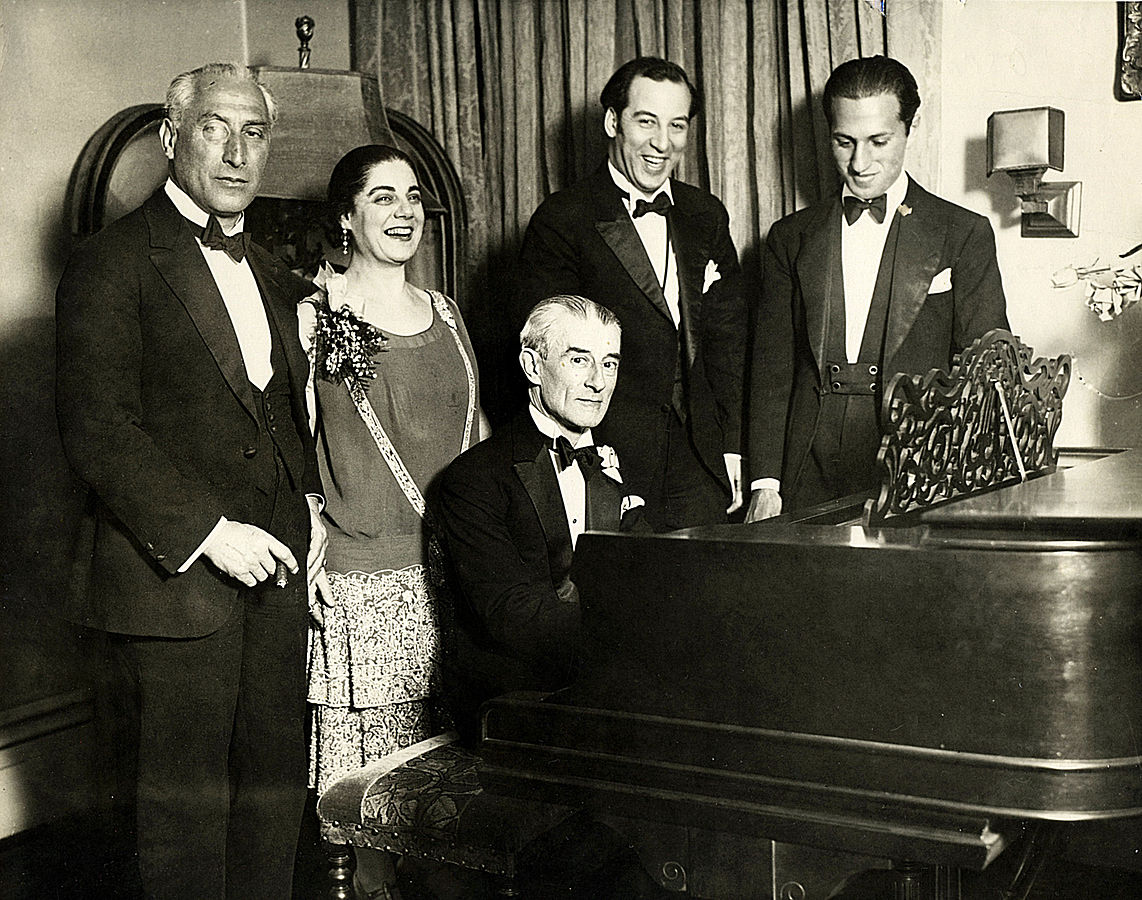
Maurice Ravel (at piano), George Gershwin (far right), and others celebrate Gershwin’s birthday in 1926. I used this photo in The Keeper. Mary found it in The Ravel Portfolio.
Backstory is something we do not really need to do with many readers: they have been devouring the genre for twenty years. The terrain is familiar, and many expect to have these items, which anchor them in Austen’s world, even though they are reading a book published two centuries later.
In The Keeper, the Rhapsody, first performed in 1924, serves as a vehicle to set in motion the time-shifting ideas that govern the entire series. However, the concerto-like piece, with which most of us are familiar as a virtuoso-level work, also signals that this book is about a changed Mary, someone originally, and in subsequent variations, portrayed as a pedantic pianist.
However, in Wardrobe’s Austenesque universe, Mary is gifted a leather portfolio by a distinguished woman in 1812. This is someone, a familiar someone, but unmet. The lady desired the third daughter to find what was inside The Ravel Portfolio—a copy of the Rhapsody’s piano score, French stamps, a photograph, and a Waterman pen—items from more than a century after the revelation. Mary spends the next forty years trying to learn the music and its interior dialogue; little did she realize that Georgiana Darcy had copied the music to learn it herself.
Jane Austen Fan Fiction—JAFF—authors often do not require much backstory development because readers know what to expect. The world is familiar. Little exposition of the outside world’s impact is necessary as action is confined to familiar locations from Longbourn to Pemberley, from Meryton’s Assembly Hall to Netherfield’s ballroom, or from Hunsford Parsonage to Gracechurch Street, with stops at Rosings and Darcy House. There will be an insult by Darcy, a ball at Netherfield where Kitty and Lydia utterly destroy the Bennet family’s image, a disastrous offer of marriage, an enlightenment, and, finally, a successful proposal. The surprise comes in the form of a unique plot to bring ODC together despite the earlier cringe points.
Austenesque writers use Austen as a starting point, although they must engage in worldbuilding to introduce the readers to their particular Austenesque universe. However, the audience requires some familiar checkpoints even if they are not exact.
In my novel In Westminster’s Halls, which examines how the Bennets and Darcy may have acted to fight the evil of the slave trade, I was forced to shift Pride and Prejudice’s time setting from 1810-11 backward to 1807. It’s nothing major, but there it is. As the story had to be set in London, I had to reimagine several cardinal points.
- The assembly and Mrs. Philips’s card party are combined into an anti-slavery reception at the Walters’s townhouse. Elizabeth meets Wickham who pours his poison about Darcy, although not about the denied living. This sets up her impression of Darcy preparing for the next point.
- The insult is now set on the street before the Opera House. Here, Darcy abuses Elizabeth’s morals as her father escorts her to an evening at the Opera. The upright Derbyshireman had previously been introduced to Bennet. His disgust at the behavior of the ton’s men boiled over when he assumed that Elizabeth was a niece who accompanied an older man for all the obvious reasons. Darcy had been ill for three weeks and was less than his affable self.
- Overheard conversations and other interactions fuel Elizabeth’s assumptions about Darcy.
- There was only one proposal, but Darcy did offer multiple reasons why they could not marry in a drunken confession to a bottlewraith.
- Darcy’s abandonment comes not after Lydia’s marriage to Wickham—that event does not matter in IWH—but rather as a result of his escorting Wickham to Newcastle in terrible weather, which results in a relapse of his earlier illness.

Other Austen anchors exist in other novels. In Plain Sight uses the Netherfield Ball to great effect. Lydia does run off with Wickham in The Pilgrim, Volume Seven of the Wardrobe. A great ball celebrating Darcy and Wentworth’s nuptials closes The Sailor’s Rest. Elizabeth overhears Darcy lamenting her youth and inexperience as intolerable in Ghost Flight.
There are limits, I think. Radically altering personality traits can be dangerous if left unexplained to readers. I portrayed Mrs. Bennet as a sensible woman in Volume Six of the Wardrobe, The Avenger, only after I had explained why she had become excessively nervous in earlier volumes. Mary’s eyes are opened about her acerbic nature after her sisters marry, and she becomes Miss Bennet. Lydia embarks on her own path of discovery in the Wardrobe to become the Dowager Countess. My book In Plain Sight finds Darcy losing his pride, not at Elizabeth’s hands but due to bad behavior. I have never been able to find a way to write Bad Jane.
Austenesque authors use Austen’s canon as a starting point for their speculations. However, these writers also know they work within a conceptual framework that is not a straitjacket to their originality. Yet, their storytelling cannot be so unique that it becomes unfamiliar. They also know that their stories cannot simply be new, unrelated stories that use the characters’ names. They must still hew to some structural elements that make their stories believable as extensions of Austen’s labors. This allows them to tell new tales of how the eternal couple—or any of the other pairings in Austen’s works—discovers their love for one another.
&&&&
This excerpt from “The Keeper: Mary Bennet’s Extraordinary Journey” is ©2016 by Donald P. Jacobson. All rights reserved. Reproduction is prohibited.
****
In Darcy House at Mary Bennet Benton’s sixtieth birthday celebration.
Chapter Forty-seven
After the dinner break, the guests returned to discover the dance floor converted into concert-style seating with one of Herr Bösendorfer’s grand pianos on a riser—the front two rows of seats filled with the family. Thomas and Madelyn held Mary and Edward back to escort the couple forward at the end. The four entered to resounding applause and a standing ovation. Even the Iron Duke struggled to his feet and uttered, “Hear! Hear!” when Maddie introduced Mary.
Once all were seated, Jane, Lydia, and Maddie stood before the guests. Jane spoke for the group. “Here we are, family and friends, gathered once again. The longer we go, the smaller the room appears. It seems incredible how far our roots and branches reach. The Five Families have outposts from Australia to South Africa, from America to Aberdeen, with special enclaves in Hertfordshire, Kent, and Derbyshire.
“Tonight, we honor our beloved Mary as she reaches her sixtieth year. You may know her as a sister, mother, aunt, or friend. We all know her to be loyal and the most caring woman who walks the earth. Others know that her attention can take the form of stern affection. If Mary Benton believes in something, she will fight tirelessly to see it accomplished.
“Or need I remind some of our aristocratic friends of her crusades for equal rights for all men and women, be they gentle or common?
“Mary Benton comes from a place in her soul that few of us will ever find. Ask her dear friend Bishop Newman about their debates over Roman and Anglican dogma. Ask her husband why the spare room in their Windsor apartments is always ready for a guest. If someone needs a roof or a meal, they will have a place to lay their heads and fill their stomachs, even in the Queen’s castle!
“When she picks up her scripture, it is not to hit someone with the book because she finds them wanting. Instead, she opens its pages to give them the solace and peace that she believes can only be found in the Word.
“Mary, I know we are missing two of our five. I am sure they look down with smiles as they remember the days when we played in the garden behind Longbourn, tormented Sir William by running through his garden patch, and marched like Napoleon into the shops of Meryton.” Jane stopped as she choked on the tears running down her face. Lydia stepped forward.
“Sister: I know I have sometimes driven you to distraction. And I cannot imagine how you bore up under some of my antics. But, Mary Amelia, be aware that I have loved you every day, and I know you never stopped loving me. You were always the rock to which I could return. Even Lizzy knew that. She told me I only needed to watch you to understand how to be in this world.
“I may not have been the best at keeping secrets, but I think we—your niece and I—have managed to hide the next away from you. So, Mary, sit back and enjoy. Here is our birthday present to you.”
The three women stepped down from the dais. Mary took Edward’s hand in hers as they focused on the piano.
A tall, willowy, grey-haired lady entered from a side door and strode to the stage. She wore a style a la mode forty years ago. Whispers cascaded around the room. “Georgiana Darcy!” “It is Madame Darcy herself, here!” “I thought she was committed to a season in Vienna with Herr Schumann!” “She and Madame Schumann are supposed to play duets for the Emperor himself!” The crowd began to clap and cheer as one of the great pianists of the age reached the noble instrument. She placed a long-fingered hand on it and curtseyed. Then she kicked off her slippers.
Georgiana looked out over the gathering. Speaking English in a voice that betrayed a slight cross-Channel back tone, she addressed the room. “Well, Mary, my old pianoforte mate, ’tis a long road from Longbourn to London, is it not? Remember when we, as girls, would alternately soothe and aggravate my serious brother with our stylings?
“Oh, William, I do hope you will not begrudge me my little teases, no? And before you start muttering, ‘propriety…propriety,’ I shall tell you that kings, queens, princes, and emperors have seen my toes.” She wriggled them playfully under the piano. “The world will not end if a fifty-nine-year-old spinster bares her feet. That is how I play, Brother.” The audience laughed as one. Darcy smiled at his little sister and bowed from his seat.
Georgiana continued. “Well, on to why I am here tonight. My sister Lydia and my niece Madelyn conspired to give Mary a special gift. About forty years ago, I found her fiddling with a composition that sounded unlike anything I had ever heard.
“A piece of music, you see, comes to me like a painting would have to Mr. Turner or Mr. Constable. I can see its world. I can smell it, touch it, and live in it.
“This music, though, I could never grasp—at least not for years. I would hear Mary tinkering with it in Kympton or York or even here at Darcy House when she, Edward, and the children would visit. I listened to her gradually finding its heart. Phrases and sections were less disjointed. The picture became distinct the more I heard her play.
“Mary would always hide the score when I came in, but about twenty years ago, when she was marching off on some cause—living conditions for factory workers, I think—I committed a sin for which I must now humbly beg your forgiveness, Mary. I sneaked into your room and took the printed music from your wardrobe. I saw you put it there one time. I copied the music and returned the original.
“Even with the score in front of me, I could not grasp it until I took the train into London from Bournemouth. The movement of the cars and the passage’s noise over the tracks from the countryside into the city brought it all home to me. This was the music of our industrial age! I could hear the roar of furnaces, the pounding of hammers, the bustle of people in the streets, and the sounds of shuttles, looms, and factories![i]
“It lived for me. And, so, my darling sister, I pray it will live for you. This is our gift to you. Your Rhapsody.”
Georgie turned to the keyboard and bowed her head. Then she lowered her hands to the keys. The two slow “F” notes below middle C led into the seventeen-note upward scale, her digits lightly tripping and floating as they flew a 1/32 note at a time. When she hit the trills at the end of the sixth bar, the audience realized they were experiencing something yet to be heard anywhere in any concert hall.
They sat at the edge of their seats for twelve minutes as Georgiana’s hands wove a spell that would not be cast for another seventy years.

The ascending chords of the last two bars faded and echoed over the heads of Britain’s elite. They had just heard and seen a woman from the eighteenth century play the music of a world that was only now coming into focus.
Mary exhaled as the Rhapsody ended. Hearing Georgie play it as a unified whole cast it into stark relief. This was what Kitty had wanted her to hear. This is why she left Monsieur Ravel’s portfolio. This was the future: a world of life, vitality, excitement, and, it seemed, violent emotion.
Dropping Edward’s hand, Mary rushed to her friend’s side, enveloping her in a great hug. The applause washed over the two women.
“Oh, Georgie, how could I ever rebuke you for being a burglar? This theft has given me the greatest gift. Just as you understand the Rhapsody, now so, too, do I. I never knew. Oh, thank you, thank you.”
Georgiana wiped her eyes and whispered, “Music like this transports you, dear Mary. I hope this gives you the courage to do what you must do without fear. Families are like sieves, darling sister. Lizzy told me that you are the Keeper of a great secret. I shall not press you, but seeing the name at the top of this score confirms her trust in me—and you. Remember that I shall always be in Deauville if you choose to talk about Monsieur Gershwin.”
[i] George Gershwin reportedly conceived Rhapsody in Blue while on a train trip from New York to Boston.


Leave a Reply