
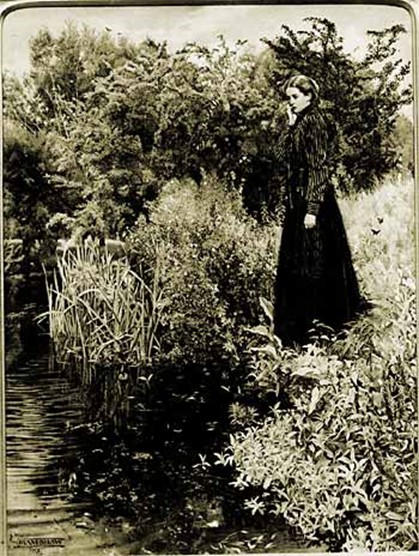

The war widow: sentimental depiction of a grieving woman whose husband has gone to fight in the South African War. Photograph of The Boer War, a painting by John Byam Shaw.
&&&&
These reflections upon military widowhood in Austen’s time found root in the first and seventh volumes of the Bennet Wardrobe Series, where Lydia Wickham lives the grief of loss. The soldier’s portion always included death in battle, and his wife’s the ever-present prospect of widowhood.
&&&&
Jane Austen closes the last chapter of Persuasion on a dark note with lines reminding her readers of the possibilities that were the daily reality of a military wife.
Anne was Tenderness itself;—and she had the full worth of Captn Wentworth’s affection. His Profession was all that could make her friends wish that tenderness less; the dread of a future War, all that could dim her Sunshine.
In this case, gentlewoman Austen’s concern appears to have been more for Anne’s heart than for her actual well-being. Captain Wentworth was, after all, a successful Post-Captain having made his fortune through the Royal Navy’s lucrative system of prize money. Once he had successfully pressed his suit, the good Captain likely had made ample provisions (as we are continually reminded in Austenesque fiction when Darcy pulls a sheaf of settlement papers from his pocket) for his new wife in the event that he never returns from a mission beyond the blue horizon.
Less so in Canon—and more often in Pride and Prejudice variations where Colonel Fitzwilliam plays more than a supporting role—we are frequently reminded of a Regency woman’s financial uncertainty when she aligned herself with a military man. In the twenty-first century, imbued as we are with the concepts of female agency and independence, we tend to focus with no little amount of schadenfreude upon the off-stage comeuppance for party-girl Lydia Bennet Wickham.
However, Austen’s readers in the early nineteenth century would have considered the most difficult of all possibilities facing the youngest Bennet girl navigating a Napoleonic War Britain—widowhood. As Austen herself understood after her father’s death in 1805, widowhood was a feature of daily life, with about twelve percent of all households headed by widows. These women would encounter vague futures unless they had been fortunate enough to marry a man of means who could support them even in death through a well-written marriage settlement. We need only to recall Mrs. Bennet’s lamentations about the master of Longbourn’s anticipated demise.
While there were Army officers and subalterns finding wealth through plunder (see the aftermath of King Joseph Bonaparte’s disastrous decision to bring the entire Spanish treasury to Vitoria in 1813), most lived a tenuous existence on the edges of tolerant families or, worse, barely ahead of the bailiffs. For an officer’s wife at home while her man was fighting, the difference between survival and poverty was separated by the King’s post delivering a letter from Headquarters.
Military widowhood had been a stark reality in Great Britain since 1792, when the Wars of the French Revolution began. They were soon renamed the Napoleonic Wars. However, until the British finally faced off against the Grand Armée in Spain after 1808, the bulk of the deaths had been absorbed by the Royal Navy. With the imposition of an effective blockade, the mortality burden necessarily began to shift toward the Army. Occupation forces in the Caribbean did fall prey to a range of fatal tropical illnesses, ao there is a degree of flexibility in the timeline.
By 1810, nearly one sixth of all British males were under the colors. Wellesley was ramping up the Peninsular Campaign. With hundreds of thousands of men under arms at any time—and over 300,000 identified deaths from battle and disease over nearly a quarter century—the number of widows in British society substantially increased during the first two decades of the nineteenth century. Nearly twelve percent of all British households were headed by widows.
Death in battle, while glorious, was also an unmitigated financial nightmare for any family left behind. In many post-wedding bell Pride and Prejudice variations, we are frequently reminded that Wickham may have hoped to sell his lieutenant’s commission in the regulars (for which Darcy could have paid upwards of £500) to garner a nest egg. Of course, that depended on the regiment, with lower-numbered units carrying more prestige. See the First Guards Regiment as opposed to Richard Sharpe’s 95th Rifles. I would be inclined to suspect that a regiment based in Newcastle would be a high-numbered upgrade of militia forces. Little prestige there.
The common practice in the British Army—until the Crimean War demonstrated the cost of incompetent officers—was to allow the purchase of commissions for all ranks from Coronet through Colonel. That meant that a duke’s second son could see his Papa purchase a majority or lieutenant colonelcy irrespective of his intelligence. This practice ensured the social hierarchy within the Army. The holder of that office could sell out (or up if he was able to purchase a promotion) for the prevailing rate.
Unless he died in battle.
Then the purchase price of the commission was forfeited to the government. The widow or family got nothing. Unlike Mrs. Bennet, who would at least have her £5,000 portion upon her husband’s death, Lydia Wickham could, at best, expect an annual pension of £40 from the Compassionate List—the charitable trust established by the King when Wickham went toes up. However, these pensions were neither immediate nor guaranteed. Higher placed widows frequently had to fight for years to win pensions that rarely exceeded £120. Lady Fanny Nelson’s £2,000 annuity was a unicorn of the rarest variety.
The post-notification options for most of these women were limited. Children complicated the matter. Unless the widow discovered a tolerant bachelor or widower willing to ignore a probable lack of dowry and be willing to care for another man’s children, remarriage within her class was not an option. She might find a farmer seeking a mother for his children and be willing to house her and her get in exchange for companionship and labor.
Assuming she could raise the fare and have some funds to establish herself, a childless widow could emigrate to an area needing marriageable women. However, with the loss of the American colonies thirty years before, only the most adventurous women would venture to South Africa, HEIC-controlled India, or the convict colony of Australia.
Jane Austen offered the clearest solution for childless, educated, gentlewoman widows: employment as a companion or governess. These, though, demanded connections and references, something which many widows—particularly those who had roots in trade—lacked. If they had owned connections of family ties upon which they could depend, they may not have found themselves in the difficult straits death in service brought. The widows of impoverished officers, non-gentlewomen, or women estranged from their families were those whose choices were necessarily circumscribed and descended further into prostitution, crime, and death.
However, this was not Lydia Bennet Wickham’s lot as she experienced the first serving of a widow’s life in The Pilgrim: Lydia Bennet and a Soldier’s Portion.

This excerpt is ©2019 by Donald P. Jacobson. Any reproduction without the expressed written consent of the author is prohibited.
From Chapter 22
…
June 23, 1815, Longbourn
The sour taste of vomit flooded her sinuses. Annie held Lydia’s hair back and rubbed between her shoulder blades. Increasing left Lydia distinctly nonplussed about the process. To be sure, it was wonderful that a little one would bless the Wickham household.
I worried I would not catch a baby for so long. No matter what George and I did—and we did it everywhere we could imagine—nothing seemed to work. Lizzy and Jane had their eldest within a year of their weddings. I, who married first, had to wait until last! Papa would have found my situation most amusing and ironic.
Now, I am with child, and it is pure misery. I have been unable to keep anything down until later in the day for sennights. Of course, the strength of my illness has Mama predicting a strapping baby boy somewhere around Twelfth Night.
It was true that morning sickness had been having its way with Lydia Wickham. However, at least for the past several days, an unnatural and unsettled feeling akin to, although powerful than, that which she had known after Vitoria had borne upon her even when she had recovered enough to eat anything more than dry toast.
Her Guide had been suspiciously quiet, only offering Lydia incongruous and disconnected images involving water and beach sand. It was as if her Guide was intentionally going deaf, dumb, and blind regarding her immediate world and presenting her with pictures of a possible future. There was little comfort—inner or otherwise—to be had. Confusion seemed to be the order of the day.
One last retching spasm left the young woman panting on the floor as Annie rubbed a damp cloth across her face, removing the sheen of sweat. A glass of water helped Lydia cleanse her mouth of nauseating residue.
Upon standing, Lydia greedily accepted a piece of bread slathered with some of Longbourn’s strawberry preserves. The sugar minus underlying grease brightened her spirits. Then she downed a mouthful of clear but well-sugared tea. A look of gratitude at her friend signaled Annie to help finish her toilette and to don a plain, muslin day dress that settled comfortably around her abdominal bump. The two matrons marched into Longbourn’s parlor in a few minutes to join the other women.
Reigning over her daughter’s Longbourn inheritance, Charlotte distributed the most immediate items of poor basket sewing to the latecomers. The children remained in the nursery so the ladies could focus on their labors. The five women, ranging in age from Mrs. Bennet down to Annie Tomkins, bent over their needles, chatting softly as Mrs. Hill shuttled the tea tray and pitchers of lemonade from kitchen to parlor.
***
Not long after the sun crossed the zenith, but before the afternoon’s rays made the west-facing room uncomfortable, the crunching sound of sixteen pacing hooves and four wheels disturbing the river-stone gravel drive broke through heat-induced muzziness. Lydia was the first of the young women to the window. Laura and Annie held back while Charlotte and Mrs. Bennet, exercising their authority, moved to the front entry.
“Oh! Oh! ’Tis the Darcy coach! Perhaps Mary and Lizzy have brought the children for a visit? Maybe they have news—” Lydia’s hopes collapsed when she spied a gloriously clad officer exit the carriage. Her eyes widened as she recognized…
“General Fitzwilliam,” she silently mouthed as she spun to face the other two soldiers’ wives. She did not see the general hand down Mary and Elizabeth from the cabin.
Lydia had been in military camps long enough to know that officers rarely arrayed themselves in full-dress uniforms and medals unless they were entering His Majesty’s presence—or delivering bad news. At last word, the King was under care at Windsor while the Prince was at Brighton. That left only one option.
Grabbing her friends’ hands, Lydia nearly ran to a sofa flush against the furthest wall. As one, the women turned expectant and terrified eyes toward the doorway in time to see Charlotte practically dragging Fanny into the parlor to unceremoniously plunk her elder in her seat adjacent to the cold hearth. Mrs. Collins pointed a shaking forefinger at the stunned lady and ferociously uttered a single word:
“Stay!”
Then she beckoned to Mrs. Wilson, who glided over to her for a hushed tête-à-tête.
With a knowing look, Laura returned to face Mrs. Tomkins. “Come, Annie, let us step into the kitchens. The general would speak to Lydia. Her sisters are here with him. ’Tis a family moment, I fear.”
Even then, Laura could not resist gently enveloping a trembling Mrs. Wickham in her arms, whispering sad notes of consolation into her hair.
As the general’s high-topped dragoon boots beat a mournful tattoo across the broad oaken floorboards, two presences pushed against Laura’s consciousness: Mrs. Darcy and Miss Bennet. Mrs. Wickham was blind to all else.
“We have her. Thank you, Mrs. Wilson,” was all Lydia heard.
***
Lydia leaned back into the cushions, her thighs pressed against Mary and Lizzy, their hands her anchors against the tides that threatened to sweep her into the abyss. From time to time, she closed her eyes to watch the abstractions of color and space her Guide was splashing across the walls of her unconscious mind as diverse emotions cascaded through her rocks and shoals. Fitzwilliam’s grayish pallor and slumping sadness drained the normally ruddy officer of his life force and offset the brilliance of the filament’s inner artistry. The weight of command bore down on the man, showing his near thirty-seven years in stark relief as the general declaimed how he imagined George’s death beneath the boughs of Hougoumont’s trees.
Lydia survived her mother’s outburst.
Mrs. Wickham marveled at Lizzy’s staunch defense of Mary.
The youngest Bennet daughter basked in the overflow of love Mary heaped upon Mama as she gently led Fanny from the room.[i]
Fitzwilliam addressed Lydia again. “Mrs. Wickham—”
Lydia stopped him with a raised hand and a wry smile. “General, we are in private now. You have known me for years. You are not Mr. Darcy. Propriety is not your middle name. Please call me Lydia.”
Fitzwilliam’s emotion at being allowed to use her Christian name colored his speech. “Lydia, then. There is one other item: I brought George back from France. He is in London at the mortician’s. We want to bury him at Pemberley beside his parents unless you have another desire.”
Lydia started to cry. “That would be a completion of his dearest wish. He always loved Pemberley. He could always bring himself out of his problems, whatever his mood by saying, ‘When I was growing up at Pemberley….’ Pemberley was his ideal. He would be happiest there, I know.”
Lizzy spoke up. “There will be no objection to interring Mr. Wickham in the chapel yard. George, wandering soul that he was, truly will be Home.”
Lydia blessed her with a watery smile, which also shone upon the general. However, that upright defender of the realm did not brighten with the completion of the proceedings with Mrs. Wickham. If anything, his eyes darkened, and his posture sagged even more. Both women looked quizzically at him.
Struggling to his feet, he unconsciously reached down and, grasping the hem of his tunic, snapped out accumulated wrinkles, restoring it to razor-crisp splendor. “Ladies, ’tis an officer’s portion to honor the sacrifices made by his men. God grant me this will be my last time delivering sad news to grieving families. Such encounters drain my soul.
“Mrs. Darcy, if I recall correctly, your father kept some rather fine Duoro in his book room. I hope I will not be overstepping Longbourn’s hospitality if I fortify myself before my next call.”
Next call?
Fitzwilliam continued, “Now, I must leave you to see Mrs. Tomkins.”
Aghast, Lydia collapsed again into Lizzy’s arms, her plaintive sobs rising to the decorative plaster moldings just beginning to cast shadows above their heads.
Young James Footman replaced the general and stood to one side against the possibility that Mrs. Darcy or Mrs. Wickham required anything. After a few minutes, he moved to begin tidying the tea tray. Looking at Lizzy, the servant nodded toward the tea service. Lizzy tilted her head toward Lydia. After he had prepared the cup in the manner that he knew to be to Mrs. Wickham’s liking, James carried it toward the ladies…
…freezing when a horrifying shriek ripped through the first floor…
…and, dropping both cup and saucer to shatter, the young man dashed from the room toward his future.[ii]
[i] These “hidden” portions of the scene can be re-read in The Keeper: Mary Bennet’s Extraordinary Journey, chapter thirty-seven.
[ii] Young James (?–1849) adopted Tomkins as his surname in honor of the corporal, married the widowed Anne Tomkins, and adopted Michael as his own eldest son.


Leave a Reply to cindie snyderCancel reply