
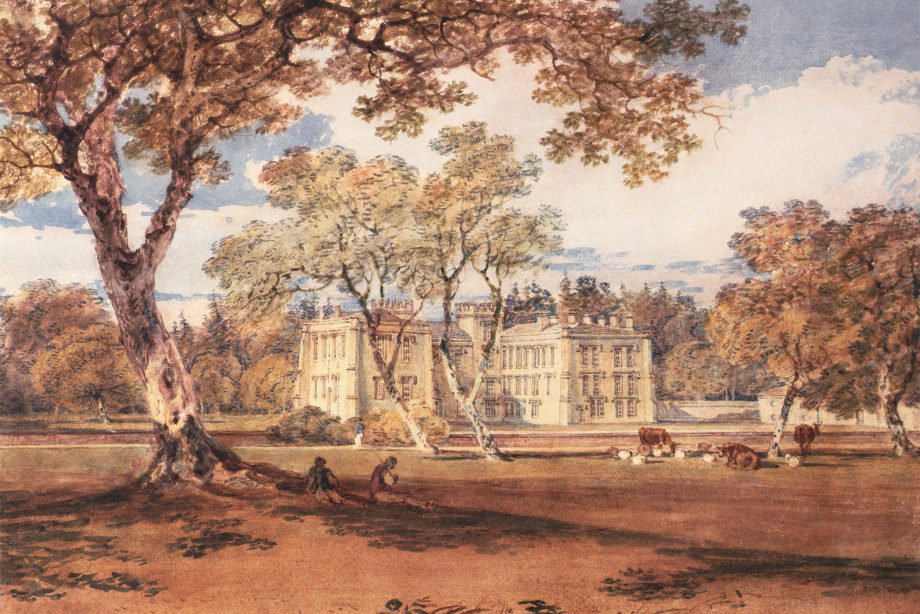
When reading Regency-set fiction, we are used to encountering mentions of the hero owning estate of a certain number of acres, or an estate bringing him X amount per year. However, what did those rolling acres represent in practice, and, most importantly, how did one manage to make them bring one that yearly income?

Well, the purely agricultural part of the estate – the world of farms and tenants – is probably the one that comes to mind most easily. A small part of it consisted of a home farm that could be managed according to the owner’s wishes. This part of the estate usually ran from 300 up to 1000 acres (depending, of course, on the size and wealth of the place). However, it was only a small slice of the lands – one-fourth at most, and sometimes as little as one-tenth. The rest was divided into tenant farms, and these tenants’ rent usually provided the bulk of the owner’s revenue.
The bulk, but not the whole of it.
Estates could also include within their acreage businesses such as breweries, kilns, and various workshops, and these rented out to tradesmen – or sometimes they could be directly operated by the employees of the estate. If one was fortunate enough to own an estate whose land contained ores of valuable minerals, whole mining operations could be conducted – though preferably as far away from the great house as possible. The landowner would not manage the mine or the quarry directly, but he could have the manager report to him. Though, of course, there were also cases of owners who did not want to sully their hands with commerce, or were just plain not interested in the day-to-day operations, so they had the manager report to the steward instead. That could be a way to delegate – but could also become a source of ruin; after all, not all estates had equally capable stewards (alias land agents). Or, for that matter, equally honest ones.

Many novels treat the notion of landowning as a straightforward scale depending on one’s rank (the hero is a duke = he owns the biggest estate in the county). However, in practice, it was not always like this – plenty of grand and wealthy landowners were men of the gentry; i.e. those without an aristocratic title at all.
How involved could these men be? It depended on many things, from the estate’s size to the personal character of the current owner. Some insisted on managing (or micromanaging…) every aspect of his “rule” – for obvious reasons, men of this kind rarely strayed away from their lands. There is not much time for sampling the delights of the town if there is a home farm to run and a quarry to oversee. Some only involved themselves with the aspects of the estate they personally enjoyed or had a special aptitude for – say, horse breeding or running a brewery on the premises. Some parceled responsibility out to younger brothers or sons, while some just handed the whole thing over to the steward and hoped that everything will work out.
However, to be fair to Regency landowners, those who chose the last route did not necessary do so out of too much love for faro and autumn hunting. There were things expected of the master of a sizable estate – for example, he was usually supposed to involve himself in politics to some degree. He could stand for office himself or discreetly (or not) support another man doing so – the system of patronage was alive and well, after all, and it still mostly consisted of the charmed circle of nobility and gentry. For example, when Pitt the Younger was a fresh graduate eager to gain a seat in Parliament, he did not rely solely on his own eloquence or even his great father’s reputation – he sent plenty of letters to the prominent landowners connected to the Whig cause to gain their support. Mind, this was a man gifted enough to become the Prime Minister in his mid-twenties (God, imagine something like that happening today) – and he still could not go far without those men’s support.
Another activity often expected of a landowner was to act as a magistrate for the shire and judge ordinary (so, non-felony) cases. The official prerequisite was to own an estate worth more than a hundred pounds a year, but in practice the post usually fell to the most prominent landowner in the area – i.e. one whose estate was worth a lot more.
In a more benevolent sphere, a man owning a sizable estate was also supposed to oversee the local application of the relief for the poor – money, food, clothing – and organize collection of funds for the purpose from the householders of the parish. They had to keep an accurate accounting of their efforts and submit those for auditions at the end of each accounting year (so, at Easter) by two justices.
Indeed, one of the reasons I usually grumble at the more ‘rakish’ heroes in Regencies is because I know that this dashing lover of gaming hells would, realistically, have quite a lot of duties to attend to back in the country!
Ann Hawthorne is a closed-door Regency romance author who is currently working on her first Regency mystery. She hopes to be able to apply her love for the era in both genres. Among other things, she also helps fellow authors with things ranging from developmental editing to social media marketing.


Leave a Reply to cindie snyderCancel reply