
Virginia Woolf is famous for two remarks about Jane Austen. In The Common Reader, Woolf says that Austen’s juvenilia and unfinished works “offer the best criticism of the masterpieces. Here her difficulties are more apparent, and the method she took to overcome them less artfully concealed.”
A lack of development in these works, she remarks, shows that Austen initially lays out her facts “rather baldly,” then goes “back and back and back” to cover them with “flesh and atmosphere.” The second and related comment, I think, comes in her essay “Woolf on Austen.” She says that “of all great writers she is the most difficult to catch in the act of greatness.” By that, I believe she means that Austen, as a writer, did many small things well rather than one large visible thing. And in her finished works, she covered her tracks artistically in a way she doesn’t in her unfinished works.
Woolf had a lifelong fascination with Austen. To a lesser degree, I’ve had a lifelong fascination with Woolf. I’ve read most of her novels, but I have not studied her systematically. I started in graduate school years ago with her two most famous, To the Lighthouse and Mrs. Dalloway. Over time, I backfilled with others. A Room of One’s Own is one I read early and late. I skimmed her criticism, but I didn’t read her critiques of Austen carefully until I immersed myself in Austen beginning about twenty years ago.
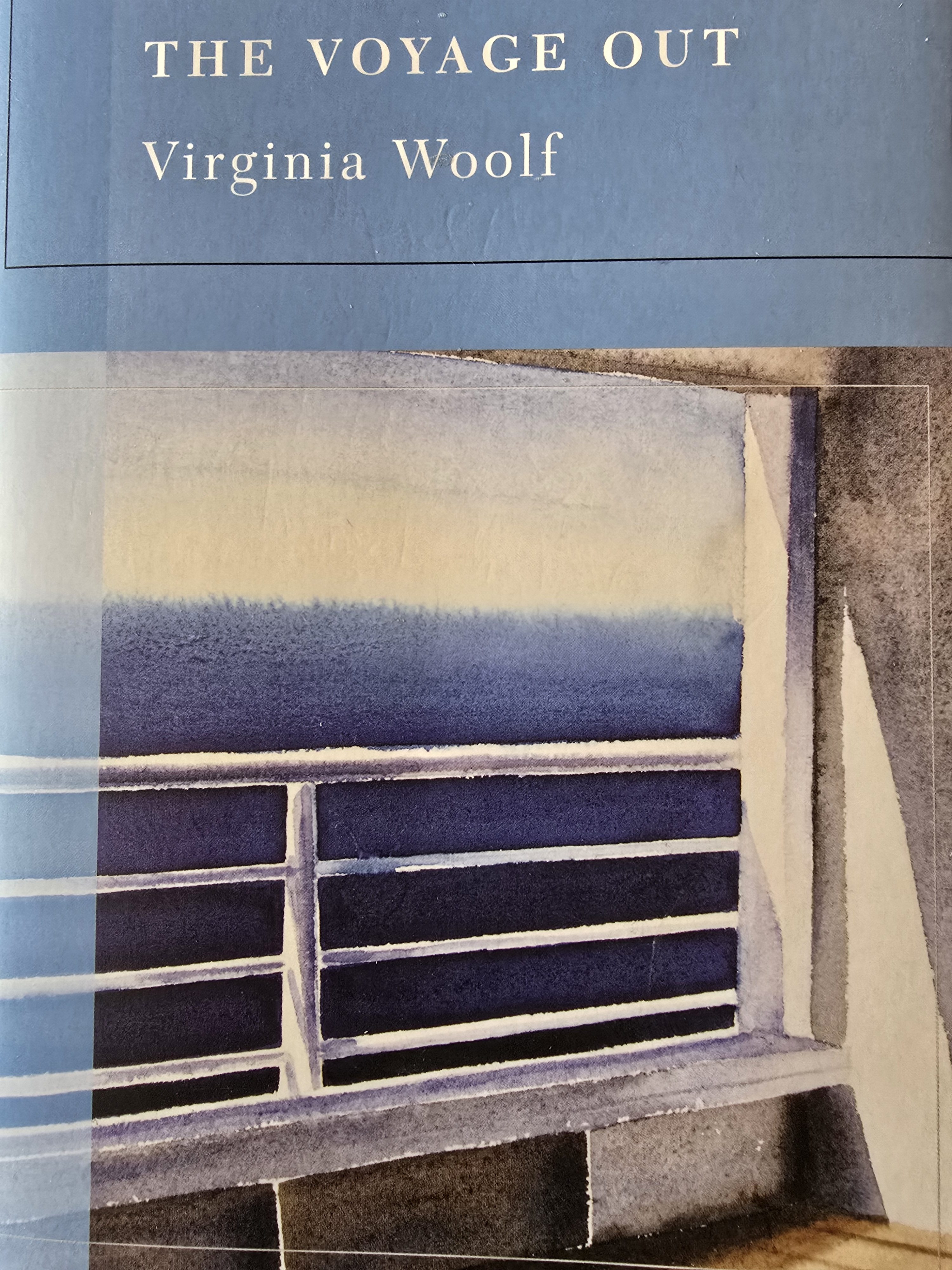
I probably should reread Woolf’s books in chronological order to see what registers now. But I remain taken with her first novel, The Voyage Out (1915), which concerns a boatload of passengers who travel to an unnamed British colony in South America in the early 1900s. It strikes me as a novel that has Woolf not only struggling with fiction but also wrestling with what Austen means to her as a woman fiction writer who preceded her.
Among the worthy elements of The Voyage Out are a proposal scene and follow-on interactions between the man and woman that are as amazing as anything I’ve ever read. We can think Darcy and Elizabeth, though Woolf’s couple never have the kind of rows that mark the early Darcy-Liz relationship. If Austen’s scenes with her two protagonists are a ten on a scale of one to ten, Woolf’s are at least a twenty. Of a number of good scenes, these are the ones in a three-hundred-page novel that set her on the path to her own genius as an author.
Woolf’s boat has many passengers, and many of these have Austen names or slight variants: Bennett, Bingley, Elliot, Hirst, Maria, and Willoughby. There’s a Mr. Parry who is often sick: a wink at Austen’s apothecary in Emma named Mr. Perry who caters to Mr. Woodhouse’s infirmities. Austen’s Mr. Perry in turn is probably named for a famous doctor in Bath named Mr. Parry.
There’s also a Miss Allan rather than Mrs. Allen—Woolf’s Allan is writing a book. There’s also a Mr. Paley. This is the name of the first soldier Austen ever “sighed for”—a military officer whose book she admired. Also, two men vie over who sleeps on the sofa versus across two chairs, reminiscent of an anecdote involving Austen and her mother. These references come in Austen letters, which I assume were among the many published by 1915. Otherwise, wild coincidences!
We even have the Austen touch in which Terence makes his case for the heroine in economic terms: at twenty-seven years of age, he has seven hundred pounds a year—still a decent sum in 1915.

Early on, there are several exchanges about the Brontë sisters and Austen. Many remarks concern Persuasion. Much later, there’s a discussion similar to Harville and Anne’s conversation regarding the faithfulness of men and women. The Voyage Out, published in the middle of the suffragist movement, contains notable discussions on women and education, women and marriage, women and the vote. Most of the men are of the old tut-tut school: women needn’t worry their silly little heads over politics.
We also have Clarissa as a minor character. This could be a shout-out to Samuel Richardson’s doomed heroine, but she is also the same Mrs. Dalloway to whom Woolf returns a decade later to develop her most complex and fascinating character.
Woolf saw Austen as a kindred spirit, I think because she was fighting many of the same battles that Austen had fought. Woolf and other creative women needed a “room of one’s own”—a place and the resources—to pursue their art. Woolf’s frustration sprang from her being barred from major university libraries. (Austen benefited from the financial support of her brothers plus access to two fine libraries of her wealthy brother.)
What was avant garde then—that women required financial and emotional security to pursue their own interests—is now sometimes criticized as applying only to genteel but poor white women. Certainly that was Woolf’s context as she scraped along.
I sense a certain despair that Woolf realizes that she and other women in 1915 are fighting exactly the same social, economic, and political battles as women in Austen’s time of 1815. The theme of the work comes in two lines. The first is during the Anne/Harville-style debate, in which the woman refers to her “curious silent unrepresented life.” The second comes when Miss Allan, speaking of her work, says: “I find there are a great many things I simply cannot say.” She is speaking of her own slowness in writing, but the import remains the limitations still placed on female authors.
The Voyage Out is as flawed in some ways as it is rich in others. The Austen touches are interesting and in no way heavy handed. Only a Janeite would likely notice the great number of them. It’s as if Woolf is putting down different Austen anchors to help stabilize her story of middle- and upper-class adventurers—and to stabilize her own fiction as she first sets sail on her own literary voyages.
—
My own book, Jane Austen and the Creation of Modern Fiction: Six Novels in “a Style Entirely New,” investigates her development as a writer and shows how her innovations as a prose stylist set the course for modern fiction. It is available from Jane Austen Books at a special low price.
The Marriage of Miss Jane Austen is also available from Jane Austen Books and Amazon. The trilogy traces love from a charming courtship through the richness and complexity of marriage and concludes with a test of the heroine’s courage and moral convictions. A “boxed set” that combines all three in an e-book format is also available.


Leave a Reply