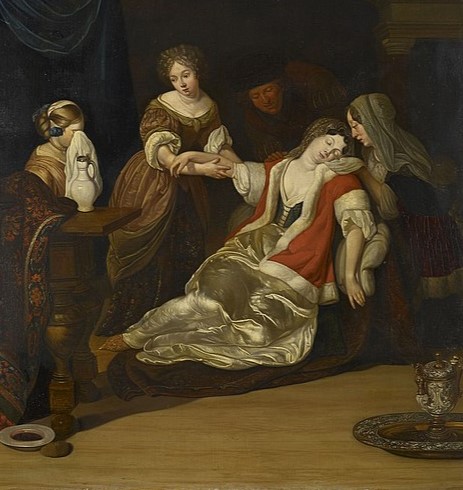
We’ve all seen it: The woman who faints at the entrance of a villain (gasp!), or because she’s heard shocking news (“Johnny’s not dead?!”), or because they’re serving black tea with blueberry scones when everyone knows black pairs best with lemon (massive swoon accompanied by self-righteous shattering of teacup).  I’m trying to be open minded, but all this swooning in the face of trouble so that a man can gallop in and save the day—instead of the woman just maintaining consciousness and dealing with it—feels false.  I’ve known quite a few women and never seen one swoon, so I have to ask: Did all this swooning really happen?

Yes, swooning is a thing.

In Jane Austen’s time, upper class women definitely thought swooning was real.  Victorian homes often had a fainting room and couch where women could retreat if necessary.  (Isn’t that an great way to get away from unwanted company?  “Excuse me!  I’m off to swoon.  Not sure how long I’ll be.  Go ahead and let yourself out, will you?”)

Regency and Victorian women also carried smelling salts in decorative containers to ward off fainting spells.  Known as lady revivers, they consisted of ammonia dissolved in vinegar or perfume.  The ammonia irritated the lining of the throat and nose to revive the victim.

Fainting rooms and special cases just for smelling salts—were these women really swooning? 

This site is ending, so I moved this post. Read the rest here. (Spoiler: yes, swooning is a thing, more so during the Regency era—find out why.)

Click the banner to visit Kirstin Odegaard’s website.

18 responses to “Did Regency Women Really Swoon?”

  1. brandva421 Avatar

    Great post!! I just recently learned that fainting couches in a bedroom existed for the woman to faint when her maid was removing the corset. Like it was a regular thing to faint while disrobing! So disturbing.

    1. Kirstin Odegaard Avatar

      That’s interesting. I read that changes in blood pressure often caused fainting, so maybe explains the fainting while disrobing. It is disturbing, isn’t it? These poor women.

  2. Collins Hemingway Avatar
    Collins Hemingway

    Fascinating new details on corsets. Hilary Davidson, who recreated one of Austen’s dresses and has written two books on Regency attire, believes Austen’s ribs were distended by fashion.

    1. Kirstin Odegaard Avatar

      Wow. I suppose I hoped that was more common among women who attended the London season several years in a row. If it happened to Austen, it must have been a much wider spread affliction.

  3. Alice McVeigh Avatar

    Excellent post. Had heard about the arsenic but not that it was so widespread. Wow.

    1. Kirstin Odegaard Avatar

      It is scary to think about. I researched Austen’s death, once, and read that some people thought her illness was caused by arsenic poisoning.

  4. Glynis Avatar
    Glynis

    I don’t think I’ve ever fainted (if I did I don’t remember) but I am grateful to not have to wear corsets or multiple clothing. The amount of arsenic and lead people were exposed to is shocking and laudanum wasn’t too healthy either! Add all that to the lack of bathroom facilities and medical care and I think I’ll stay in this century. (Although with the state of the world nowadays I might prefer the fifties and sixties of my youth!) 😉

    1. Kirstin Odegaard Avatar

      I’m so grateful to live now too–especially when I think of some of those amputations or early experiments with surgery…

  5. Glory Avatar
    Glory

    Another reason to be glad I live now & not in the layers of clothing, limited water intake & corsets!!!! Not counting the bloodletting or other medical practices of the time that truly didn’t help. Oh ya indoor plumbing too 😉

    1. Kirstin Odegaard Avatar

      Yes! I think of how grateful I am for indoor plumbing when I’m up in the middle of the night–and in the winter! Oh, and all those diseases from rats! Lots of reasons to be happy for modern advancements.

  6. cindie snyder Avatar
    cindie snyder

    Wow, those corsets sound uncomfortable! Glad we don’t wear them now. My youngest niece has issues with fainting once in a while but she stays hydrated and keeps a handle on it now. Those smelling salts sound horrible no wonder it roused the women when theyfainted! The pelvic massage just sounds bad!lol I am glad for modern meds too!

    1. Kirstin Odegaard Avatar

      I’m glad your niece has figured out a way to handle her condition.
      I wonder what smelling salts are like! They must be strong to rouse someone to consciousness. I think most boxing matches have banned them these days.

  7. Tom Odegaard Avatar
    Tom Odegaard

    “From art to opera to books to Hollywood, we love the image of the delicate woman fainting into a man’s capable arms.”

    I wonder who is more likely to provide such images?

    Does this kind of thing depend on the gender of the author/director/person financing the particular art form??

    Inquiring minds want to know.

    1. Kirstin Odegaard Avatar

      It does. The men have historically had more access to these jobs (making the movies and art and writing the books), so they have given us more of these images. But it’s also true that women and men both learn sexism from the society they are raised in, so women aren’t immune to creating similar scenes.

      I really wanted to put some images after that line, but they were all copyrighted. This one has some great images: https://kelleepratt.com/2016/01/29/the-vapors-swooning-fainting-women-in-film/#:~:text=Ripley%20in%20the%20ALIEN%20(1979,(1991)%20come%20to%20mind.

  8. mostsublimesongTroy Avatar

    I am reading your blog to find out the science behind swooning from love. In Solomon’s Song of Songs 2:4-6 the woman swoons. She has been shown love over and over again while Solomon the new King was courting her. They enter the banquet hall and there is a banner she walks under that say LOVE. She gets weak from feeling so greatly loved. Asks for something to sustain her. And it is in his arms that she rests, feeling loved to a high degree that she has never had before. She was a slave girl Song of songs 1:5, at the time an now was being courted by King Solomon so she was about to be queen from being a slave. All of this seems too much and she swoons.

    Is this lack of oxygen to the brain? Is this the muscles in the body being weak? And are there studies proving this?

    Thanks

    1. Kirstin Odegaard Avatar

      I think there are studies backing that up! Here’s what I found from Mayo Clinic:

      One of the most common reasons people faint is in reaction to an emotional trigger. For example, the sight of blood, or extreme excitement, anxiety or fear, may cause some people to faint. This condition is called vasovagal syncope.

      Vasovagal syncope happens when the part of your nervous system that controls your heart rate and blood pressure overreacts to an emotional trigger. Your heart rate slows, and your blood vessels widen. In turn, that causes your blood pressure to drop. When that happens, your body cannot deliver the blood your brain needs, and you lose consciousness.

      Me again. So, yes, it sounds plausible that the slave woman turned queen could have been overcome with emotion. Her heart rate and blood pressure could have dropped, less blood could have gone to her brain, and she could have fainted. It’s a theory, anyway. What do you think?

      Thanks for the question!

      Here’s the site:
      https://newsnetwork.mayoclinic.org/discussion/mayo-clinic-q-and-a-when-does-fainting-require-medical-attention/#:~:text=One%20of%20the%20most%20common,condition%20is%20called%20vasovagal%20syncope.

  9. Keionna Avatar
    Keionna

    Very well written!

    1. Kirstin Odegaard Avatar

      Thank you! What a nice comment to get!

Leave a Reply

Discover more from Always Austen

Subscribe now to keep reading and get access to the full archive.

Continue reading