
I have been writing Austenesque fiction since 2015—so about nine years now. In the beginning, I was certainly writing JAFF—Jane Austen Fan Fiction. Within a year, though, I found that the idea of JAFF, like an Aerosmith Tribute Band, was constraining my creativity. The idea that the characters began and ended on Austen’s little writing desk seemed to say that when she sealed her inkpot during those final months in 1817, all froze and remained forever immutable.
Elizabeth was impertinent.
Darcy was so comfortable in his control he was blind to his failings.
Jane was ethereal.
Mary was a prosy moralist.
Kitty coughed.
Lydia was…well…
Mr. Bennet was indolent.
Mrs. Bennet was a distracted and poor mother.
Mr. Collins was a buffoon.
Admiral Croft was comic relief.
Sir Walter was a satirical caricature.
Frederick Wentworth was a somewhat indifferent lover (I mean, he did not fight until the end)
And so on.
I am not disputing that Austen described essential features that should prudently remain unchanged. Casting Darcy as a fribble might be several bridges too far. How could Elizabeth love such a fool? I have problems with “Bad Jane” stories because such a character is too far from the original as to be unrecognizable. Her Austenesque nature is not that of Mary Crawford. However, an author can note her original nature and write her to be strong and assertive. That woman might become bored with Charles Bingley and logically gravitate to the colonel or a marquess.
To my eye, many JAFF books from seven years ago were simply retellings that hung new plot cruxes on Austen’s primary storyline. The Hunsford proposal was always in the parsonage’s parlor, where Elizabeth had sought refuge from her headache. The insult happens at the Meryton assembly.
Oh, there may be a murder or a kidnapping or an unfortunate sticky closet latch, but the essential branches of the tree remain. I cannot begin to wonder how many cases of amnesia or tumbles in the woods of Longbourn or Pemberley I read in years past.
Jane Austen’s character sketches were indisputably marvelous and perfect for the books she wrote. However, what do authors who seek to use Austen to move beyond Austen do to have their characters become Austenesque?
Allow me to define the term. My friend, the wonderful Austenesque author, Victoria Kincaid, clarified what I had suggested in a blogpost in 2017. Victoria highlighted that JAFF authors seek to hew closely to the original in their writing efforts. Austenesque writers use Austen as a starting point and build their stories atop Austen’s foundations.
What caught my eye in 2016 was that the prevailing tone of the genre was an acceptance of the secondary characters precisely as Austen had written them. This was not unexpected, for the main characters were likewise accepted as they were written. Yet, my inveterate “look-under-the-rock” nature made me wonder what made them the way Austen wrote them.
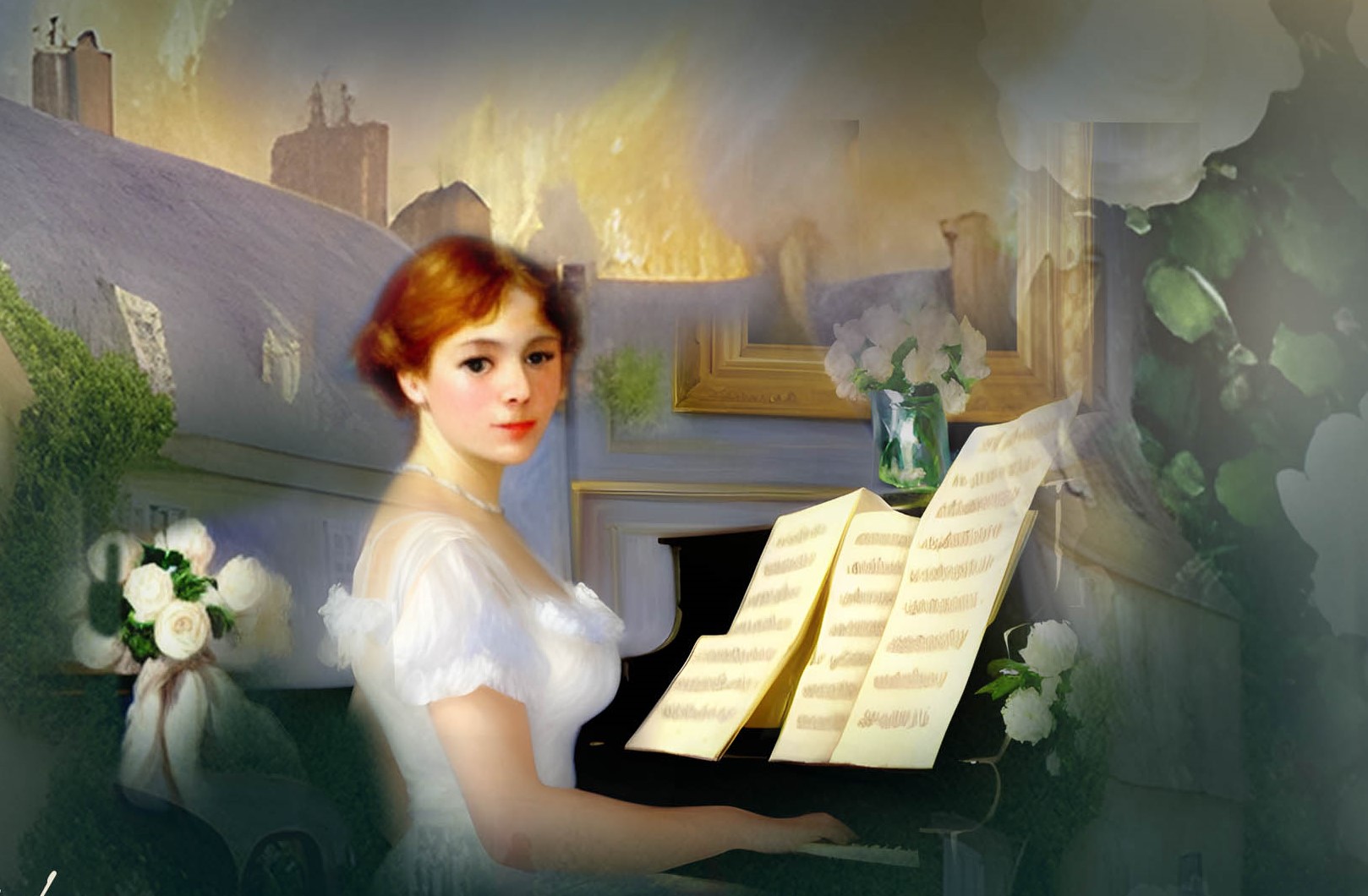
The sorry soul who captured me first was Mary Bennet. In Canon, she is presented as a prosy moralist, a sanctimonious preacher with the added handicap of being a woman who could never be ordained (perhaps saving her from becoming Ms Collins). She sang weakly and played pianoforte as if she were a Prussian grenadier marching across Jena’s fields.

Austen, though, has her appearing in the parlor armed with her Fordyce or a glower. The author is not thoroughly cruel and does give Mary some revealing lines that illustrate the time’s prevailing thought. Yet, what shaped her underlying behavior? What drove Mary to be Mary?
Back in 2016, I tackled the ‘What about Mary’ question, which led me deeper into the First Volume of the Bennet Wardrobe. I saw her as a young woman oppressed by the authorial pen that wrote Elizabeth and her counterpoint. The double weddings removed those two giants from Longbourn to allow sunlight to reach their younger sister, who had been starved beneath their boughs. The Keeper: Mary Bennet’s Extraordinary Journey is a story of the growth of Mary Bennet from a moralist into a woman of deep faith. She could never become lively like Lydia, nor abandon her deep faith, which provided the foundation for her psyche.
Thus, I tried to explore why she became the way she did so that Austen could give us the young woman’s portrait in Pride and Prejudice. See the following excerpt where revelations explode the day after the double wedding. This is a young woman coming into focus and assuming a solidity she had never known before.
&&&&
This excerpt from The Keeper: Mary Bennet’s Extraordinary Journey is ©2016 by Donald P. Jacobson. Reproduction in any form is prohibited. Published in the United States of America.
Chapter Twelve
After passing through the gardens behind the house, Mary followed the track that skirted several of Longbourn’s fields as she headed toward the trail leading up the hillock’s side. The crispness of the air chilled exposed skin, giving her cheeks a rosy glow. The countryside still slept under a glaze of frost that cast the brown expanse in a pale overcoat. The last days of autumn had yet to give way to a winter that was not due—if Papa’s almanac was accurate—for another eleven days on the twenty-second. Even then, it was doubtful that Meryton would experience more than cold weather over the next few months. Unlike the Darcys’ Derbyshire, southerly-located Hertfordshire rarely enjoyed more than one or two snowfalls during a season.
As she warmed to her exertion, Mary realized that the combination of cold air and activity was positively bracing. She had never felt more alive, more in tune with her surroundings than now. Minor details she would have ignored in earlier days—self-absorbed as she was in her swamp of self-hate—now called out to her. A disused bird nest hung precariously from a drooping branch. A hedgehog preparing to enter its burrow blinked in the brightening pre-dawn twilight. A woman bent beneath multiple shawls picked over a field seeking turnips or swedes missed in the late harvest. Some landowners chased away the poor. She was proud that her father followed the Biblical injunction:
“Do not go over your vineyard a second time or pick up the grapes that have fallen. Leave them for the poor and the alien.”[i]
Turning away from the lane, Mary began climbing Oakham’s lower slopes. While not a mountain in its truest sense, Oakham dominated the area around Meryton. Mary knew that the hump was one of the easternmost of the Chiltern Hills downslope—chalk rises that stretched northeast from Oxfordshire to Luton. As she walked, Mary looked down to avoid roots and rocks waiting to trip the unwary. She observed a vast and colorful array of mosses and lichens clinging to south-facing tree trunks and rock faces. That there was life even amongst the russet skirts of Nature’s autumn ensemble threw Mary into a contemplative reverie.
How could I have missed all this in nearly twenty years of existence? I thought I understood the glory of God’s handiwork found in the tiniest flora. Such active husbandry emphasizes the speck-like nature of Man. Yet, men persist in trying to climb to godlike heights. They would seek to place themselves above their fellows, claiming a divine right. These poseurs seek to pervert the Word. They were chosen not by God but rather by men. They would have the trusting faithful believe they were only acting as the Almighty’s handmaidens. These Collinses who claim that God speaks to or through them seek to be exalted, not because it brings them closer to God, but rather that it puts them above other men.
And that was just what I had wanted. I needed to find a way to be better than my sisters were. I had to find a way to shine to my father. I had to become something to push aside Mama’s remarks. Ultimately, my behavior separated me as completely from society as if I had stood by the roadside and rung a leper’s bell.
Lost in her thoughts, Mary needed several moments to realize she was no longer climbing. She had reached the wide-open tabletop summit of Oakham Mount. All of Hertfordshire stretched out before her.
***
Pausing to drink in the scenery, Mary looked southeast toward the darkened smudge on the world’s edge: London, some twenty-four miles away. Here she was, young Miss Bennet, standing above all she knew, waiting…waiting…
The first slice of sun broke the horizon and limned the high country beyond the Mimram. Rose hues leaped from crest to crest as dawn took hold, yet the radiance ignored the haze hulking above the great metropolis to the south. The glowing tide raced along the ridges and crossed the valley to embrace Mary in its warm folds as it washed over the plateau. With the dawn came a surge of energy that left her breathless. The minutes she stood there—stock still, eyes closed, faced upturned into the brightening day—were different from any other in her memory.
The rays of the late autumn sun caressed her, their crystalline clarity speaking soundless volumes of peace and comfort.
Let go!
And her tears came.
Gently at first, seeping from the corners of her eyes and coursing through the soft down of her cheeks.
Then in harsher shoulder-shuddering spasms, the dam of a dozen years of isolation holding back her anger began to crack.
At some point, Mary’s knees buckled, and she collapsed onto the turf-covered hilltop, sitting on her haunches, head bowed, weeping her sense of loss. But for what was she mourning?
Was it for the little girl, still in ribbons, running into the parlor eager to show her Mama her drawing of the horses in the stable only to be ignored in favor of some juicy gossip offered by Aunt Philips? Or was it for that same untutored child feeling the sting of criticism as she fumbled the notes of one of Mr. Bach’s sonatas? What of the day she became a young woman, and the elders in her life did nothing to ease her fears?
She had spent half of her life counting every grievance committed that made her feel less than her sisters, unwanted by her parents, and ignored by the community. Instead, she fumbled from one disaster to the next, never recovering, always confirming her inadequacies. She raged against those who should have guided her but did not. Even the eye rolls of her sisters and their husbands-to-be scoured deep tracks in her heart. It was much easier to deny them all, be separate, imagine herself superior, and create that invulnerable girl: Mary alone.
Mary turned her face into the rising sun, tilted her head back, and screamed, gut-wrenching in its agonized intensity. She shrieked her injuries out to the bare branches of the ancient oaks that circled Oakham’s crest. She laid each word, glance, slight, and hurt onto the mount’s high altar for all Creation to see. As Mary recalled each one, she felt them wither and blow away as they lost their power over her. She released them for the first time, and her soul cried out for joy.
***
When Mary regained her senses, the sun was higher in the sky, and the hoar frost had burned off the grasses where she lay. Rubbing her eyes, Mary sat up and, spying a large log about halfway across the meadow, stood to walk over to it. As she approached, she could see a bare spot worn in the ground near its middle.
This must have been where Lizzy sat and scrubbed the ground clean as she pondered the view.
She settled onto the trunk, finding it smoothed by years of use. As Mary was taller than her sister, the perfect perch for Lizzy was a bit low for Mary. The seat was ideally situated to take advantage of Oakham’s attributes. There was a compelling silence, undisturbed by noises from the outside world. A gentle breeze rattled the few remaining leaves in the trees. Clouds sweeping across the December azure sky dappled the fields with patches of shadow. The air seemed fresher, crisper—a tonic to soothe Mary’s heartaches.
She breached the musette and unwrapped the bread and jam. Sips of tangy cider washed down the first few bites of the sandwich. After the past hour’s emotional turmoil, such simple tastes helped her center herself.
Strange how elemental articles like cider, bread, and preserves help me find my way back to where I should be!
The calming influence of a full stomach and surrounding beauty allowed Mary to reflect on her catharsis. Every sensation upon which she had built her adolescent reality struck her as no defense against further outrages but rather the corrosive cause for her social isolation. Her responses trapped her in a cycle where her reactions to others led to censure of her behavior, which caused her to be even more critical of those around her. Everything she had tried to this point had failed to help her fit in, to be accepted by her family.
As this last passed through her mind, Mary’s eyes narrowed. There was something wrong with the idea of just “fitting in.” That sounded as if anyone could wedge their way into a group. That was a world away from being accepted.
How did one become “accepted?”
That was a thought to ponder. Mary recalled when Lizzy confronted her after one particularly awful scene with Maria Lucas. This was barely eight months ago, shortly after Elizabeth had returned from Hunsford. During her visit to Kent, something had left Lizzy less tolerant and more acerbic.
“Mary, you try too much. You wear people down with continual exhibitions of your capacious memory, prosy moralizing, and disapproving scowls. Just sit back and enjoy what people have to offer. You will discover that each person is special and unique and has God-given gifts they will freely share if you open your heart to receive them.
“Who made you so upright and holy? What does the Book say? ‘Judge not lest ye be judged?’ and ‘He who is without sin, cast the first stone?’
“Honestly, Mary, you would think that, with all the use your Bible has enjoyed in the past few years, you would be a vessel full of Christian charity. Your disapproval, especially of an innocent creature like Maria, does you no credit and alienates you from those who would like you if you only allowed it,” Lizzy railed.
Closing her eyes, Mary recalled the earlier scene in the Lucases’ parlor, not as herself but as a fly on the wall. She could see and hear everybody around the room: Lady Lucas, Mama, Maria, Lizzy, Lydia, and herself. Kitty was at home recovering from a cold. In her imagination, Mary did what she rarely did during these calls: she listened to the conversation.
Certainly, Maria was capricious and somewhat silly. But she was still a young girl, barely old enough to merit attention on the marriage mart—and even then, only in the country. So being flighty was not out of Maria’s norm. Mary then looked across the room to where she herself sat. She could see the anger billowing from that other self’s posture, the ever-darkening glower on her face, and how she snapped the pages of the book she held in her lap.
What was it about Maria’s prattle that bothered me so? Was it because I felt so insecure in groups of people discussing topics I had no knowledge of or interest in? Or was it something else—Lydia! Yes, Lydia! Maria reminded me that Lydia, Mama’s favorite, could spout inanities without end and still be petted and rewarded. Yet, anything I would say or do earned me nothing but criticism.
Mary watched as her spectral form lifted her eyes to Maria and delivered a remark that stopped the conversation. Maria’s head snapped as if she had been slapped. She bit her trembling lower lip as tears began to flow. She had gathered her skirts and dashed from the room in a moment. Even usually oblivious Lydia threw Mary a piercing glare before she looked to Mama who nodded her permission for Lydia to chase after her friend. Lizzy spoke briefly to Lady Lucas and practically dragged Mary from the room and out the front door. Then she began her lecture.
Mary opened her eyes as the vision ended, basking in the summit’s beauty. Hot tears of shame washed down her cheeks. Was she such a shrew? How could any abide her company? Would everyone be better off if she never came down from Oakham?
No, self-murder is the worst of all sins!
She had to find a way to carry on; she had to find a way to live with herself, to exist in this world. Mary needed to make radical changes and begin a complete alteration, not just a minor course correction.
A clarifying thought exploded through her mind. She had always turned to the Word for guidance; moreover, she depended on a fusty old man to explain its meaning. Today’s tears had flushed away layers of calcified thinking. Mary realized that the solution to all her problems began with her.
And why beholdest thou the mote that is in thy brother’s eye, but considerest not the beam that is in thine own eye?
Or how wilt thou say to thy brother, Let me pull out the mote out of thine eye; and, behold, a beam is in thine own eye?
Thou hypocrite, first cast out the beam out of thine own eye; and then shalt thou see clearly to cast out the mote out of thy brother’s eye.[ii]
St. Matthew’s words glowed in front of her. First, she had to release her log—her anger. Then she had to end her selfishness, to cease making everything about her when most did not involve her. Finally, she had to realize that building a better self-image began with appreciating others for who they were, not how she believed they should be. Each person was treading their path and would have to settle their accounts when they faced their Lord.
Mary Bennet realized that her ledger mainly had black marks, but thankfully, she had seen her failings before it was too late. While winter was in the air atop Oakham, spring had begun in the breast of Mary Bennet.
[i] Leviticus 19:10
[ii] Matthew 7:3-5 KJV https://www.biblegateway.com/passage/?search=Matthew+7%3A3-5&version=KJV accessed 1/2/16.


Leave a Reply