
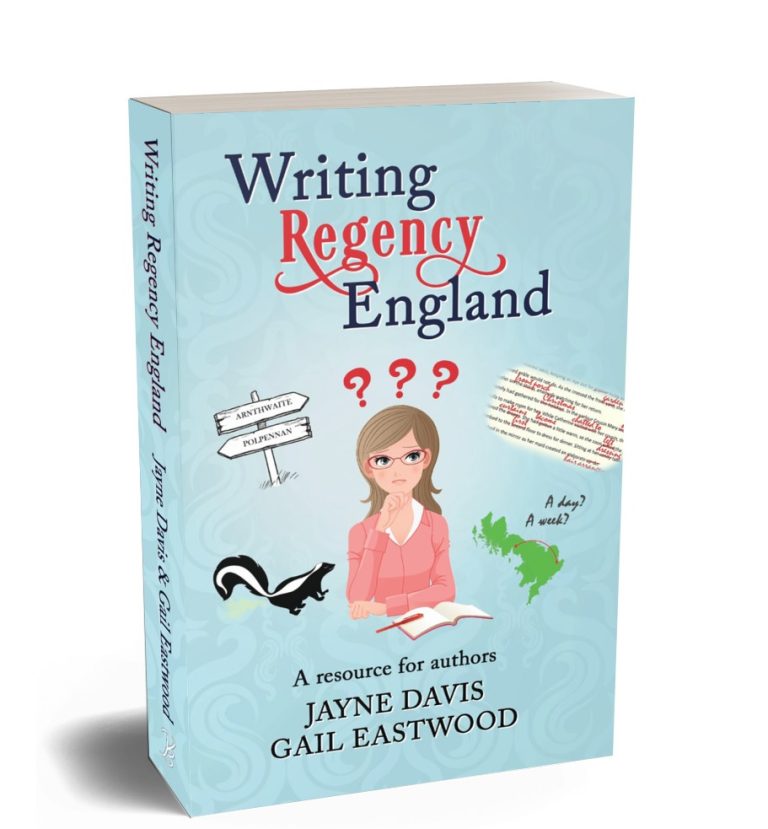
Today we’re talking with Jayne Davis and Gail Eastwood, the author-researchers behind Writing Regency England, their guide for authors using the Regency period for their stories.

Q: What inspired you to tackle the challenge of writing WRE?
A: (Gail) First, let us thank you for inviting us to be here! We’re both authors of Regency fiction, so that means of course we are also voracious readers of the same. A lot of shared online conversations about the errors we kept seeing over and over again in the genre led us eventually to create a workshop addressing these. We called it “Beyond Brit-speak and Americanisms: Developing Your Regency Voice.” It focused primarily on the language we writers use to tell our stories, but the words (and the errors) cross over so many other things, our talk included quite a number of topics. We presented it at the first annual virtual conference of the Regency Fiction Writers in 2021.
(Jayne) Our presentation was enthusiastically received—so much so that we were asked about expanding it and offering it as a class for the RFW’s Academe program. We discussed that idea, but we realized that a book would reach more writers, could include more information (for a lower cost), and would be a more permanent resource to help improve the genre. It surprised us that no one had already put together something like this, and there was clearly a need for it. With the idea of basing the book on our presentation, the project didn’t seem insane when we started working on it.
(Gail) I think we became the victims of our own enthusiasm, as we kept adding topics we wanted to include. By the time the project grew well beyond that first intent and we realized doing it was insane, we were too invested to give it up!
Q: What personal background or credentials gave you the courage to wade in where others had feared to tread?
A: (Gail) Even though we both write fiction now, both of us had worked in the non-fiction writing field as well. I was a reporter and then a freelance journalist for 20 years before I wrote my first novel.
(Jayne) I was an aeronautical engineer, a science teacher, then a publisher and author of science textbooks before I started writing fiction.
(Gail) Jayne’s experience with publishing textbooks was invaluable when it came to formatting and publishing WRE. But we both have strong research skills and a love for Jane Austen and the Regency period, and we highly value authenticity in what we read and what we write. As writers, we know how important the world-building is when creating historical fiction, and as readers, we know how disappointing and disturbing it is when an error too big to ignore bumps a person right out of a story.
(Jayne) We feel for authors who’ve put their heart into a story only to have readers leave bad reviews, citing the historical errors or the language mistakes. Everyone writing historical fiction faces the problem of “you don’t know what you don’t know.” It’s often hard to determine which things you need to research.
(Gail) The other thing we bring to the table is the fact that Jayne is British and I am American. By partnering for this project, we could offer a perspective from both sides of the pond and include a wider variety of the kinds of challenges Regency writers face. All of us are writing now for an international audience of readers. When I first started (1994!) the market was almost entirely American and the readers, while well-versed in the period, were not as expert as many of them are now. Over 30 years, the available knowledge and the resources open to us have exploded, thanks to continued interest and the advent of the Internet.
Note from Regina: Some of you may remember the Spot the Mistakes! post shared from these two authors on 30 April. If you missed it previous or want to revisit it, click the hyperlink to the article.
Q: How did you decide what to include in WRE?
(Jayne) We tried to maintain a focus on the purpose of the book, which is to help authors avoid the most commonly seen errors. Whenever we ran across an error we were tempted to address, we noted it down, whether we had only seen it once or if multiple authors had made the same mistake.
(Gail) Obviously, no matter how much we read, two people could not have read every Regency novel out there. To expand our reach, we asked readers and other authors in the genre to share their pet peeves or errors they had noticed. That gave us a much broader base from which to draw our topics.
(Jayne) Possibly too broad. We started joking about the book becoming a multi-volume encyclopedia! But it was only kind of a half-joke. I think we were a little afraid it might come true.
Q: Can you give us an idea of what the book does cover?
(Gail) WRE has sixteen (not “six and ten”) chapters, plus appendices and an index, and is divided into three sections: language, setting, and society. While most of the information is available on the Internet somewhere, there’s a lot to sift through to find what you want. Rabbit holes are everywhere (not gopher holes!), and not everything on the web is correct! Our chapters are followed by resource lists for the covered topics. We designed the book to be a basic research guide as well as an information source in itself.
(Jayne) The first section, on language, offers four chapters. Chapter One covers historical flavor, developing an ear for period language, research sources and pitfalls, modernisms and Americanisms. Rather than give just a few examples (muffins, suitcase?), we devoted the second chapter to categorized tables meant to help catch commonly seen word errors, whether they are not British usage or not used in our period (or both, in many cases), also appended as an alphabetized list.
I wanted a chapter on how characters speak, especially the variations due to class or location. For instance, a labourer from Yorkshire might say nowt to mean nothing, but have that word from a Cornishman and it would feel wrong to anyone familiar with the West Country. There are so many variations in local dialects and vocabulary, this chapter cannot be more than a basic guide, but we hope it will help authors avoid glaring errors!
(Gail) And I wanted a chapter to address how we name our characters. A wrong choice of given name, surname or even title name can annoy a reader all the way through an author’s story! Even though the upper classes tended to stick with the same conservative given names like Elizabeth, Mary, Jane or William and James, for instance, there are ways to have more interesting names that are still authentically period and won’t catapult the reader right out of the story the way a Chelsea, Ashley, or Randy (which in the UK and parts of the US means “someone eager to have sex”!) would.
(Jayne) The second section on Setting has five chapters. The first four are about the plants and animals, natural and built landscapes and how places are named. Authors who are not British make the most mistakes in these areas, but even Brits sometimes fail to learn what plants or animals were introduced when, what the landscapes are like in an area not familiar to them, or what cultural & historical influences affect the names used for features in a given area.
We included tables listing some of the animals we and other readers have encountered in Regency fiction that should not be there. (Some, such as skunks and chipmunks, have never lived in Britain. Others did but were extinct by the Regency, or were introduced after our period.) Two appendices list when a selection of Regency-era garden plants were introduced and their blooming times. The last chapter in this part is about travel, helping authors to ensure their characters aren’t travelling from Gretna to London in a day, or crossing the Atlantic in a week, and looking at different modes of travel they might have used.
(Gail) The third section deals with daily life, culture and society. This one part could have been a whole book, er, encyclopedia, but we omitted many topics that are easy to research and have spawned whole books dedicated to them, such as fashion, furniture or architecture. Seven chapters cover such varied topics as money (earning it and the value of it), military service, titles & forms of address, inheritance laws, marriage and divorce, the postal service, and recreations such as dancing, hunting and shooting.
Q: WRE came out in November of 2023. We’ve heard some authors refer to it now as their “bible.” Have you since returned to your fiction careers, and what are you working on?
(Gail) Jayne just released her first Regency story since we finished WRE.
(Jayne): Yes, Fair Ellen, which is a novella, came out on May 15th. It has felt so good to get back to fiction writing! I’m in the process of finalizing a short story for a multi-author anthology, and editing a full length novel set in France and England in 1812 onwards (An Improper Correspondence).

(Gail) I have happily returned to working on my Regency series set in rural Derbyshire. Book Four in the Tales of Little Macclow (His Lady to Love) is well underway—I hope to release it in late August or early September. I am also working on a prequel to the series that will be free for my email subscribers.

I have to say, my brain simply cannot hold all of the information we put into Writing Regency England. Even though we wrote it, I often find myself reaching for it to confirm some word or bit of information I’m suddenly not sure about. I’m proud of the work we did and don’t regret putting in the vast amount of time it took us to create it, despite a year’s delay in my series. We hope it helps a lot of writers!
Thanks again so much for the opportunity to come and visit the blog today. We hope if people have questions or comments, they’ll start a conversation with us in the comment section below.


Leave a Reply