
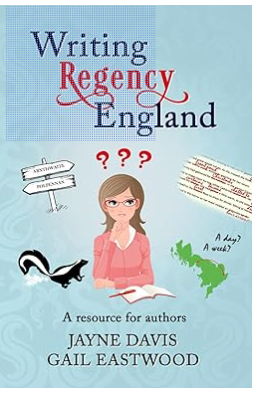
As I have mentioned previously, one of the Facebook groups I follow is Regency Kisses: Lady Catherine Salon.
Back in November, Gail Eastwood, one of the admins on the site, shared a number of short posts and asked us readers to spot the errors. Some mistakes were easy to spot. Some I did not know, for they were more a “British” thing, than an American one, but ones I would have researched before adding them to my books. Even so, if I am to speak the truth, some were ones I might not have thought to research. All that being said, today I wish to share two excerpts and see how you would do. Have fun with it, but learn something also (so says the English teacher).
****************************

From Gail Eastwood as Introduction to the exercise: All but one of the chapters in Writing Regency England have a little boxed entry at the beginning which asks the reader to “Spot the mistakes” in a couple of sentences relating to the chapter’s topics. The answers are given at the chapter’s end, before the list of resources. Jayne and I thought it would be fun to invite you to test yourselves with a couple of longer “spot the mistakes” examples here in the salon!
Directions: Read through the following snippet Jayne Davis wrote especially for you, take note of the errors you see, and comment below saying the number of mistakes you found. Did anything surprise you? Confuse you? Etc.

SAMPLE #1
The post chaise pulled into the yard of the Hounds and Hare, located on the edge of the village of Mickelthorpe. Lord Basildon descended and stretched, taking in the familiar sight of the red-roofed cottages with their flint walls flanking the edge of the moorland, then turned to help his wife Lady Elizabeth exit the vehicle. Only another few miles to his estate on the Cornish coast. Even now, he could see the glitter of sunshine on the ocean and a passel of small sailboats gathered where the creek flowed into the bay. Despite the cool weather of early fall, bluebells would still be in bloom beneath the trees in the woods surrounding his home.
They were surprised to see a strange face bowing them into the pub’s dim interior. “Where’s Tregarron?” Lord Basildon asked.
“Pritchard’s the name, your grace. I have bought the place from Mr Tregarron.”
“That’s not a moniker from around here, is it?” Lady Elizabeth enquired.
“My family came originally from Scotland, my lady. My parents have passed, so there was nothing to keep me there. We have a new private parlour in back, if you would follow me.”
Ten minutes later a maid entered with a laden tray. There was a pot of tea and jug of cream for Lady Elizabeth and a mug of ale for Lord Basildon, together with plates of cookies, frosted cakes and Yorkshire pies.
That is our first excerpt. Let us see how many errors you managed to find.
+++++++++++++++++++++++++++++++++++++++
Attempt to discover how many errors you can spot in the little scene below, written for you by Jayne Davis – Author. Share the number you found in your comments. Is there something that confused you? One you smacking yourself across the forehead for missing?

(illustration is a 1920’s painting but I couldn’t resist her clear longing for her lost love)
—————————————————
SAMPLE #2
Miss Chelsea Smyth’s spirits sank as the post chaise travelled further north and they passed from Lancashire into Cumbria. If only Papa had not sold his commission in the Navy, her romance would have remained undiscovered until it was too late. At least he had not come with them—it was so tedious having him mad at her all the time.
“I will tell the coachman to stop in the next village,” Mama said. “It is still a ways to my sister’s house, and there is a friend in the next visit we can visit with to break the journey.”
Mama’s friend was as boring as Chelsea expected, and she sighed with relief as they finally arrived at their destination, with a butler waiting on the stoop to greet them.
“My dears!” Aunt Sarah greeted them. “But where are your maids, and your luggage?”
“They should arrive soon,” Mama said.
“Oh. Jenkins, go find a maid to attend Mrs Smyth. They will want to wash up after their journey. Have refreshments in the parlour in a quarter hour.”
Chelsea’s room was not large, with only a small vanity and a chair near the window. She brushed out her hair and twisted it into a simple updo that was all she could manage without a maid. She checked the paper and envelopes were still hidden in the bottom of her suitcase; later, she, she would write Donald to let him know where she was.
============================================
============================================
ANSWERS. I HOPE YOU DID NOT CHEAT.
These are the errors found in our first excerpt.
Let’s start right out with the answers to the first “Spot the Mistakes”. Jayne Davis managed to pack an amazing number of intentional errors into one short tidbit! Total number (that we see, anyway) = 23 to 25, depending on how one collects them. Here they are:
1. There are plenty of inns/pubs called the Hare and Hounds, none called Hounds and Hare.
2. The setting is Cornwall, but ‘thorpe’ is a typical ending for village names in the north, not in the south.
3. Lord Basildon – this name is not incorrect, but the town of Basildon has appeared in the top ten of ‘worst towns in England’, and ‘Basildon Bond’ is the name of a line of stationery, so doesn’t really give a ‘lordly’ impression to many British readers.
4. Red roofs are common in places on the east side of the country, not in Cornwall (where slate is far more likely).
5. Flint walls are a south-eastern thing (no shortage of building stone in Cornwall).
6. Lord Basildon’s wife would be Lady Basildon, not Lady Elizabeth.
7. Brits would leave the vehicle, or descend from it.
8. Brits refer to ‘the sea’, not ‘the ocean’
9. ‘Passel’ is American
10. They are sailing boats rather than sailboats
11. ‘Creek’ is not used as a general description of rivers or streams in the UK, and there are only a handful of watercourses with ‘creek’ as part of their name.
12. The season of falling leaves is called autumn.
13. Bluebells bloom only in the late spring.
14. ‘Pub’ is a much later contraction of ‘public house’.
15. Lord Basildon should be addressed as ‘my lord’, not ‘your grace’
16. ‘Moniker’ is American.
17. Lord Basildon’s wife would be Lady Basildon, not Lady Elizabeth, again. Your total may vary depending on whether you counted this as a single error just repeated or counted each time it occurs (there’s one more after this).
18. Pritchard is a Welsh name, not Scottish.
19. People die (or ‘pass away’) in Britain, they do not ‘pass’.
20. The parlour would be ‘at the back’, not ‘in back’ (those tricky prepositions).
21. Tea is taken with milk, not cream.
22. Cookies are biscuits.
23. ‘Frosting’ is icing.
24. ‘Yorkshire pie’ is not a specific dish. There are pies made in Yorkshire, of course, but they could contain any type of filling. In foodstuffs, the ‘Yorkshire’ name is best known for Yorkshire puddings (a savoury side dish today, but in earlier times mostly eaten by the poor as part of a main meal, not as something with afternoon tea).

How did you do with Excerpt #1?
=============================================
Now, here are the answers to Excerpt #2,
You will find many of the errors were words that were non-Regency style errors.
Our second example had fewer errors than the first one, but Jayne still managed to include quite a few! Here they are, below. Total =16
1. A Regency Miss would be extremely unlikely to be christened ‘Chelsea’.
2. Cumbria did not exist in the Regency. Cumbria today encompasses what was Westmorland, Cumberland and part of Regency Lancashire.
3. Commissions were only bought and sold in the army (and then only in cavalry and infantry regiments, not artillery or the engineers).
4. ‘Mad at’ would be ‘angry with’ or similar for Brits.
5. A post chaise would be ‘driven’ by a postilion mounted on one of the horses (or two postilions if there were four horses), not a coachman.
6. ‘A ways to’ translates to ‘some way to’ or ‘a long way to’
7. ‘Visit with’ should just be ‘visit’ (as they are actually going to call at her house).
8. British houses do not have stoops. It would be at the top of the steps, or similar.
9. ‘Go find’ would be ‘go and find’ or just ‘find’.
10. ‘Wash up’ means doing the dishes in Britain. They would want to ‘wash’.
11. ‘a quarter hour’ would be ‘a quarter of an hour’.
12. A ‘vanity’ is a dressing table. (‘vanity table” is modern)
13. “Updo” is a modern term.
14. Pre-made envelopes were not available in the Regency.
15. ‘Suitcase’ is early 20th century. It would have been a “portmanteau” or “cloak bag”.
16. She would ‘write to Donald’, not ‘write Donald’.

Did you score better with this second one? Let us know.
Meet the Authors of Writing Regency England.
Gail Eastwood is an Anglophile and storyteller from an early age, Gail is the award-winning author of “sweet/low heat” Regency romance fiction. She is currently working on Book 4 in her “Tales of Little Macclow” series, featuring an assortment of lovable gentry, working class and aristocratic characters and set in a tiny Derbyshire village where the cause of True Love may be getting some extra help!
Hooked on Georgette Heyer from her teens, Jayne Davis finally got around to writing her own Georgian and Regency romances in her fifties. She is the author of twelve books, including the popular Marstone series, and is currently working on her next novel while also settling in to a new home in the often wet and windswept Cumbria.


Leave a Reply