
I offer two selections from the redoubtable H.L. Mencken to defend my thesis. The first is an opening salvo by the great commentator.
Who ever heard of a bad autobiography? That is, a bad honest one?
I can scarcely imagine it.
And two sentences later, still in the same paragraph:
(For there is a dreadful fascination with the truth.) It alarms and annoys
the absurd bladders of unstable colloids who rove and pollute the earth, masquerading in God’s image, but at the same time, it arrests and enchants them.[i]

In his introduction to the month’s book reviews, the ever-acerbic Mencken, like the intelligent journalist he was, first grabs his reader. Only later does he remind them of his point of view (much like what got Socrates killed) of ‘those who would know better’ and how they view their intellectual capacities. (I wonder what Mencken would have thought of Caroline Bingley, Lady Catherine, General Tilney, or Edward Crawford…maybe the same as the Lady.)
It is less critical in this instance to appreciate what Mencken wrote. Rather, consider how he wrote it. And therein lies the purpose of this essay.
We must, though, look at writing—in our case, fiction—in a different sense. Without a doubt, the overt purpose of fiction writing is to tell a story.
In addition to the previous, I would also argue that any writing, but good fiction, alters the consciousness of others. One cannot do that unless the work engages the reader. I would retain this for consideration in a moment.
Why do we write #Austenesque fiction? So that a diverse body may READ our tales.
The previous sentence is, by its nature, a modern construct. True, individuals did read Jane Austen’s work. However, those persons were, at the least, the wealthiest of Britain’s citizens. The most charitable and broad interpretation would add in all those who were literate enough to read her imaginings but also liquid enough to afford to purchase her books or pay for a subscription at a library. Thus, Austen’s works were constrained in their distribution by the nature of the society into which she was releasing them. T’was not until the population became literate after the 1880s that her work once again began to flourish. Oh, lest we forget, Modern Society (a term applied by historians) also gave that population enough leisure time to enjoy a good book.
But, if the word and concept of Reading is essentially a modernist term, what came before? I discount the first 300 years after the invention of the printing press. Books were too few and too pricey to gain broad acceptance. That said, we know, for instance, that populations were exposed to written works in the millennia before the Regency. The Christian Bible is an excellent example of that. From the Latin Vulgate version to that of King James I, the faithful were buoyed and transformed by the Word as their priestly interlocutors expressed it.
However, nearly all who imbibed at the fount of the Old and New Testaments were thoroughly illiterate.
However, they listened to the clerics whether they were a peasant in Derbyshire or a butcher in Lyon.
The deep clue comes wrapped in the fact that much of the Bible is remarkable poetry: Psalms, Proverbs, the Song of Solomon—the entire King James Version—they are part of Western Civilization’s oral tradition. Likewise, Shakespeare’s plays (and Jonson’s) were indeed created to stroke the psyches of The Globe’s aristocratic financial backers. However, the Bard also wrote them to separate farthings from those in the pit. Whether t’was feet in the dirt in front of the stage or posteriors planted on rough-hewn planks above and around, all heard the same words without the penalty imposed by a lack of education.
Why? I contend that each hews most closely to the original purpose of writing.
Writing was invented to allow the stories it preserves to be performed by others who were not the work’s creator. After that, all original—modern or ancient—writing grew from that original intent and thus needed to comport with the idea that the spoken word is an expressive communication medium.
Now, we must peel back the onion of history to get to where the use of writing moved beyond that of record-keeping.

Long-lasting civilizations like Sumer, Egypt, and China tended to endure long enough to establish the continuity that would allow the evolution of writing to proceed uninterrupted. While hieroglyphs do not lend themselves to audible performance, they do, nonetheless, allow for a literal, if not lyrical, presentation of the stories immortalized there. Cuneiform did record the first extant story, The Epic of Gilgamesh. There may have been others predating EofG; however, they are lost.

Of course, the problem with “translating” something like Gilgamesh is that cuneiform is representational…much as Japanese ideographs reflect concepts rather than specifics. The modern interpreters of ancient Sumerian necessarily must impose their presentist thoughts upon a work 5,000 years old. Yes, while the ancient sense of the story remains, the poetry of it, the performance value it may or may not have, is likely an artifact of 19th or 20th Century scholars’ effort to impose their expectations (based in the Shakespearean tradition of performance) upon the writing.
But, now we get to Classical Greece.
Rather than belabor the impact of the Greek Dark Ages (~1100 BCE to ~800 BCE), suffice to say that, by the time of Homer, the Greeks had lost the capacity to write. Even then, if they had retained the Mycenean Linear A, they would only have been able to order 200 ships to Troy. As with most ancient writing, pictures, not words, offered the most entertaining tales until the blind poet Homer.
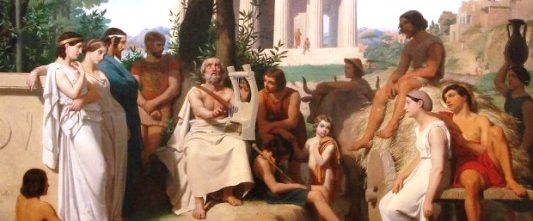
The itinerant bard would go from warlord’s keep to warlord’s dining hall, paying for his supper with stanzas of epics charting a time when Greece stood tall, and giants walked the hills and valleys of Attica and the Peloponnesus. There were no DVRs, no flat screens: just a man and a harp.
Of course, when Aecheines went home after dinner, he wanted to impress the men who would recline on dining couches in his salon next week. However, Homer had moved on by that time. What to do?
The Greeks copied the Phoenician alphabet to write down the Homeric Epics before Homer died…so that Aechines, Philias, or whoever could find a local man to perform some of The Iliad.
However, the letters used by the Mediterranean’s master merchants were designed to record the number of goats traded for the number of baskets of barley. There were no vowels.
‘Dg’ could easily be read as dug as dig or dog. True, contextual clues could help ascribe meaning.
However, the Greeks invented vowels to adjust the sound of the words and remove the guesswork inherent in a vowel-less system. And, before you could say Marathon, the works of Homer were preserved, and all the great poetry and plays of the Greeks became possible.
At that point, somewhere in the Eighth Century BCE, writing as we understand it came into being.
And, it arrived because performers who were not Homer could offer up his work to entertain those who could not read—as in darn near everyone—but could listen.
Thus, the greatest stories ever composed were preserved so that they could be performed in their original format—aloud to a group—by others who were not the author.
I doubt if Shakespeare wondered if Hamlet would survive beyond his death. Yet, it has left us with the question: is reading a copy of the play silently to oneself or, as Austen allows us to imagine, as rewarding as when Mr. Bennet plays Polonius while Lizzy is the prince and Jane Ophelia?
The core of my belief about writing rests on this: good writing (if not necessarily good stories) rests upon sounding “good,” a condition that leaves the listener with a clear mental image of the crux of the story. And that image is wrapped in emotions inspired by the words rising from the paper and delivered directly to one’s ears.
However, even here, I would refine my point. Rather than establishing “sounding good” as the final standard, we must take it one step further as writers who produce and as readers who imbibe. I suggest that the work must sound right for its genre.
Part of this model rests on matching the meter, the beat, of writing with the desired emotions. Sounding right means that the reader falls in step with the consciousness alteration desired by the author.

Consider Raymond Chandler…
It was a blonde. A blonde to make a bishop kick a hole in a stained-glass window.
Or
Mr Cobb was my escort. Such a nice escort, Mr Cobb. So attentive. You should see him sober. I should see him sober. Somebody should see him sober. I mean, just for the record. So it could become a part of history, that brief flashing moment, soon buried in time, but never forgotten – when Larry Cobb was sober.
Chandler leaves little to the imagination, and his pacing describes the character perfectly. He turns…and fractures…grammar to his purposes, forcing the reader/listener to slide into the world he creates. He sounds right for the smash-mouth brutality that characterizes his stories.
Yes, you could get that from a silent reading. But, imagine the goosebumps the second quote could raise—not from fear but rather from the sheer pleasure of hearing the language used as it ought to be used.
Like Jane Austen, I work to make my writing “sound good” when read aloud. If I am writing fiction inspired by her, I try to paint word pictures as well as she does.
Equally formed for domestic life, and attached to country pleasures, their home was the home of affection and comfort; and to complete the picture ofgood, the acquisition of Mansfield living by the death of Dr. Grant occurredjust after they had been married long enough to begin to want an increase of income, and feel their distance from the paternal abode an inconvenience.
The penultimate paragraph of Mansfield Park offers an epilogue to the story of Fanny and Edmund. It spells out everything: love, no deprivation, anticipated children, and a desire to once again dip into the bosom of childhood homes through tonality and meter. Read aloud, the sense of her pacing and vocabulary illustrate all the ideas while leaving behind a warmth that makes one smile. Austen sounds right. Read silently, though, and I am less sure.
&&&&
This excerpt of The Sailor’s Rest is ©2023 by Donald P. Jacobson. Any reproduction without the expressed written consent of the author is prohibited. Published in the United States of America.
Chapter 41
An Excursion to Città Vecchia, April 21, 1815
The donkeys’ progress was uneven at best. The powdery track leading from Città Vecchia into the Bingemma Hills ascended through worn hummocks—only in the Thames Valley would they have been awarded the courtesy title of ‘mount’—toward Rabato. This ageless village surrounded even more ancient Phoenician tombs.
According to their guide, the beasts had never lost a paying customer when the party’s two gentlemen had voiced concerns. The grey and black fellows seemed more interested in returning to their stalls for dinner—that inspired sure-footedness.
As it was, only one couple—Frederick Wentworth and Anne Elliot—remained aboard their donkeys. Anne had overheard Elizabeth insist that she had been “cooped up in a boat the size of Longbourn’s rose garden” and that she needed “to burn off some of her nerves before the wedding lest she ignites some of Malta’s few remaining trees.”
Shortly after leaving the old town, Elizabeth pulled her donkey to the trail’s edge and leaped to the ground. Darcy was left to scramble off his steed, collect the reins to Elizabeth’s, and give them to the guide. Then he used his long legs to catch up to his beloved, already well past their chaperones. Within five minutes, the couple was out of sight: their voices echoed from one of the switchbacks higher up the hillside.
The captain’ gaiety showed his sailor’s talent to release months of pent-up emotions. He gripped his donkey’s flanks with his knees as his hands gesticulated his pleasure at the sights on either side. Anne’s face showed her determination not to be unseated by the donkey’s erratic movements, followed a comfortable twenty feet behind to avoid eating her fiancé’s dust. She was not unfamiliar with four-legged transportation, but her equine experience was limited to more stable platforms like Kellynch’s mares Athena and Circe.
Wentworth looked over his shoulder at Anne, a big grin splitting his handsome features. His quarterdeck roar—something they would have to temper lest he disturb their anticipated wee ones—split the afternoon air. “Annie: this reminds me of when I was a youngster back on Minerva. Croft can tell you that she was a sweet-sailing fifth-rate. I was one of the captain’s least favorite young gentlemen. I think he had been obliged by Bristol’s port captain who had a fondness for my father’s sermons to take me aboard in exchange for the premier spot on the provisioning pier!
“I vow I spent two watches out every ten up in the crosstrees for some infraction. This pitching back and forth sends me back twenty years when I would be one hundred feet above the deck swinging and swaying over sea and ship like I was on a binnacle’s compass gimbal.”
***
Frederick’s childlike joy was a tonic for Anne. She and Elizabeth had spent the past three days since the flotilla had made its way beneath Fort St. Elmo’s glowering ramparts and into Valletta’s anchorage raiding the town’s few shops. Sophie and Sarah insisted that even though the upcoming weddings were hurried affairs, standards for the future wives of a well-off post-captain and a wealthy landowner had to be maintained. Luckily each lady had packed a traveling trunk at the start of the adventure. The admiral’s wife, Mrs. Wilson, and Mrs. Tomkins—Sarah and the coxswain had married within hours of their feet touching Valletta’s quay, two guineas being the only banns required by the waterfront vicar—sorted through Misses Bennet’s and Elliot’s wardrobes. These worthies judged that only new frocks and millinery would be necessary to credibly display the young ladies at their nuptials on Monday, April 24.
Neither Darcy nor Wentworth were spared; both grooms had been taken in hand by the Governor’s valet to replenish their diminished wardrobes. Two months of manual labor had broadened their shoulders, narrowed their waists, and added muscular girth to their thighs. The clothes hurriedly packed by Anne and Elizabeth stretched like drums across their backs and ballooned comically around their middles. The less said about their old pantaloons, the better. General Maitland’s tailor measured and drew, transferring his designs onto swaths of fine Egyptian cotton broadcloth. His apprentices—needs must were the watchwords—had been set to sewing a new post captain’s uniform and a first circle gentleman’s topcoat under their master’s watchful eye. Boots proved the most difficult as neither man had worn either for over sixty days. Before, each man’s well-cobbled footwear had narrow toe boxes. Now their new shoes resembled peasant sabots, loose and relaxed slippers to allow splayed digits to spread in comfort. Forcing their feet into more conventional shoes was not a recipe for a happy wedding ceremony.
Torture completed, the four made their collective voices heard. They had been at sea for weeks and now wished to enjoy the pleasures of dry land: not that they had found their luxurious accommodations in the Governor’s Palace lacking. Darcy had dryly noted that the Grand Master of the Knights of St. John certainly had not taken a vow of poverty if his former residence was any indication. However, the Palace was a gilded cage, and the air of a Mediterranean spring beckoned.
Anne and Elizabeth had proposed a sightseeing trip to explore the island’s center. The destination was Città Vecchia, Malta’s Pre-Crusade capital. There they would view the great cathedral on the Piazza San Paulo and perhaps the church dedicated to St. Paul in Rabato, where the Apostle was said to have lived in a grotto for several months. A final inducement was the pagan burial grounds on the heights.
The Wilsons and Tomkinses also wanted to escape but preferred an opportunity to tour the grand Fort of St. Elmo and the adjacent regimental parade grounds. RSM Wilson usually disguised his status and used his rank to gain entry into the Sergeant’s Mess for the ladies and Tomkins. He knew there would not be any overt displays of interservice prejudice if Sarah and Annie were aboard. Barroom brawls were unseemly, most of all in a regimental mess.
In the end, both foursomes were satisfied in their desires.
The subaltern couples took a coachman’s holiday to wander through the bastion protecting Valletta’s harbor. Cox’n Tomkins was excited to see the bulbous breeches of the battlement’s gigantic 48-pounders. He had only seen such monsters when the Laconia bobbed and weaved heated shot trailing her coat before Toulon’s forts. The sergeant wanted to explain to his wife how the milled stone glacis was impervious to repeated broadsides. The Army and Navy had required two years to evict Napoleon’s forces in the Year Zero, only accomplished after starving out the diehards. Wilson recalled the last time he had faced such formidable redoubts: Badajoz.
For the officer class, an open-air carriage ride from Valletta to the walled town preceded a walking tour of the cathedral where richly decorated icons of St. Paul beckoned, glittering in the sunlight filtering in. A pensione on the cathedral square supplied a luncheon of cold meats, cheese, bread, chilled fruit, and dry white wine. The couples enjoyed dining al frescobefore one-and-all climbed aboard their furry express.
***
Anne signaled Frederick to wait for her. Now that Elizabeth and Darcy had moved up the trail, she could address the pachyderm that had taken rooms in their lives for two months. She was no Lizzy Bennet who would strike at the heart of the matter with her first words. Anne preferred to work her way in from the edges. His strong arms helped her down from her donkey, leaving Miss Elliot’s nose within inches of his shirtfront.
“I know we are supposed to be keeping an eye on Lizzy and Darcy, much as they are assumed to be chaperoning us. However, our weddings are only three days off. I cannot see what harm there is if we bend propriety.” She dipped her head and blushed but then forged onward, knowing they would share the ultimate intimacy Monday evening. No need to become missish. “It is not as if someone could anticipate their vows on this arid hill.”
Wentworth’s snort stopped her. “I think that with those two, the ship has already sailed. Or, to use a landsman’s metaphor: closing the barn door after the horse has run.“
Anne rolled her eyes. “Captain Wentworth: you forget yourself with your bawd-house manners. Humph: sailors will always find a salty way to tell their story. I do not know if I can ever dress you and take you to dinner.”
Wentworth archly shot back, “I do hope you will cease acting like your elder sister, fuming at the manners of anyone titled lower than viscount!”
Anne gave him a dazzling smile to remind him of which Elliot lady owned his heart. “Impertinent man: you are safe in my love for you, but please, Frederick, do not resort to the dreaded comparison to Miss Elliot. You will win no favors by reminding me of my elder sister.”
She quieted before adding, “Although I know you jest, I pray that if I ever treat people as my sister does, you will discipline me.
“No, do not look dumbfounded, sir. I am not suggesting that you would thrash me. You are too noble to abuse a lady. But, Frederick, I will be a discredit to you—and myself—if I begin presuming that I am somehow so much better than another of our fellow men.
“How soon would it be before some harpy whispers in her lordship’s husbandly ear that Captain Wentworth’s wife is just bad ton, acting as if she is a duke’s eldest daughter rather than the middle child of a rustic baronet?”
Wentworth enveloped her in his arms, forcing her to speak into his chest as she warmed to her subject. “No sir, all we have will be our good name and the good opinion of our friends. Yes, we will have money, but if we presume that wealth purchases character, we will both be dreadfully disappointed.
“And that is what frightens me, Frederick. This business with my cousin proves that prospects—his assumption of the baronetcy and Kellynch upon Papa’s death—cannot confer integrity. We know his depravity, but others do not. He will use that ignorance and his connections to continue his designs against you and me.”
Wentworth sobered even more. “This vile creature has no compunction about using his hoard of poisonous barbs to extort others for favors and money.”
“I could live with that because we could arrange our lives so we would never cross his path.” Anne continued. “But, dearest, that was our lives before…before…”
“Before he reached out to touch us,” Wentworth growled.
Anne shivered in his arms. “And now you are away yet again. You have Melpomène, and Alfred says you will raise your broad pennant as commodore with Persephone and a few Maltese sloops in tow to interdict the Straits of Sicily.
“I am worried, Frederick. What are we to do? What little you and Darcy have told me of my cousin’s perfidy, I cannot see how we can be protected if you are not on the field.”
Wentworth gathered her in and stroked her hair. “Yes, my love. We are to be separated again.”
“Such is the lot of a navy wife.”
They fell into companionable silence, comforted in the security of each other’s arms.
Hot and dry, a tiny part of the scirocco swirled fine loess about them, obscuring the blue dome overhead. Isolated as in a tiny universe, the same thought simultaneously struck them.
What does he want?
He wants you, Anne…me…and to get me, he needed to remove you, Frederick.
Wentworth shouted up the slope for Darcy.
[i] H. L. Mencken, The Library, The American Mercury, no. 35 (November 1926), p. 380.


Leave a Reply to cindie snyderCancel reply