Jane Austen’s novels don’t change but we sure do. Rereading Austen at different ages feels a bit like opening the same letter and discovering new sentences have appeared overnight.

Have you loved different books as you age? I’ve always loved Persuasion and P&P, but as I get older, Mansfield Park is growing on me (at last!). I’m curious if others have shifted in their favorites too.

So, here is my entirely subjective guide to which Jane Austen novel belongs to each decade of life—and why.

(Obviously we can love any and every book whenever we want, so just take this for fun!)


A promotional image for the adaptation of Jane Austen's _Northanger Abbey_ featuring characters in period costumes, with a castle in the background.

Teens 13-19: Northanger Abbey

When talking to real people is hard, you’re super into a weird genre of books, and you’re surrounded by immaturity

Catherine Morland is, of course, way more naive than most of today’s teenagers, but she isn’t an idiot. She took a deep dive into her gothic stories, and got a little carried away, but you can totally see her as the girl who stayed up late watching a horror movie her parents told her not to, and getting real jumpy when she hears a noise.

Also, in the teenage years you often have to move to unfamiliar social spaces (new school, town, friend groups, university, or work). Catherine’s agony at knowing no one, and willingness to latch onto anyone who seems friendly is so relatable. Thankfully, she falls in with Tilney, who actually is a good guy, and her reading of people is good enough that she knows it.


A romantic scene depicting a man and woman embracing closely against a scenic background, capturing an intimate moment of connection.

Your Twenties: Pride and Prejudice

When everything feels like a test of your intelligence or independence, you have to make major life decisions without enough information, and your confidence might temporarily outstrip your abilities

Elizabeth Bennet is old enough to understand the ways of the world, her parents’ weaknesses, and her own abilities. But she also believes that being clever and observant will protect her from serious mistakes in judgement.

We root for her because she *is* so smart and funny, but we also get to travel with her as she realizes how blind she still is when flattery and insult come into play.

In your twenties, you have to make judgments rapidly: about love, about people, about everything. This is a great book for remembering to take a second look and be ready to switch course if you’ve made a mistake.


Young woman wearing a straw hat with a light blue ribbon and a black coat, looking thoughtfully off-camera.

Your Thirties: Sense and Sensibility

When you are learning to be “the responsible one,” dealing with loss and difficult finances, and your first close friends get divorced

I love Elinor Dashwood. She’s the poster child of maturity, emotional self-regulation, and dependability. This novel belongs to the years when you are learning how to balance feeling deeply with surviving practically.

But I also love Marianne! She isn’t at all like me, but she wasn’t foolish to fall in love with Willoughby. Elinor, despite her reservations about their speed, liked him too! Marianne’s devastation reminds me of the first time a close friend’s marriage fell apart. I didn’t forsee it, I couldn’t stop it–all I could do was try to be there for her. This book has really grown on my in the last ten years or so.


A woman dressed in a period white gown with puffed sleeves and a ribbon in her hair, sitting outdoors near a picnic setup with a scenic green backdrop.

Your Forties: Emma

When you are confident, competent, (hopefully) a little better off, and people are coming to you for advice

I struggled with where to place this one, but Emma Woodhouse, despite her youth, was pretty unrelatable to me in my twenties. I’ve actually come to identify with her more now that I’m older. For the first time, I am tempted to interfere and even (very lightly) matchmake. I do feel like I’m smarter, or at least more experienced, than these twenty-somethings making shy eyes at each other!

Emma is also not strapped for cash, knows her community well, and isn’t questioning who she is. For me, that makes Emma the novel of midlife comfort—the age when you have got to seriously check yourself. Certainty, Austen reminds us, is a dangerous place to live. Or to sum up, “Pride goes before destruction, and a haughty spirit before a fall.


Four characters dressed in Regency-era clothing pose in front of a historic building.

Your Fifties: Mansfield Park

When you have the self-control to keep your mouth shut, but you know who you are and don’t compromise. Also you can tell when somebody is bad news.

This one is growing on me, although it is still far from my favorite. Mansfield Park has lots of good morals: charm isn’t the same as virtue, don’t marry somebody you don’t trust, and–last but not least–don’t isolate and abuse children!

Anyway, Fanny Price is good and kind, but her life is largely not even about herself, which also comes as we are watching our own kids grow up and marry and whatnot. This novel is barely a romance, it’s more about understanding people and their choices.


A woman in period attire, looking back over her shoulder with a book in her hand, set against a green background.

Your Sixties and Beyond: Persuasion

When a good second chance can make you cry

Okay, so this has always been my favorite. It could go with any decade, but it does feel like the oldest of the novels. Anne has missed her chance and she feels old. She is an aunt and a caregiver both to her family and her nephews. She even has the relationship with her dad that many reach in their fifties–trying to help parents make good steps, whether it be emptying out their house or moving to assisted care.

But then we get the wonderful second chance with Wentworth! And even when Anne still thinks he’ll marry Louisa, she handles it consistently with maturity and self-possession. (In passing, I think my major gripe with the latest Persuasion is that they make Anne immature! My Anne Elliot would never humiliate herself like that.)


In Conclusion: Jane Austen Grows With You

Austen’s heroines are all young, but her writing makes them readable at any age. Which books have you loved at different times of your life? Has it changed? I’d love to hear.

Thanks for reading!

Corrie

As always, don’t forget to check out my books on Amazon!

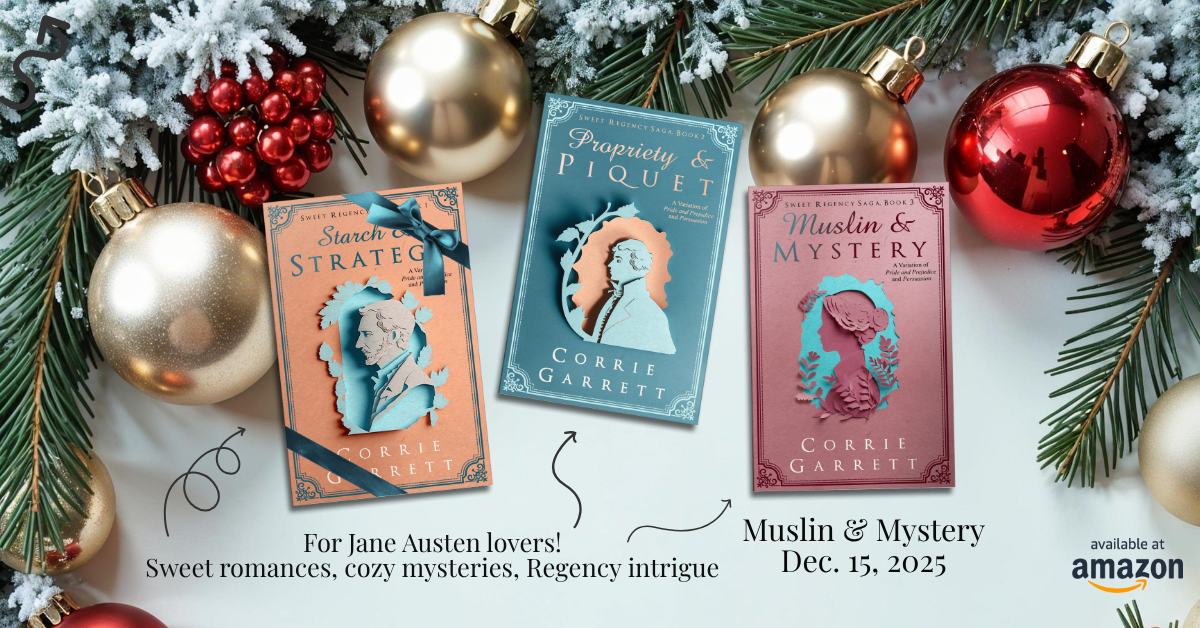
A festive holiday scene featuring three books by Corrie Garrett on a decorative surface with pine branches and ornaments, promoting sweet romances, cozy mysteries, and Regency intrigue.

12 responses to “An Austen for Every Age: A Book for Each Decade of Your Life”

  1. Lois Avatar
    Lois

    Oh I did so relate to this article. I did read somewhere Miss Austen wrote Emma to see if she could write a compelling story based around a character she disliked. I will be keeping this email in my special JAFF folder. Thanks

    1. Corrie Garrett Avatar

      Oh, thank you, Lois! Yes, I’ve heard that about Emma, and it’s amazing Austen could do so much with a character that was so counter to what she valued… I don’t think I have the guts (yet) to write a heroine I don’t like! 😆
      Thanks so much. 🙂

  2. Glynis Avatar
    Glynis

    I’m afraid mine is always P&P. I first read it in my early teens when I chose it as my Sunday School prize in the 60s. I only read the others later in life because I loved that one so much. I did enjoy reading S&S, Persuasion and Emma, Northanger Abbey I liked but I’ve only read Mansfield Park once and I’ve watched two tv versions but I won’t again as I’m not at all fond of that one. If the others are on tv I will usually watch them but I have DVDs of both the 1995 and the 2005 P&P which are possibly almost worn out AND I watch both when on tv or Netflix. Does this mean I’ve never grown up?

    1. Corrie Garrett Avatar

      Good morning! And no, not at all (about not growing up)! 🙂 I can only guess, but it probably means you knew who you were as a teenager and you were right! You’re probably also a very loyal person to those you love.
      I completely agree about the 1995 and 2005 P&P! Those are wonderful. I’d really love a similarly wonderful Persuasion movie to be put out. I like a couple of them well-enough, but none of those movies have the same place in my heart as the P&P adaptations.

  3. Katie Jackson Avatar

    Great points! Really enjoyed reading your perspective on this. I hadn’t considered these books in this way before. Fun to ponder.

    1. Corrie Garrett Avatar

      Thank you, Katie! I hadn’t thought of it this way either, but it was fun to speculate! 🙂

  4. cindie snyder Avatar
    cindie snyder

    I agree with your picks as well, I never thought like that either! Pride and Prejudice is my favorite just because it was the first Jane Austen book I read and opened up her world to me!

    1. Corrie Garrett Avatar

      Yes, Pride and Prejudice is incredible! I think I have the same feeling for Persuasion because that was the first one that I read and it opened Jane Austen to me! I have a soft spot for my first Georgette Heyer novel too (Sprig Muslin).

  5. Alice McVeigh Avatar
    Alice McVeigh

    The trouble with THIS is, of course, that we’re not guaranteed to live to sixty, or indeed to any age beyond our current one… Imagine missing out on PERSUASION because of passing in our fifties, whether by accident or illness, or for some other reason!

    Instead, I prefer putting them in the most accessible ORDER, without specifying any time/age frame. There’s a REASON why P&P is even more famous than Jane Austen (!) so P&P should come first, in hopes of inspiring enough interest to try either S&S or Northanger Abbey next – though, without SOME knowledge of Gothic literature, the latter can puzzle 21st-century readers.

    Personally, I’d gulped them all down by my late teens (not that I truly understood EMMA, M.F. or PERSUASION at all. Still, I promised myself I’d get back to them later, and did.) No great harm in waiting until one’s thirties for these more complex three, but the rest of your timeframe… No. Just no. Have lost wonderful friends in their forties, fifties and sixties. 🙁 It can happen.

    All the best to you, Alice

    1. Corrie Garrett Avatar

      Hi Alice! I apologize if I made it sound like one should *wait* to read any of these books! You’re absolutely right that we don’t know how long we have. It’s presumptuous to assume we’ll have 60, 80 or 100 years. (To paraphrase the Bible, “Who of us by worrying (or reading) can add a single hour to our life?”)

      This was just a thought experiment… but I definitely wouldn’t start a newbie with Northanger Abbey, even though I mentioned it first, etc.

      I really like your accessible order listing!

  6. Cookie Avatar
    Cookie

    I suppose Jane has very few really old people in her novels because not many acquired old age at the time and she was dead by 41 herself.

    People romanticize about the past but you can read between the lines that life was short and you better get on with it, no waiting until your thirties to settle down and have children if you weren’t married and with children by mid twenties then you were on the shelf, no fertility clinics to help you.

    That’s why there is so much happening in relationships so early in life, Lydia married at 16 was normal.

    1. Corrie Garrett Avatar

      That’s a really good point! Jane was so young herself (in my eyes, at least) when she wrote these books. And she died so young at 41, but sometimes I forget that wasn’t that unusual then. Everyone knew they needed to make the time years count. Thanks for pointing that out.

Leave a Reply to GlynisCancel reply

Discover more from Always Austen

Subscribe now to keep reading and get access to the full archive.

Continue reading