
I come very proud Scots. I am from a direct line of Clan MacThomas from the seventh chief of the clan, John Mccomie (Iain Mòr), who has passed into the folklore of Perthshire. Therefore, in my family, New Year’s (or Hogmanay as it was once called) played a popular part of my childhood. Although I admit to overspending at Christmas, something psychological, I suppose, from being raised poor, I am not one to overindulge in either holiday food or drink, other than a bit of plum pudding and a small mincemeat pie for each of the the twelve days of Christmas. However, I find the traditions of New Year’s more fulfilling because beyond the singing and dancing and drinking too much there is something hopeful in the tradition, and, as another new year approaches, I pray it holds bountiful promises for all of us.
 Prior to the Reformation in 1560, Christmas in Scotland, then called “Yule,” was celebrated in a similar fashion to the rest of Catholic Europe. However, the Reformation transformed attitudes to traditional Christian feasting days, including Christmas, and led in practice to the abolition of festival days and other church holidays; the Kirk and the state being closely linked in Scotland during the Late Middle Ages and the Early Modern period. [Christmas in Scotland: Christmas Around the World. World Book. 2001. p. 23.]
In the 1600s, many Scots rejected Christmastide celebrations as Papist excesses. Christmas in Scotland was traditionally observed very quietly, because the Church of Scotland, a Presbyterian church, for various reasons never placed much emphasis on the Christmas festival. Christmas Day only became a public holiday in 1958, and Boxing Day in 1974. The New Year’s Eve festivity, Hogmanay, was by far the largest celebration in Scotland. The gift-giving, public holidays and feasting associated with mid-winter were traditionally held between 11 December and 6 January. However, since the 1980s, with the fading of the Church’s influence and the increased influences from the rest of the UK and elsewhere, Christmas and its related festivities are now nearly on a par with Hogmanay and “Ne’erday.” [Christmas in Scotland] The season’s highlight is still Hogmanay, the Scottish term for December 31 and all the “party” it entails. Indeed, the celebrations are so intense that most businesses remain closed until January 3.
It is believed that many of the traditional Hogmanay celebrations were originally brought to Scotland by the invading Vikings in the early 8th and 9th centuries. These Norsemen, or men from an even more northerly latitude than Scotland, paid particular attention to the arrival of the Winter Solstice or the shortest day, and fully intended to celebrate its passing with some serious partying. In Shetland, where the Viking influence remains strongest, New Year is still called Yules, deriving from the Scandinavian word for the midwinter festival of Yule. [The History of Hogmanay]
 Hogmanay traditions have been adopted by many cultures. Did you realize that Scotland gave us “the bells” that chime in the New Year, the singing of “Auld Lang Syne” as soon as those bells cease tolling, and the taking of a “cup o’ kindness” —or several—in the hours that follow.


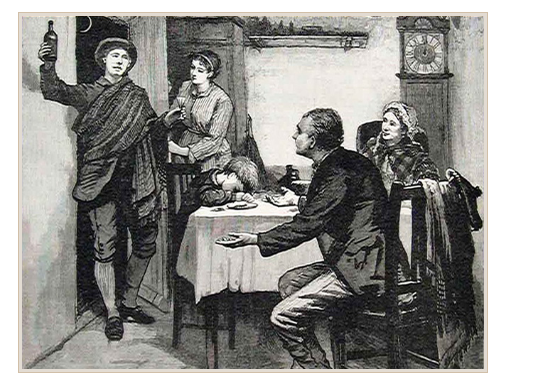
First Footing is also a Scottish tradition, which can still be found on the Isle of Man and in the northern shires of England. In first footing, a tall, dark-haired man is selected to be the first person to cross over the threshold of a home. He brings “good luck” and “good fortune” to the family. He customarily enters through the house’s front door, ushering in his hopes and goodwill for the upcoming year. He would exit through the rear door of the house, taking with him all the ill and lost hopes of the previous year. On his visit, he carries ceremonial gifts—a lump of coal, salt, a piece of shortbread and/or black bun, coins, and a wee dram of whisky—which brings warmth, food, financial stability, luck and prosperity for the coming year.
The preference for dark coloring dates back to the days of the Viking invasion. As Historic UK explains, back then, “’a big blonde stranger arriving on your door step with a big axe meant big trouble, and probably not a very happy New Year!’ (The choice of a man surely has a less surprising explanation: misogyny.) Even on the Isle of Man, ‘a light-haired male or female is deemed unlucky to be a first-foot or qualtaagh.’ Just a silly New Year’s suggestion: If first footing ever takes root on this side of the Atlantic, where Viking invasion has never been a real and present danger, let’s dispense with this part of the tradition and fight racism and sexism by designating blonde headed women as America’s official New Year’s threshold crossers (or better yet, those over 65 years of age, though we tend not to make it to the bell drop on New Year’s Eve anymore).
Traditional Customs and Ceremonies website tells us, “Indeed the earlier accounts record it as a Scottish custom as noted by Chamber’s 1856 Book of Days :
“There was in Scotland a first footing independent of the hot pint. It was a time for some youthful friend of the family to steal to the door, in the hope of meeting there the young maiden of his fancy, and obtaining the privilege of a kiss, as her first-foot. Great was the disappointment on his part, and great the joking among the family, if through accident or plan, some half-withered aunt or ancient grand-dame came to receive him instead of the blooming Jenny.”
A dark night?
Who should be the first footer was always important but there appears to have been virtually countrywide agreement. For example the standard description for the first footer is described in Lancashire:
“a light-haired man is as unlucky as a woman, and it became a custom for dark-haired males to hire themselves out to “take the New Year in.””
 The History of Hogmanay website tells us: “The firework displays and torchlight processions now enjoyed throughout many cities in Scotland are reminders of the ancient pagan parties from those Viking days of long ago.
“The traditional New Year ceremony would involve people dressing up in the hides of cattle and running around the village whilst being hit by sticks. The festivities would also include the lighting of bonfires and tossing torches. Animal hide wrapped around sticks and ignited produced a smoke that was believed to be very effective in warding off evil spirits: this smoking stick was also known as a Hogmanay.
“Many of these customs continue today, especially in the older communities of the Highlands and Islands of Scotland. On the Isle of Lewis, in the Outer Hebrides, the young men and boys form themselves into opposing bands; the leader of each wears a sheep skin, while another member carries a sack. The bands move through the village from house to house reciting a Gaelic rhyme. The boys are given bannocks (fruit buns) for their sack before moving on to the next house.
 “One of the most spectacular fire ceremonies takes place in Stonehaven, south of Aberdeen on the north east coast. Giant fireballs are swung around on long metal poles each requiring many men to carry them as they are paraded up and down the High Street. Again the origin is believed to be linked to the Winter Solstice with the swinging fireballs signifying the power of the sun, purifying the world by consuming evil spirits.”
Additional Resources:
Start the New Year Off Right with Scotland’s “First Footing”


Leave a Reply