

Lyon’s Obsession was the second book in my Dragonblade romantic suspense/mystery series. Each of the heroes in the books are “adopted” sons of Lord Macdonald Duncan, a Scottish lord, who trains them to serve the United Kingdom’s interests. They were each in danger of being killed before they could claim their respective earldoms. [Book 3, Lyon in Disguise will arrive this month on the 17th. Claim it, as well as, Lyon in the Way (book 1) and Lyon’s Obsession (book 2). Lost in the Lyon’s Garden will arrive on March 18, 2026, and the final book, Lyon on the Inside appears on June 17, 2026. They are spaced three months apart.
The hero of the second book was not raised to the aristocracy, though he came from an aristocratic line. His father, the fourth son of an earl, was disowned and set out on his own, but Robert Dutton had no skills to survive in the world. He drops lower and lower until Robert and his family, including young Alexander live in the London slums. Yet, what did that mean?
In the early 1800s, more than 10% of England’s population lived in London. Industrialization and manufacturing drove many city in search of employment. The City’s poor competed for a variety of jobs.
As for the rest, the following comment by George W. M. Reynolds (British writer and journalist) was made 1844, but was equally true in the Regency. “The most unbounded wealth is the neighbour of the most hideous poverty…the crumbs which fall from the tables of the rich would appear delicious viands to starving millions, and yet these millions obtain them not! In that city there are in all five prominent buildings: the church, in which the pious pray; the gin-palace, to which the wretched poor resort to drown their sorrows; the pawn-broker’s, where miserable creatures pledge their raiment, and their children’s raiment, even unto the last rag, to obtain the means of purchasing food, and – alas! too often – intoxicating drink; the prison, where the victims of a vitiated condition of society expiate the crimes to which they have been drive by starvation and despair; and the workhouse, to which the destitute, the aged, and the friendless hasten to lay down their aching heads – and die!”
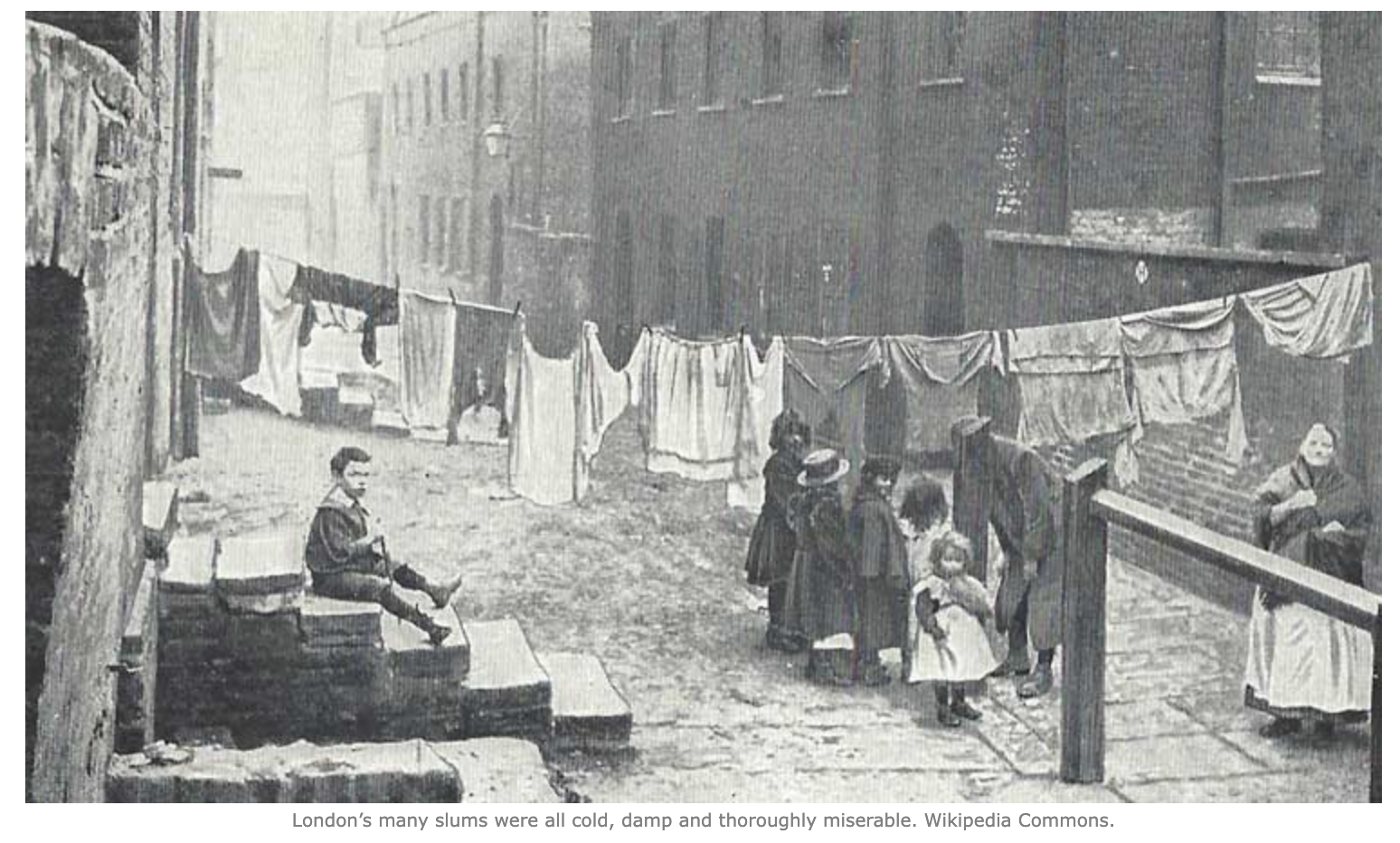
During the Regency era, England’s rapidly growing urban population, particularly in London, led to the development of crowded and unsanitary slum areas known as “rookeries”. These neighborhoods, characterized by poor-quality housing, overcrowding, and a lack of sanitation, became havens for crime, disease, and poverty, starkly contrasting with the opulent lives of the upper classes.
Key Characteristics of Regency Slums:
- Overcrowding: Population growth outpaced housing development, leading to families crammed into single rooms or even cellars.
- Poor Housing: Buildings were often dilapidated, poorly constructed, and lacking basic amenities like ventilation and sanitation.
- Disease and Filth: Sewage and refuse accumulated in the streets, contributing to the spread of disease.
- Criminal Activity: Rookeries became known for prostitution, gambling, theft, and violence.
- Stark Contrast: The slums existed in close proximity to wealthier areas, highlighting the social inequalities of the time.
Examples:
- St. Giles Rookery: One of the most notorious examples, known for its lawlessness and criminal activity.
- Whitechapel: A slum area in the East End, also known for its poverty and dangerous conditions.
Social Impact:
- The conditions in the slums highlighted the social and economic inequalities of the era.
- The rapid growth of slums contributed to public health crises, as diseases spread easily in the unsanitary conditions.
- The contrast between the opulent lifestyles of the wealthy and the squalor of the slums fueled social unrest and reform movements.
Author Carolyn Warfield tells us, “They lived in squalid houses above narrow streets, entire families to a room or two or three, often dependent on crime or the sale of sex for a few coins to supplement whatever casual work they could get from the docks or the sweatshops. Many did not even have a room. Men, women, and whole families lived on the streets, procuring a rented bed in a lodging house for a night or two when funds permitted. The rapid increase in population meant opportunity to some property developers. Already, they were beginning to throw up the tenements on marshy land that became the gruesome slums of Victorian London. In Regency London, though, there was less of a demarcation between slums and and the homes of the respectable working class, between them and the better off merchants and tradesmen, and between the wealthy ‘other sort’ and the upper classes.”

Other Sources:


Leave a Reply to cindie snyderCancel reply