
It’s just over a year since I released Pride and Pursuit, my most recent Pride and Prejudice variation, a caper wherein Darcy steals a carriage… with Elizabeth Bennet inside! On the run for their lives, they need to put personal differences aside as they make all haste for the one place Darcy thinks they will be safe—the Fitzwilliam family’s hunting lodge in Wales.
Once again this year, we spent a couple of weeks in September in the UK, touring around before taking our daughter back to her university for the year, and we decided to spend a bit of time in Shropshire, the part of the country where my husband’s grandfather was from. We wanted to see Ironbridge (worthy of a whole post on its own), the town where his great-grandparents lived, the lovely countryside, and once we were that close, we decided to head into Wales to see the magnificent Pontcysyllte Aqueduct.

Ironbridge and the aqueduct are engineering marvels, part of the huge strides forward in technology that made Britain the driving force of the Industrial Revolution, and part of what made the Regency era such a fascinating time period. But that’s all a whole other set of blog posts. More relevant to my novel, we happened to be in just the part of Wales where Darcy was heading, hoping to find safety from his pursuer within his uncle’s estate’s walls.
The Pontcysyllte Aqueduct is a sight to see. It solves the question of how to continue a canal across a deep river valley. One could, of course, build a series of locks down into the valley and up the other side. Locks, which gradually raise or lower boats by filling and draining large boat-sized “tubs” with water, are simple and effective, but not very efficient, and a series of them would add days to a relatively short journey. Another solution, one proposed by engineer Thomas Telford, was simply to keep the canal where it was and build a bridge filled with water, so the boats could float high above the valley floor! The canal was completed in 1805, and took 10 years to build. Our local public transport service should take note of the relatively fast production schedule.


The aqueduct happens to be a few short miles from the beautiful town of Llangollen, Denbighshire, which features in my story. Of course, we had to visit. Still rather terrified by the narrow and winding British roads, not to mention driving on the “wrong” side of the street, I nevertheless managed to weave my way through the busy streets and with only one wrong turn, find a parking spot! Then, thankfully on foot, we set about exploring a bit.
Well, what an absolute delight! I had no notion that Llangollen was so freaking cute. It’s a really lovely place, nestled on the banks of the River Dee. I had looked at photographs while writing, of course, but had I known how charming the town was, I might have let my characters linger for a while before sending them onwards toward their next stop.


Llangollen takes its name from the Church of St Collen – Llan, meaning churchyard or religious settlement, and Collen, meaning, well, Collen. Collen was a 7th-century monk who established a church along the river at the site. Castell Dinas Brân, a suitably romantic and ruined 13th-century castle, sits on a hill north of the town, and its crumbling walls give the townscape a particular je-ne-sais-quoi. We considered hiking to the castle and back down, but we had a long drive ahead of us and decided to opt for Welsh oggies (pasty-like pies) instead.


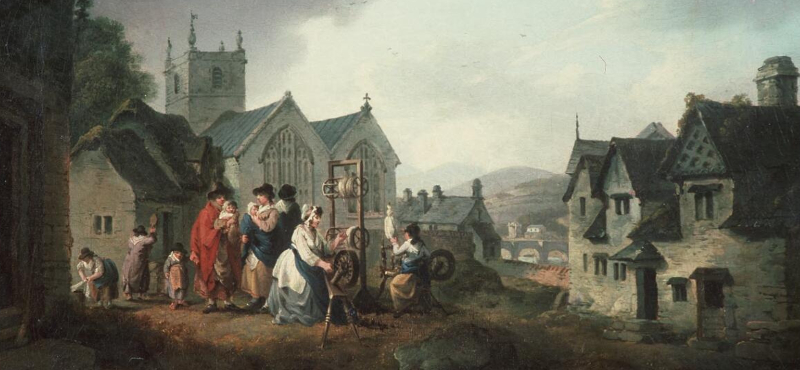
Also coincidentally, I used a painting of Llangollen as part of the cover art for my novel. “The entrance to Llangollen, North Wales” by Julius Caesar Ibbetson, dates from 1792. It’s changed a bit since then!

Please enjoy this excerpt from Pride and Pursuit. Elizabeth is missing, but has managed to send a letter to Longbourn. The Bennets’ new neighbour Mr Bingley has rushed to London to seek help, which has arrived in the scarlet-coated form of Colonel Fitzwilliam. We join our friends in the Bennets’ parlour as they hope to find their missing Elizabeth.

“Mr Bingley has apprised me of this sad situation in which you find yourselves, and I am moved to offer my assistance. I believe I can help. Darcy, you see, is my cousin and a man I am proud to name as a friend.”
“Your cousin!” Mrs Bennet burst out. “Then you believe he could really do such a thing?”
The colonel turned his serious face towards her. “I have learned, Madam, that in the most trying of circumstances, all men are capable of the most unimaginable things. But my cousin is not a man to act rashly, and if he has, indeed, done as your daughter’s letter suggests, I can only believe it was under the utmost duress. Darcy is a man given to serious thought and hides his passions, even from himself. He has the finest principles, and I can assure you without hesitation that if your daughter is with him, he will move mountains to keep her safe.”
Jane’s spine sagged in relief at these words, the first she had heard in two days that offered any hope that her sister would be returned in good health. Until now, it seemed that worry alone had kept her upright. But another dreadful thought soon left her back rigid once more.
“But why would he have done this?” Her voice trembled in her ears. “If he feels such fear that he must steal our carriage and dear Lizzy, is she not in terrible danger as well?”
Colonel Fitzwilliam contemplated her, his dark brown eyes meeting her own blue ones. “What Miss Bennet says has merit. But matters may not be quite as dire as we all fear. I believe I have some notion of the cause of my cousin’s alarm. I also believe I know exactly where he is going.”
There was an onslaught of sound in the parlour, as everybody called out at once.
“Let me explain,” the colonel said when he could be heard. “I cannot divulge the entire story, but allow me to say this. I have heard a rather alarming story from somebody most intimately involved, that a certain person we know from our youth believes my cousin Darcy to have done him out of a great deal of money. He is quite mistaken, but in his misapprehension, he attempted to both steal the money and destroy somebody of great importance to us all. Darcy foiled this scheme, rendering this man furious.
“Wickham is his name, and he has always been something of a scoundrel, but has never been violent. Until now. The… person from whom I had the story recounted hearing him utter threats to my cousin of the most alarming nature.”
He stopped as another wave of exclamations swelled and ebbed in the room.
“I made some inquiries in Town yesterday and requested leave from my general until we find your daughter. We also made a stop this morning as we travelled northward from London, hence our delayed arrival.”
Jane’s alarm grew as the colonel told of Mr Wickham’s mounting debts in Town, and of how he had been heard uttering vile threats against Darcy in his usual haunts. Then, Mr Bingley interjected, they had stopped at the inn at Islington where Mr Darcy had said he would stay the night before Lizzy disappeared. The place where Mr Darcy was last seen.
“The innkeeper told us a dreadful story,” he blurted. “It was in the small hours of the morning, when the world was still asleep. There came a great noise that drew everybody from their beds, and it transpired that somebody had broken in the door to Darcy’s room!”
“But how,” Mary asked, “did that somebody know which room was his?” Mary always kept a cool head.
The colonel took up the tale again. “You have a clever daughter, Mrs Bennet. I asked the innkeeper the same question. He told me that a window was broken, allowing somebody access to the property, and the register was discovered and left open. It appears that Wickham, for Wickham it must have been, discovered the room number and made his way up the stairs to attack whoever was inside.
“The room was quite ruined. Whoever had broken in there must have been fuelled by rage, for everything was destroyed. The innkeeper took us to see it; it was terrible. The mirror, the bedding, all shattered and ripped, the walls damaged in places, furniture in pieces. But of Darcy, there was no sign at all. The window was open, and we found some scraps of clothing where he must have ripped his shirt as he climbed out. If he knew Wickham was coming, he was quite right to be afraid.”
“And, with these words,” Jane’s father observed, “we are to forgive your cousin for relieving us of both our carriage and daughter. And what do you propose we do now, sir?”
“Ah, there I can help.” Colonel Fitzwilliam leaned forward again. “May I see the letter from your daughter, Mr Bennet?”
Jane’s father pulled the missive from a pocket and handed it over. The colonel read it slowly several times before returning it.
“This gives me hope. Llangollen is exactly where I would expect him to go, rather than Pemberley. That, I ought to explain, is Darcy’s estate in Derbyshire. Wickham grew up there; he knows the area intimately. All the back roads and hiding places are an open book to him. It might have been Darcy’s first thought, but he would not risk returning there. With Wickham around and seeking him, Darcy would not be safe there. But Wickham has never been to Coed-y-Glyn, our hunting box in Wales. He knows it exists, but knows nothing of its exact location, or the land around it. Darcy is a smart man, and I am certain that is where he is headed. He knows the land, the towns, and where to hide if necessary.”
“And?” Mr Bennet asked, bushy eyebrows raised.
“And thither we go, at first light, in Mr Bingley’s carriage. Do you join us, sir?”


Leave a Reply to David J BorchertCancel reply