
When I was younger, though my hair was blonde, I would upon occasion use a mixture of Ivory Flakes™ (powdered detergent), peroxide, and bleach. Yes, as in Clorox™. If bleach was good enough for Jean Harlow, it was good enough for the generations that followed her. The bleach was hard on the hair, but the Ivory Flakes made it feel quite silky.
As to the Regency, the following may prove more useful than my teen years.
From the Fashionable Magazine’s October 1787 edition:
There are many simple contrivances to make red, or other “ill-coloured hair”, more pleasing to the sight, by changing it to a black or dark brown, without a possibility of injuring the person even when applied to the eye-brows. Among these may be recommended the roots of the caper-tree or holm-oak; the barks of the walnut-tree, the willow, and pomegranate’ the leaves of the myrtle, the wild vine, the raspberry-bush, the mulberry-tree, the fig-tree, and the artichoke; the green shells of walnuts or beans; and poppy flowers, ivy berries, or red beet seeds.
Either of these articles may be boiled for this purpose in wine, vinegar, or rain-water, with the addition of a little marjoram, sage, betony, balm, or any other cephalic herb; and being strained off, the liquor may be used at pleasure. The usual way is to rub the hair well with the liquid on going to bed. Alum, and most preparations of lead, boiled and applied in like manner, will produce the same effect.
If, after washing the head with spring water, the hair is every day combed in the sun with a comb dipped in oil of tartar, the hair will become quite black in a week’s time. The hair may be moistened with oil of Benjamin, to give it a fine scent.
Here is another. This one is a Recipe for Flaxen Dye For The Hair
Boil a pint and a half of ley prepared from vine-twig ashes; a quarter of an ounce each of turmerick, celandine roots, and briony; one drachm and a half each of lily roots, saffron, and flowers of mullein, yellow stechas, St. John’s wort, and broom. After straining off the clear fluid, use it frequently to wash the hair, which will in a short time change to a beautiful flaxen colour, which may be easily made more or less light at pleasure, by a very little attention to the several ingredients, and such other circumstances as cannot easily escape notice.
The other method of changing the color of hair, and one that was at one time more popular than dyeing as it did far less damage to the hair was using hair powders. These could be brown, grey, orange, pink, red, blue, or violet. Please note, though, that the application of white powder over dark hair produces shades of light to dark grey, not the paper white seen in films and costume wigs. White powder applied over very light hair produces a heightened blond effect. Powder was applied with a bellows (the person was covered with a cone-shape face mask and a fabric smock). They then carried a puff for touchups and a knife for removal.
Note though that the use of hair powder died out very quickly from the 1780s.
There was a dye made from black walnuts that was said to last a while. Though Black Walnuts are native to North America, they have been grown in southern England since the 18th century. This dye stained the hands so one would need someone else to apply it. Black walnut powder is still used today in some hair colorings. However, before you run out and collect the walnuts in your back yard, please know that the black powder also has risks and side effects. There were other hair dyes that were more toxic. Anything that stained the hands like beets and berries could be used with limited success.
There are many web pages about the history of hair coloring, but not all list the materials used to achieve this. There are You Tube videos about using crushed Black Walnut shells.
Also, https://www.cnn.com/style/article/hair-dye-evolution/index.html
Wikipedia Hair Coloring
CNN has a page on hair dyes.
It was not until the Middle Ages in Europe that hair dyeing began shifting into a predominantly female habit.
Bleaches, often made with blended flowers, saffron and calf kidneys, were particularly in vogue, although Roman Catholics associated blond hair with lasciviousness.
Red dyes, often a mix of saffron and sulfur powder – the latter of which could induce nosebleeds and headaches, was popularized during the 16th-century reign of Elizabeth I of England.
From Rainbow to Gray: The Evolution of Hair Coloring https://www.cnn.com/style/article/hair-dye-evolution/index.html
One could also use Ink to have black hair–though an author had her heroine end up with blue hair after a naughty boy threw ink at her.
It depends on how long the disguise was to last.
For a man who could do it, black walnut was probably good. Of course, even in the Regency, some older men were still wearing powdered wigs or powdered hair. Judges were required to wear wigs. Fake hair and wigs were also available for use by men. It might be easier for him to have a wig of a different color. Outside he would always be wearing something on his head.
Due to the association with ruling classes in European monarchies, the wearing of wigs as a symbol of social status was largely abandoned in the newly created republics, the United States and France, by the start of the 19th century, though formal court dress of European monarchies still required a powdered wig or long powdered hair tied in a queue until the accession of Napoleon Bonaparte (1769–1821) to the throne as emperor in 1804.
Women’s wigs developed in a somewhat different way. They were worn from the 18th century onwards, although at first only surreptitiously. Full wigs in the 19th and early 20th century were not fashionable. They were often worn by old ladies who had lost their hair.
During the late nineteenth and early twentieth century hairdressers in England and France did a brisk business supplying postiches, or pre-made small wiglets, curls, and false buns to be incorporated into the hairstyle. The use of postiches did not diminish even as women’s hair grew shorter in the decade between 1910 and 1920, but they seem to have gone out of fashion during the 1920s. In the 1960s a new type of synthetic wig was developed using a modacrylic fiber which made wigs more affordable. Reid-Meredith was a pioneer in the sales of these types of wigs.
Rachel Knowles’ Regency History blog has an excellent article on hair powder if one is interested in learning more.
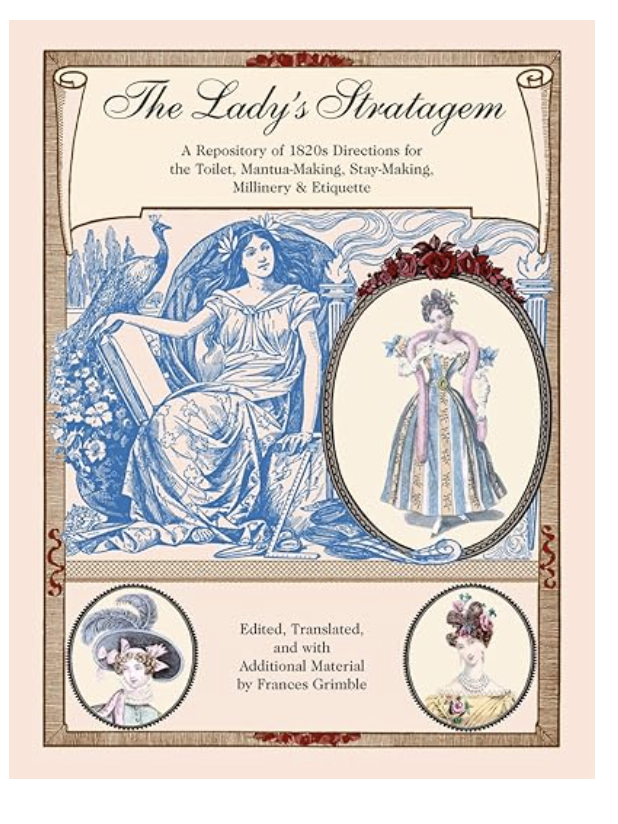
The Lady’s Stratagem: The Lady’s Stratagem: A Repository of 1820s Directions for the Toilet, Mantua-Making, Stay-Making, Millinery & Etiquette, quotes from Duties of a Lady’s Maid (1825, 1829) and the Manuel des dames (1827, 1829, 1833) advises against dyeing hair, noting that commercial preparations, available at perfumers, contain metallic oxides. The Manuel des dames makes a similar point: “You must take care, however, not to burn yourself with it, as it will eat through your skin like a piece of red-hot iron.” The book goes on to offer recipes for making one’s own hair dye, such as using gall nuts, but others include lead ore and steel filings. I can’t vouch for the efficacy of any of the recipes (or receipts), but none are long-lasting.


Leave a Reply to Regina JeffersCancel reply