
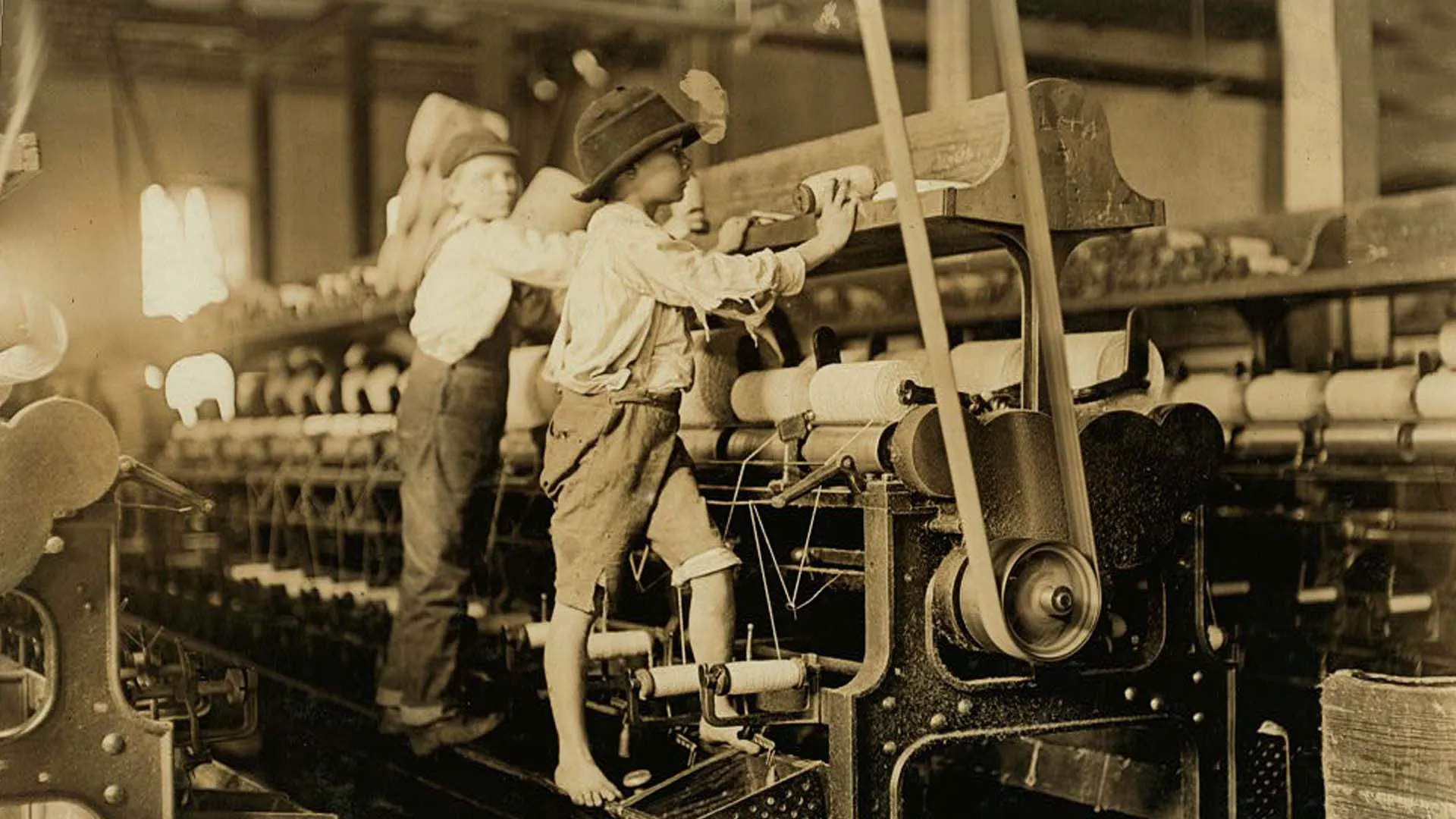
Learn more about child labor laws and reform in England during the early Regency era.
While the drawing rooms and ballrooms of the Regency era evoke visions of silk gowns, glittering chandeliers, and the measured grace of high society, the reality for much of England’s population—especially its children—was far harsher. In the early 19th century, at the height of the Industrial Revolution and before the advent of meaningful labor protections, thousands of boys and girls toiled long hours in factories, coal mines, and workshops, often in dangerous and degrading conditions. Though the seeds of reform were planted during the Regency period, meaningful protections for child workers would take decades to bloom.
Childhood in the Age of Industry
During the Regency (1811–1820), England was a nation in transition: politically restless, militarily engaged against Napoleon, and rapidly industrializing. Demand for cheap, unskilled labor surged, and children—small, obedient, and inexpensive to feed—were considered ideal workers. For many families facing poverty, sending a child to the mill or mine was not a cruelty, but a necessity.
Children as young as five or six could be found working 10 to 14 hours a day, six days a week. In textile mills, they darted beneath looms to tie threads or clear debris—an act that often ended in mangled limbs or worse. In coal mines, boys called “trappers” sat for hours in the dark, opening and shutting ventilation doors, while older children hauled wagons of coal through narrow shafts. Chimney sweeps sent small boys up soot-choked flues, where some suffocated or fell to their deaths.
The Lack of Legal Protection
At the beginning of the 19th century, there were no comprehensive laws regulating child labor, hours, or safety. The doctrine of laissez-faire economics held sway, and many lawmakers believed the state had no right to interfere in business affairs—even where children were concerned.
Criminal abuse and neglect might be prosecuted under common law, but these cases were rare, and the burden of proof high. In most industries, discipline by beating, starvation, or public humiliation was accepted, even encouraged, as a way to manage juvenile workers. Many children lived at the mercy of their employers, particularly pauper apprentices—orphans or poor children handed over to factories by parish workhouses, often with no oversight.
Even in rural settings, children worked long hours as domestic servants, agricultural laborers, or apprentices in trades. Physical punishment was considered normal, and few legal avenues existed to challenge mistreatment unless it resulted in death or permanent disability.
Early Voices of Reform
The moral and humanitarian awakening that would drive reform began during the Regency, though it was limited in reach and influence at the time. Evangelical Anglicans and utilitarian philosophers alike began to question whether the unchecked exploitation of children was compatible with national progress.
One of the first meaningful laws came just before the Regency, in 1802, with the passage of the Health and Morals of Apprentices Act (sometimes called the Factory Act of 1802). Proposed by Sir Robert Peel, a mill owner and MP, the law aimed to protect pauper apprentices in cotton mills by limiting their working hours to 12 per day, mandating basic education, and requiring factory owners to provide clean clothing and dormitories.
However, the Act was rarely enforced. It applied only to apprentices, not to children hired directly by their families, and there were no government inspectors to ensure compliance. It was, in many ways, a law in name only.
Other figures, such as Lord Shaftesbury, would later take up the cause of factory reform in earnest, but during the Regency itself, little more than philosophical groundwork was laid.
Public Perception and Literature
Despite widespread child labor, public sentiment was slow to stir. Middle- and upper-class families were often unaware—or indifferent—to the conditions in factories and mines. The working child was seen as a social inevitability, a stepping-stone to adult employment.
Yet seeds of sympathy were being sown. William Blake’s Songs of Innocence and Experience (1794) includes “The Chimney Sweeper,” which portrays the brutal life of young sweeps with piercing irony. Later authors like Charles Dickens, himself a former child laborer, would give voice to this forgotten class in the Victorian era. But during the Regency, literature and law alike largely ignored the plight of the working child.
A Slow Turning of the Tide
Though the Regency era itself produced only modest legal steps, it formed the cultural and political backdrop for more significant change. The outrage that followed the Peterloo Massacre in 1819 helped galvanize the reform movement and increased pressure for greater representation and protection for the working class. In 1833, Parliament passed the Factory Act, finally banning the employment of children under 9 years old in textile mills and restricting the hours of those aged 9 to 13. It also introduced factory inspectors, marking the first real step toward enforcement.
In this way, the Regency was not an era of resolution, but of reckoning—when England began to ask uncomfortable questions about the cost of its industrial greatness and who, precisely, was paying it.
The glittering façade of Regency England concealed many dark corners, and none were darker than the world of child labor. With minimal protection and virtually no recourse against abuse, working children endured conditions unimaginable by modern standards. Yet even in this time of neglect, the first embers of reform were lit. The story of child labor in the Regency era is not only one of suffering—but of the slow and necessary awakening of a conscience.


Leave a Reply to Alice McVeighCancel reply