
Darcy stood silently, admiring the fearless way in which she approached the large, spirited animal. Many women were afraid of him, and indeed he seemed to tower over Miss Bennet. “Miss Bennet, I am glad we met this morning,” he began.
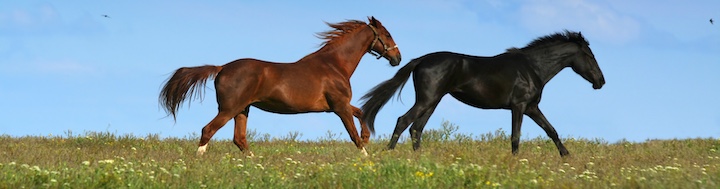
Last May, I introduced you to two couples of deerhounds, one pair at Pemberley, the other at Netherfield. I think it’s high time I invited you to the stables to meet one or two of the favorite horses of my imagination. I should point out something at the outset. Many authors imagine Elizabeth to be afraid of horses, perhaps due to some accident in childhood or to her avowed preference for walking. The Elizabeth of my imagination is perfectly at home with horses—the draft animals at Netherfield or the horses belonging to her neighbors. She enjoys riding and is not averse to mucking out a stall, conducting a rubdown and hoof inspection, or serving up hay, oats, or crunchies. In the course of “Rose Cottage,” Darcy needs a riding horse due to his long stay at Netherfield. He has brought along his favorite grey, a tall stallion named Sirdar. “Sirdar” is an Arabic term for a military commander in chief.
Rose Cottage and Sirdar
The introductory paragraph describes the meeting between Elizabeth Bennet and Darcy’s favorite horse. Despite his size and his value, Sirdar has been well trained by Darcy and is the favorite for journeys on horseback as well as rides in London and around Pemberley or whatever farm Darcy is visiting. Darcy meets Elizabeth on the way to Meryton and is delighted by her calm and affectionate reaction to his horse. It is not long before the two of them are communicating through the horse, their observations carrying both obvious and hidden meanings. In an initially lighthearted game, Darcy serves as “interpreter” between Elizabeth and Sirdar, relaying his idea of Sirdar’s responses to a “conversation” between Elizabeth and the horse. The fact that Elizabeth is so well accepted by Sirdar is an advantage.
It is not long before Sirdar begins to inhabit the couple’s dreams about each other. He appears first in Darcy’s dream/nightmare about finding Elizabeth in the midst of an angry crowd. The dream horse assists Darcy in rescuing her, carrying them both off to a safe place.
In real life, Elizabeth, out for one of her brisk walks, has an accident which appears to be serious. She and Darcy have arranged to meet for an early morning stroll, and Elizabeth, en route, turns her ankle on a stone in the roadway, spraining it and striking her head as she falls to the ground. Darcy and Sirdar, waiting at the arranged meeting spot, become anxious and hurry forward in search of her:
She balled her fists pugnaciously as if daring some unknown opponent to argue with her. Her hair had come loose from its pins, and loops of it fell annoyingly over her face. She shook her head angrily and was assailed by a new wave of pain.
In the meantime, Mr. Darcy and Sirdar had arrived at the meeting point. Both man and beast looked expectantly up the lane for a sight of the woman they both adored. Sirdar’s affections were quite simple. She never failed to bring him a tasty apple or carrot, she spoke in soft and soothing tones that did not set his nerves on edge, and she knew all the best places to pet him without being asked. She also stood where he could see her, a fact he appreciated. His aspirations extended only so far as another agreeable encounter, another tasty tidbit, and further soothing attentions to his head and neck. He also realized, dimly, that should he ever find her mounted on his back, he would be more than happy to carry her safely to the ends of the earth or wherever else she might wish to go.
As we have seen, the man’s affections and wishes were far more complex and extensive. He resolutely pushed gloom aside, refusing to believe that she had deliberately avoided him. Her warm smile the evening before had been as good as a promise, had it not? She had most likely been detained at home and was even now walking briskly to meet him.
Darcy and his horse did not tarry long. He resolved to ride ahead to meet her, fully expecting to encounter her on the lane. They proceeded at an easy pace with that idea in mind. He was, therefore, startled to discover her lying in a small, dazed heap by the side of the road.
Sirdar carries Elizabeth home on his back, carefully, and makes himself useful alongside Darcy in running the numerous errands associated with the mishap. Later in the book, Darcy will present Elizabeth with Noor, a mare whose name means “Light.” The two are able to find peace and a bit of respite from all the goings-on at Longbourn and Netherfield, and it is my hope that eventually the humans and horses enjoyed many rides and outings at Pemberley.
The Mudlark and Boots
The Mudlark remains a work-in-progress, and I remain determined to finish it. It features quite a different Lady Catherine De Bourgh, and a very fine horse named Boots. The early action of the story takes place during a widespread smallpox epidemic. A young Lady Catherine has suffered the terrible double loss of her husband Lewis and their infant daughter Anne. An unnamed threat hovers over Rosings, and Lady Catherine finds it necessary to reach out for help regardless of the raging epidemic. She has just summoned her butler to issue a series of orders involving a fast and clandestine trip to deliver papers to her solicitor in London:
She held up the package. “Can you suggest a reliable man from among our best?”
Summers paused for only a moment. “Jeremy Thomas, my lady. He is commonly called Jem. He is the second senior groom and has been at Rosings for five years. He has survived the smallpox, though he was made an orphan by it, and he received a good education at the school in his parish. As a boy, he served as tiger and then stable lad to the late Marquess of __, so he has an excellent exposure to the various districts of London, and he will not lose himself in the metropolis.”
“Excellent. Leave word with Agnes that I am to be awakened at half-past four. You, Mr. Summers, bring Jeremy Thomas to me at five. No word of this must be spoken to anyone. Not a living soul, especially the Earl. See that Jeremy has a purse with ample funds and pack a saddlebag with plenty of food and drink for his journey. If all goes well, he should be able to return here by late tomorrow evening. In case of dire necessity, he may stay at the town house. Write a note to Mrs. Husted and instruct her to give him meals and a comfortable bed within the house. He must ride Boots.”
“The master’s favorite, my lady?”
“Just so, Mr. Summers.” It was an open secret in the stables at Rosings that the gelding, Boots, was Pegasus in disguise. To strangers, he resembled nothing so much as a mule—an ugly, wrong-footed mule. Yet he could run like the wind, and his strength and endurance were legendary among those who knew him. Catherine’s husband had loved him, and the horse had returned the affection. She allowed herself a sigh and continued. “He looks like a poor man’s horse, but he will get the job done. Just be sure this is kept perfectly quiet. Construct some story about sending Jeremy on an errand. If the servants should gossip, or if the Earl should get wind of this, all will be lost.”
“Understood, my lady. Cook is already abed. I shall see personally to Jem’s saddlebag and purse before I retire, and I will alert Agnes to awaken you in the morning. If he is on his way before six, none of the other servants, including those in the stables, will learn of this.”
“Thank you, Mr. Summers. Good night.”
It did not take me long to find a real horse to serve as model for Boots. He is patterned after the Triple Crown winner, Seattle Slew. Slew was not known for his good looks, and the word “mule” was used to describe him from time to time. As a young foal, he was given the nickname “Baby Huey.” He did not look like much, but his appearance was outshone by his determination, pride, and amazing speed. He was the tenth U.S. Triple Crown winner, achieving his championship in 1977.
As I write about Boots, I keep Slew’s description always in mind. As my story progresses, he will become instrumental in saving the Darcys of Pemberley as well as Lady Catherine at Rosings, carrying his rider, Jem, swiftly and reliably through the countryside.
Horses and humans were intimately connected for millennia, and they were certainly a necessity for our characters as they moved through their daily lives. Sirdar and Boots are the products of my imagination, based on that traditional and close relationship. Each has his own valuable traits, and I took some care in developing their descriptions. As with the dogs, they have become characters in my stories, each with his tale to tell. In a later post, I will introduce Mamacita, also known as Willow, a very ordinary cat with an exceptional tale to tell.


Leave a Reply to cindie snyderCancel reply