
In January of this year, after having 4 barometric migraines in 5 days, I found myself on the floor in my library, vomiting into the trash bin. For the next two weeks, I was told I had positional vertigo, but they didn’t want to treat it beyond medications to control the dizziness and nausea until they determined it wasn’t neurological. My husband, being the fixer that he is, bugged the administrative staff at the doctor’s office until they printed out directions for the Epley Maneuver and we did it ourselves. (Yes, we looked it up on YouTube, but the directions they provided were clearer and more effective.)
During this time, I wondered what my fate would have been if the year had been 1812 instead of 2025 (a common ponderance in my profession). There are multitudes of blogs regarding medical treatments in the Regency era—many on Always Austen—but I was in no condition to read them at that time. Now, with An Interrupted Proposal published and me looking for topics to share with you, I decided to revisit this topic. Well, that and another plot bunny hit me last night (immediately following another vertigo attack).
For those of you who have never had a vertigo attack, I will try to explain it. Basically, it is a false sense that everything around you is spinning or moving. It feels like you are in a funhouse to a degree—but it isn’t any fun. The causes and severity can vary. My vertigo was positional (BPPV). Everyone has tiny calcium crystals in their inner ear. These are normally attached to the “wall,” but when you have positional vertigo one or more of them has broken away and is floating around in the fluid, throwing everything off. The Epley Maneuver I mentioned, (which wasn’t discovered/invented until 1980!) has the patient change and hold positions in a specific order to get the crystals back against the wall. One other symptom of vertigo is nystagmus (rapid, involuntary, rhythmic eye movements). My husband, a retired federal police officer, used the drunk test on me to see if my eyes would follow objects. I failed miserably. They were jumping all over the place.
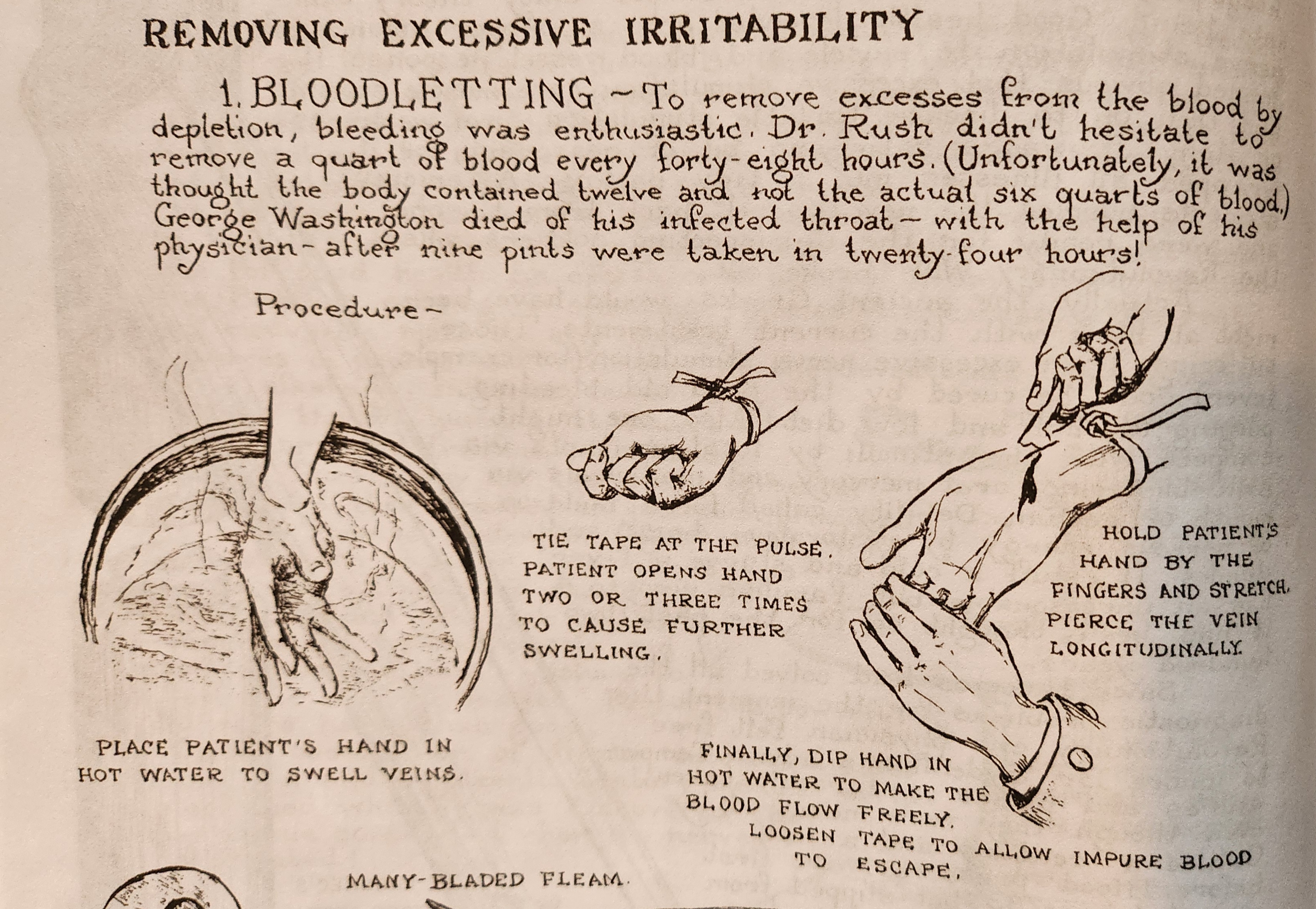
What I learned from my quick dive into the internet was basically that in 1812, if you had vertigo, good luck. Although there were many changes to health care in the 1800s, most came later in the century. During the Regency era, most conditions were attributed to “miasmas” (evil airs), and the treatments were to balance the humors by bloodletting, purging, etc. Vertigo was basically considered a brain disease or mental illness. Imagine you have a patient that can’t walk straight, is vomiting, and their eyes are twitching all over the place. Yeah, Bedlam here they come. Actually, I was a bit distressed to read that the definition of vertigo is still inconsistent amongst the experts.
If you want to read more about it, I have listed a few sources at the bottom of this blog. But now, here is a scene that I wrote (not the one that came to me last night, but one that would have been the catalyst for that one 😉).

Lizzy Bennet looked over her shoulder to see if John Lucas was still far enough away for her to hide before he could catch her. She was only steps away from the stables, but he was already rounding the orchard wall. If she didn’t run faster, he would see which direction she turned. Pumping her arms as fast as she could, she turned the corner . . . then everything went black.
The ringing in her right ear caused her to squeeze her eyes closed against the pain, and the earth beneath her seemed to dip and spin. A moan escaped her lips just before she flung herself on her side and emptied her stomach. This sudden movement only made her feel worse and she heaved again and again.
“Get the master!” she heard, but she couldn’t open her eyes to see who had said it. “And Mrs. Hill!” was added at a louder volume and she realized it was Pete, the stable master. “Now, now, Miss Lizzy. Just you be calm. Help is comin’.”
A tear rolled down her cheek. She dared not say a word or move a muscle for fear the world might turn the opposite direction and she was just starting to become accustomed to its current motions.
“What happened?” she heard her father bellow and felt him drop to the ground beside her. A cry escaped her as he began to gather her in his arms and the retching began again. “Lizzy?” he whispered. “What happened?” he demanded once more from those around him.
“Miss Lizzy was runnin’ towards the stable, lookin’ over her shoulder, then she turned and ran right into it, she did. Wasn’t looking where she was goin’ and runnin’ like the wind.”
“I saw that Lucas boy behind her, but he took off home when he saw her fall.”
“Hill,” her father called, a hint of desperation in his voice.
A moment later, her father moved from her side and Lizzy felt their housekeeper’s warm steady hand upon her shoulder. “There, there, Miss Lizzy. What have you gotten yourself into now?”
She wanted to shake her head or say something, but she was too scared. Instead, she just let the tears run from the corners of her eyes as a quiet whimper escaped her.
“Now, now. I know it hurts, but you have to open your eyes for me, Love. I need to see those beautiful brown eyes.”
Cautiously, she opened her eyes and tried to focus on the comforting face hovering above her, but the world decided to reverse direction, and she felt as though she was tilting with it. Slamming her eyes closed, she moaned and clutched her stomach.
“Her eyes,” she heard a groom whisper.
Hill just tsked and ordered everyone back to work. “Miss Lizzy will be well, but not with everyone hovering over her.”
“Should I carry her inside?” her father asked.
“It’s gonna make her feel worse.” Hill’s hand settled on Lizzy’s stomach, like it was holding her in place while everything tried to throw her around. “Best if she settles a bit first. Perhaps a bit of water.”
Lizzy could hear her father’s steps as he walked away. “Hill?” she whispered.
“Hush now, Miss. You might feel this one for a while. Just lay there and be still.”
Mr. Bennet returned, and Hill held a wet handkerchief for Lizzy to suck on, rewetting it several times. Eventually, the earth calmed down and Lizzy was able to open her eyes, but she still had no desire to turn her head or sit up.
Hill tsked again. “Close your eyes, Child. Your father and I are going to let you rest here a minute. Just be still.”
Laying as still as she could, Lizzy tried to hear what was said but was only able to catch the word “wiggling.” She felt so very tired, and she just wanted to roll on her side and go to sleep. Maybe she would feel better if she did. As carefully as she could, she turned her head, but the earth didn’t like that, and everything dipped and swayed again.
“No, no, Lizzy,” her father cried, and he and Mrs. Hill were by her side again. “We cannot leave her lying in the yard. I must carry her inside.”
With another tsk, Mrs. Hill agreed but insisted he take her straight to Lizzy’s room, so they did not have to move her more than once. Mr. Bennet whispered an apology as he gently lifted her from the ground. Lizzy wrapped her arms around her father’s neck and clung to him as he moved her inside. Soon, she was settled in her bed, laying on her side with a cool rag on her head and a chamber pot close by.
“Keep your eyes closed, Miss Lizzy, and try to lay still.” Hill patted her arm. “Sarah is right here if you need anything.”
The maid’s cold fingers squeezed Lizzy’s hand. “Don’t you worry, Miss Lizzy, Mama will see you right as rain.”
A bellowing could be heard as the door opened and closed, and Lizzy opened one eye. “Momma?”
“The Mistress wants Mr. Bennet to call the apothecary, but he won’t do it. Mama don’t hold with none of that bleedin’. Just makes you weaker, she says.”
“Hill’s medicine tastes better, too,” Lizzy whispered as she drifted off to sleep.
***********

“Miss Lizzy,” she heard as she slowly came awake. Her eyes blinked open and Mrs. Hill was looking at her with a pleasant smile. “Do you feel better, Sweetling?”
Lizzy nodded and the world only shifted a little bit, allowing her stomach to just dip and not flip.
“Let me see your eyes, Love.”
“Why?” she asked as she looked up at the woman.
“To see if they are still moving about.”
“Moving about?”
The housekeeper chuckled. “You’re feeling better. You’re asking questions again.”
“Were my eyes moving about?”
“They were. You hit the stable wall mighty hard. Best to look where you’re going and not where you’ve been in the future.”
“How were my eyes moving? I wasn’t moving them?”
“No, you weren’t, but they were wiggling like you do when you’re supposed to sit still.”
A soft giggle escaped her. “My tummy feels better.”
“Are you hungry, then?” Hill asked. Lizzy nodded. “Let’s sit you up and you can have some toast and tea. Move slow now.”
For the next week, Lizzy alternated between moments of debilitating dizziness and slight nausea. Any quick movement set her back, and the normally rambunctious child was forced to be still far more often than she liked. Worse still, her eyes refused to focus for any length of time, so she was unable to read or draw or sew (well, maybe that was not so very bad). Her sisters took turns amusing her and her father allowed her to sit in the garden on her good days.
The Lucases came to visit, and John apologized for chasing her, but Lizzy accepted the blame for her accident. They were playing a game, so it was only her fault for not looking where she was going. Eventually, she began to feel more normal and was able to read and draw and sew again. She tried to be mindful of her surroundings at all times and always kept her eyes ahead. Though she sometimes had dizzy spells, and once in a while a bit of nausea, they were never as bad as that first occurrence.

I hope you enjoyed this little scene. Not sure what I might do with it right now as I have a few others ahead of it but thought I’d share.
Here are those sites I said I would share:
Origins of Vertigo – https://acnr.co.uk/articles/origins-of-vertigo/
The History of Bloodletting – https://bcmj.org/premise/history-bloodletting
Regency Medicine – https://randombitsoffascination.com/2017/03/04/rename-a-touch-of-consumption-by-kyra-cornelius-kramer/
Apothecaries in Georgian England – https://pmc.ncbi.nlm.nih.gov/articles/PMC2663976/


Leave a Reply