
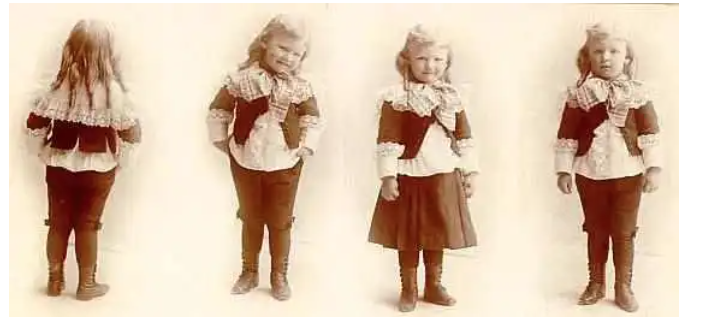
Before the 20th Century, clothing for boys and girls lacked “gender” distinctions. Up until the 16th Century, both males and females worn some sort of gown or tunic. However, eventually, male and female clothing became more distinct. Boys and girls in the past both wore “gowns.” Many pictures, especially as photography developed after 1840, show little boys in what modern day standards would term to be a “dress.” However, we must remember, the clothes were made for “children,” not for “boys” and “girls.”

Up until the early 18th Century, people believed swaddling a baby was necessary to straighten and support a newborn’s arms and legs. It was not until theorists such as John Locke and many in the medical field began to criticize “swaddling” did the practice go out of favor. In Locke’s Some Thoughts Concerning Education, he advocated for freer movement for children.
By the early 1800s, babies were taken out of swaddling around 3 months of age and put into “slips,” which were long linen or cotton dresses with fitted bodices and full skirts that were several inches longer (many up to a foot longer) than the child’s height. These “dresses” were referred to as “long clothes.”

As children learned to first crawl and then walk, they wore “short clothes.” These were ankle-length skirts, called petticoats. These short clothes had a back opening bodice, which was generally boned or stiffened. Girls wore this style until they were in their early teen years. Boys wore it until they were somewhere between four and seven. The decision to “breech” the boy was nearly always that of the wife. Many of whom saw no reason to change their son’s clothes until they were older. The more masculine the boy appeared often was the deciding factor. “Breeching” was a rite of passage for a young boy.
Basically, children wore the long slip dress from birth to five or six months of age. “Frocks,” an ankle-length “slip dress” replaced the stiffened bodices and petticoats of the 1760s. During the latter part of the 1700s, clothing for older children became less restrictive.

This change affected little boys more than little girls. When a boy was “breeched,” he no longer wore the petticoats of childhood. He would be permitted to wear the adult style clothing of his station in life. They wore more relaxed versions of adult clothing, beginning about age 6 to 8 years. They wore looser-cut coats and open-necked shirts with ruffled collars-until their early teen years. Also in the 1770s, instead of the more formal bodice and petticoat combinations, girls continued to wear frock-style dresses, usually accented with wide waist sashes, until they were old enough for adult clothing.
“These modifications in children’s clothing affected women’s clothing-the fine muslin chemise dresses worn by fashionable women of the 1780s and 1790s look remarkably similar to the frocks young children had been wearing since mid-century. However, the development of women’s chemise dresses is more complex than the garments simply being adult versions of children’s frocks. Beginning in the 1770s, there was general movement away from stiff brocades to softer silk and cotton fabrics in women’s clothing, a trend that converged with a strong interest in the dress of classical antiquity in the 1780s and 1790s. Children’s sheer white cotton frocks, accented with waist sashes giving a high-waisted look, provided a convenient model for women in the development of neoclassical fashions. By 1800, women, girls, and toddler boys all wore similarly styled, high-waisted dresses made up in lightweight silks and cottons.” [History of Children’s Clothing]

Historical Boys’ Clothing ~ Some mothers sought to preserve images of breeching their sons. This mother had her son photographed in his Little Lord Fauntleroy suit which he initially wore with a skirt. When she decided to breech him, she then had him photographed wearing both his Fauntleroy dress and then in his new knee pants. Notice how lovingly she had laid out his ringlet curls so they show to best advantage in the photograph. This mother has decided to breech her son before having his curls cut.


Leave a Reply to GinnaCancel reply