
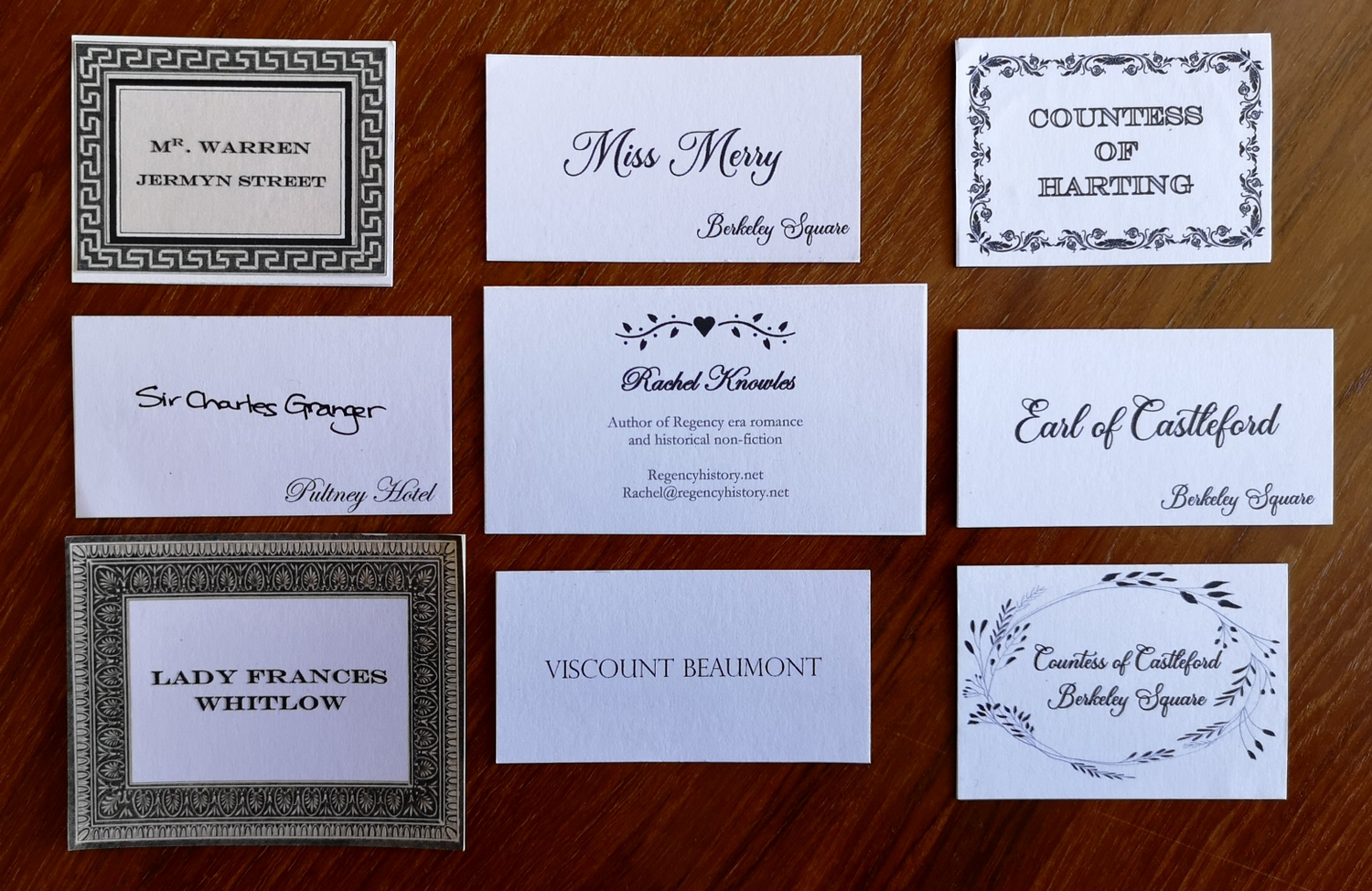

One tradition that has been kept, and for the better, is the calling card, though it is now the business card. As I was designing one, I wondered more about the calling cards of the Regency. One fun fact is that the lady’s card was actually a little larger than a man’s.

There were so many rules to these cards and who was to receive one, one for each person of the house a gentleman intended to visit, folding the corner if a young woman was not at home to indicate a gentleman caller had come in person. And that women would, once introduced by the men of their houses, be allowed to expand their social circle and call on the ladies new to a neighborhood or their circle of acquaintances.
To leave a card was expected. To not have a card, or to not give a card, was considered a slight to the person and, perhaps, a whole household. When calling, it was necessary to present a card, even if only one gentleman or lady was present, for the servant would then present the card to the one being called on. It was then decided if the caller should be shown to a room of the host/hostess’ choosing or it would be left on the silver plate by the door.
Regency cards had both the name and address of the caller. The more expensive the quality of the cardstock, the greater the impression. Savvy individuals wanting to portray having wealth they could not claim but wanted would spend more for a card stock that helped them seem of a higher class. Still, the address on the card was equally important. No one in London would be fooled that a peer lived within three miles of the area known as the Seven Dials.
Hoban Cards, one of the sources, has a piece with the history of the calling cards, and some are too elaborate. They are almost garish, and I am rather glad it was not one of the Regency’s collections. However, you can see them and order cards from the site at the source link below. The Victorian era would see a great difference in the calling card with the advancement in printing and with the use of color. I have added an example here.

The one I chose is a mix of the two eras, the beauty of the Regency and the colors of the Victorian era, and, if simple, I think it blends the two beautifully sans the home address.

What kind of design did you use for your calling card? Or, if you do not have one, what would you choose to have on a card to represent you?
Sources for The Weight Your Calling Card Holds
Staple Photo: Facsimile Regency visiting cards with a modern business card to show relative sizes (Rachel Knowles’s experimental history 2022)
Vic “Calling Cards in Sense and Sensibility and Persuasion” Jane Austen’s World, April 9, 2008 Calling Cards in Sense and Sensibility and Persuasion | Jane Austen’s World (janeaustensworld.com)
Green, Clarie “Calling Cards and Visiting Cards: A Brief History” Hoban Cards, September 12, 2016 Calling Cards and Visiting Cards: A Brief History – Hoban Cards
Grace, Maria “Morning Calls and Formal Visits: Socializing in the Regency Era” English Historical Fiction Authors, August 10, 2013, English Historical Fiction Authors: Morning Calls and Formal Visits: Socializing in the Regency Era (englishhistoryauthors.blogspot.com)
Knowles, Rachel “Visiting cards in the Regency” Regency History, June 1, 2022 Blog | Regency History
Regency Reader “Regency Culture and Society: The Etiquette of the Call” Regency Reader, Regency Culture and Society: The Etiquette of the Call – Regency Reader (regrom.com)
6 responses to “The Weight Your Calling Card Holds”
I don’t know. My calling card would probably have roses and maybe a pic of a dog, because I love both of those things. Or maybe a pic of a book somehow incorporated into it. Who knows it seems there are tons of possibilities!
It was a really cool process for me, and, of course, led to so many other thoughts, as is expected. But it was a lot of fun. Even if you don’t buy them, go through the effort to make one, I think you’d have a blast!
When my children were very young, I printed up a few cards – almost a joke – that said “Johnny’s Mom”, with my name and phone number in small print below. We all knew each other by the kids’ names, after all.
Now I have a business card with my author info, but I also designed a calling card (matching ones for me and my husband) with Art Deco designs and fonts, just name and email. They’re a lot of fun to make.
That is so hilarious! Johnny’s mom cards, because it is true, we parents know one another by kid’s names when they are young. How fun! And cards for you, as well as matching ones for you and the hubby? I love that!!!
I tried to follow the links you provided to additional material, but they all came up blank.
Thank you! I will see what happened, though I did make this some months ago, I will be sad if other sites had changed as I always want to give proper credit!