
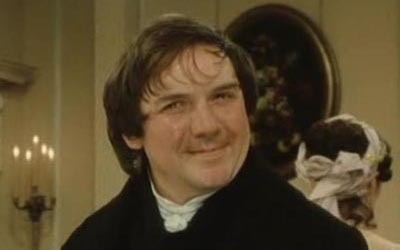
Oh, Mr. Collins. We all think you’re a fool. Why are we so hard on you?
It might be because of the novel’s narrator, who doesn’t hold back. Here are some of the ways the omniscient narrator describes Mr. Collins:
Weak headed
Not a sensible man
Possessing a stupidity with which he was favoured by nature
Conceited
Full of pompous nothings
(That last one is a little funny.) For many years, I laughed at Mr. Collins along with the narrator, never questioning her pronouncements. After all, don’t we all feel that the narrator is Jane Austen? Every English teacher tells us, No! The writer and narrator are not the same! But every reader goes ahead and equates them anyway.
But now I’m wondering, what if the narrator is just a narrator? And what if maybe, just maybe, there are things to like about Mr. Collins? For this post, I’m stripping away my prejudices and taking a judgment-free look at the clergyman.

The other characters are too hard on Mr. Collins.
The narrator isn’t the only one who judges Mr. Collins, but maybe we shouldn’t adopt the characters’ opinions so easily.
Let’s start with Mr. Bennet. Before he even meets the clergyman, he confesses he has “great hopes” that Mr. Collins will not be a sensible man. He says:
There is a mixture of servility and self-importance in his letter which promises well. I am impatient to see him.
Here is Mr. Collins, visiting his estranged family, hoping to mend the breach, while his host is…looking forward to laughing at him. If this is how Mr. Bennet treats a dinner guest (and cousin) who comes offering an olive branch, then I’m not sure his is an opinion we should trust.

Let’s switch to Elizabeth. Here’s what she has to say about the clergyman:
Mr. Collins is a conceited, pompous, narrow-minded, silly man.
Yikes. No wonder we look down on him. But why are we trusting Elizabeth’s assessment? Isn’t the point of the novel that she has prejudices to overcome? We’re supposed to question her judgments, not adopt them.
Plus, she treats the clergyman as poorly as her father (most likely because of her father). When Mr. Collins is proposing to her, the clergyman says that he is run away with by his feelings for her. OK, we know that’s not true, but the guy is trying. Here’s Elizabeth’s response:
The idea of Mr. Collins, with all his solemn composure, being run away with by his feelings, made Elizabeth so near laughing that she could not use the short pause he allowed in any attempt to stop him farther.
He is mid-proposal, and she’s laughing at him! I get it. Mr. Collins botches this proposal. But I’m not sure there’s any world where it’s okay to laugh at someone while he’s asking you to be his life partner. I love you, Elizabeth. But this was cruel.

Clearly, the other characters’ are unfairly prejudiced against the clergyman. Now let’s check out Mr. Collins’ good qualities. (Yes, they are there!)
Mr. Collins is polite.
When he visits Longbourn, he compliments Mrs. Bennet on her beautiful house and daughters, and when he inadvertently offends her by suggesting one of her daughters cooked the meal, he is quick to apologize.
When he meets Mrs. Phillips, he is again full of praise, calling her an “elegant woman” and admiring her house.
He might be annoying, but he tries hard to be a good guest. Contrast this with Darcy, who…doesn’t. If I’m throwing a dinner party, I might prefer the gracious and eager Mr. Collins over a sullen Darcy, who, for all his money and looks, isn’t going to keep the conversation flowing. (Unless we’re saying it’s Colin Firth coming to my house?—in which case, I’ll find a way to work with the moody silence.)

He’s not a sore loser.
At Mrs. Philips’ dinner party, Mr. Collins loses every point at Whist. This worries Mrs. Philips, who thinks he might be upset with her, but Mr. Collins remains in good spirits. He reasons that he played a game of chance, so he had to be prepared to lose. Be honest here: How many people do you know who can lose every point in a game and still walk away happy? Mr. Collins can, and that’s rare.
He’s forgiving.
When he chooses a book of sermons to read aloud (since, well, he is a clergyman), Lydia interrupts him. Mr. Collins is quick to understand that his cousin is bored by him. Is he upset? No. He says a few annoying things—he is Mr. Collins, after all—but then he drops the book, says he bears “his young cousin no ill-will,” and goes off to play backgammon with Mr. Bennet. Even Mr. Bennet agrees that this was a good judgment call. Lydia is rude, and he forgives her instantly.
Later, after he marries Charlotte and welcomes Elizabeth as a visitor, we again see this lack of resentment. He could be angry at Elizabeth’s earlier rejection of him, but instead he’s an attentive host. When she leaves, he wishes her well, telling her:
Let me assure you, my dear Miss Elizabeth, that I can from my heart most cordially wish you equal felicity in marriage.
Would you invite someone who rejected you into your house to stay with you for a few weeks? And then say this? Someone you formerly wanted to marry? Neither would I, but Mr. Collins does.

He’s resilient.
Mr. Collins is relentlessly cheerful, and when life deals him a difficult hand, he keeps smiling. He first comes to Longbourn hoping to marry Jane, but when Mrs. Bennet says Jane is taken, he says, “Np! I’ll go for her younger sister!” His wooing goes south, and Elizabeth gives him a rejection he did not see coming, but he’s still okay. “Nm!” he says. “Her next door neighbor is cute, and I’ll marry her!” Then, when Elizabeth visits him at Hunford, we see that he is indeed happy with Charlotte, and there are no apparent hard feelings. This guy. Life cannot knock him down.
He’s not perfect, and there are definitely moments I can’t defend. (That marriage proposal to Elizabeth when she said no and he ignored it…not OK, Mr. C.) But he’s polite. He’s grateful. He’s a kind husband to Charlotte. And, come on. He’s only 25. Isn’t a central piece of the novel that people can change?
What do you think of Mr. Collins? Loveable goof or too annoying to stomach? I’d love to hear your thoughts!
Other posts to check out:
Was Jane Ever in Love? (Part 1: Tom Lefroy)
Was Jane Ever in Love? (Part 2: The Mysterious, Seaside Romance)
Was Jane Ever in Love? (Part 3: The Marriage Proposal)


Leave a Reply to Kirstin OdegaardCancel reply