
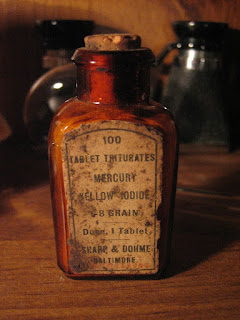

Everyone who reads my books knows that I have the Miss Bennets, particularly Mary, and, at times, Charlotte Lucas to be extraordinarily capable alchemists in the stillroom. Rarely is it without a later purpose, from scented waters that may be included in travel kits to medicinals that Miss Kitty needs to ease her cough to poultices that will draw infections from the wounds. And, yes, there are other purposes to come with offerings both deadly and merciful. But one of the ingredients we all know is deadly but widely used, much like arsenic, is mercury. To see if a viable choice for an accidental death of a character, I wanted to know how likely mercury might fall into the hands of someone some four hours away from London.

Mercury, also called quicksilver, or calomel, is a main ingredient in blue mass and is contained in the brick-colored ore called cinnabar was readily available in many forms. In fact, medicinally it has been used since before 2000 BC by the Egyptians and Indian people. One Chinese physician, Sun Simiao, known as the “King of Medicine”, gave a Jiajing Emperor an elixir of life combining mercury, sulfur, and arsenic. As you might suspect, he died shortly after he started to take the concoction.

Many know that in the Regency the alchemical ingredient mercury was prescribed to patients that had contracted syphilis. It stemmed from the paradoxical effect that small doses of a disease are beneficial, which eventually led to vaccines. Mercury was not the only heavy metal prescribed to counteract major diseases, mainly venereal; gold was another. “They were actually occasionally effective, though the pain they caused might have created a placebo effect (if it hurt so bad, it had to be helping).” –Doctors in the Regency By Alicia Rasley
“The idea behind the mercury treatment was to get the patient to excessively salivate, which was thought to help get rid of the impurities causing the disease. The initial administration of the mercury often occurred in a hospital, where patients typically stayed for a minimum of five weeks. However, mercury is a poison, so the treatment led to severe side effects, including painful mouth ulcers, loss of teeth, kidney failure, and often death.” –One in five Londoners had syphilis by age thirty-five in the late 18th century, historians estimate. These treatments could go on for months, even years, during the Georgian and Regency eras. The most affected were the young and impoverished in the 1800s.

Apothecaries often sold dangerous, deadly compounds, as shown here in “Voyage to Death.” A couple buys some narcotics from an apothecary whose assistant, Death, works with a pestle and mortar in the back room. The caption reads: ‘Don’t worry, I have an assistant who never gets it wrong.’ (Source: Wellcome Library, London, image # V0011779 Wikimedia Commons CC BY 4.0)
While most know mercury is the liquid in thermometers already in circulation by the Regency, it was also used for making felt hats. Also, “a common medication during the 17th through the 19th centuries was the blue mass. Physicians specifically prescribed it to combat syphilis, but its uses expanded as the years passed. Eventually, blue mass became the treatment for constipation, toothache, parasites, and the pains of childbirth. In the early 19th century, sailors combined this treatment with a black draught to treat constipation. Typically, the blue mass contained mercury, licorice, glycerol, rose honey, and some type of Althaea (marshmallow) plant.” Medical Uses for Mercury Through the Years.
The conclusion from this research, I killed off the character with mercury under the guise of assisting him, and isn’t that a wonderful way to absolve guilt in the eyes of all?
Sources for When Mercury Was a Cure-all
Ashton, Jan “Regency Medicine: Herbs, Snake Oil, And ‘Mother’s Friend’” Q&Q Publishing, Updated October 11, 2022, Regency Medicine: Herbs, Snake Oil, And ‘Mother’s Friend’ (quillsandquartos.com)
Morris, Diane “Regency Medical Treatments for Scarlet Fever” Moorgate Books, May 25, 2017, Regency Medical Treatments for Scarlet Fever – Moorgate Books
SuziLove “Doctors in the Regency By Alicia Rasley” Regency Fiction Writers, February 7, 2012 Doctors in the Regency By Alicia Rasley – Regency Fiction Writers
Suzie, Facty Staff “Medical Uses for Mercury Through the Years” Facty Health, Updated January 21, 2021 Medical Uses for Mercury Through the Years – Facty Health
Perry, Susan “One in five Londoners had syphilis by age thirty-five in the late 18th century, historians estimate” MINNPOST, July 8, 2020 One in five Londoners had syphilis by age 35 in the late 18th century, historians estimate – MinnPost
Martin, Madeline and Knight, Eliza “Part One: History of Medicinal Herbs” History Undressed, October 11, 2017 History Undressed: Part One: History of Medicinal Herbs
Center for the History of Medicine “Apothecaries from the Eighteenth Century Onward: England” Onview Apothecaries from the Eighteenth Century Onward: England · Jars of “Art and Mystery”: Pharmacists and their Tools in the Mid-Nineteenth Century · OnView (harvard.edu)


Leave a Reply to cindie snyderCancel reply