
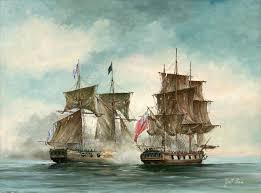
In a Jane Austen novel, sea travel usually happens offstage. A letter arrives, Tom Bertram returns, Captain Wentworth is promoted to captain—that sort of thing. But if you lived in Austen’s world and needed to get to the Continent (or the West Indies, or the Cape of Good Hope), you would likely have found yourself aboard a packet ship: a creaking but efficient, salt-stained mix of mail truck, passenger bus, and naval vessel. I mentioned last month that my next novel Muslin & Mystery will take place largely on a packet ship, so I have been doing my homework!
These packet boats, or more formally, packet ships, carried official “packets” of mail along fixed routes. They weren’t pleasure cruises, but they were how British information, people, and (some) goods moved across oceans in the 19th century.

What Was a Packet Ship?
A packet ship was a small, fast sailing vessel, designed for speed and reliability, not luxury. Operated by the British Post Office, packet ships connected Britain to its far-flung territories, colonies, and trading partners. Typical destinations included New York, Jamaica, Lisbon, Gibraltar, Halifax, and occasionally India or the Cape of Good Hope.
Unlike merchant ships, which sailed when full, packet ships departed on fixed schedules—hence their importance in wartime communications. They carried mail, government dispatches, newspapers, some cargo, and passengers—usually in cramped, damp quarters that were cheerfully described in advertisements as “accommodations.”

Ticket Prices and Who Was on Board
Travel wasn’t cheap. A passage to New York on a packet ship in the early 1800s could cost £25–£55, depending on the season, the ship, and your tolerance for sea biscuit. That’s a respectable amount—more than a governess’s annual wage, or roughly $4k to $5k in today’s money.
For that price, you got a bunk, some food (usually salted meat, hard bread, and tea), and the chance to spend four to six weeks at sea—longer if the weather turned. Cabins were small, ventilation poor, and the smell—a mix of tar, livestock, and and fellow passengers—probably inescapable.
Passengers were often naval officers, colonial administrators, merchants, missionaries, or families joining relatives abroad. Jane Austen herself never sailed on a packet ship, but her brothers Frank and Charles were Royal Navy officers. They traveled extensively on various vessels (although probably not packet ships), and knew firsthand the hazards and difficulties of sea travel.

Routes and Regular Runs
Some of the most important routes during Austen’s time included:
- Falmouth to Lisbon – A vital link to Portugal during the Napoleonic Wars.
- Falmouth to Jamaica – Part of the West Indies packet, carrying sugar, mail, and (maybe?) yellow fever.
- Falmouth to New York or Halifax – The North American route, often treacherous in winter.
- London to the Cape of Good Hope – For passengers bound for India.
Falmouth, in Cornwall, was the chief departure point for British packet ships for much of the 18th and early 19th centuries. Its deep harbor and relative seclusion made it ideal, and the town became a bustling crossroads at that time.
Cargo: What Was in the Hold?
In addition to letters and passengers, packet ships carried light, valuable cargo—usually goods that needed to arrive quickly and in good condition. This included:
- Textiles and ribbons (popular exports)
- Small crates of books, medicines, and instruments
- Private letters and parcels (for a hefty fee)
Sometimes passengers brought personal cargo, which might range from trunks of gowns to caged birds or a small traveling piano or harpsichord. I decided I definitely need an intstrument for the ladies in my novel!

I have more research about the dangers of packet boats and their guns and defenses, but I’ll save that for later. In the meantime, an excerpt! Thanks so much for reading along.

Excerpt from Muslin and Mystery, Chapter 2
Caroline was distracted by a large wooden case in the tiny dining room of the ship. The case was about four feet by two, an odd shape that was reminiscent of—“Why, a folding harpsichord! How quaint.” She looked about her and found the captain just leaving his own quarters. “Excuse me, captain. Whose is this?”
The captain looked a gentleman, but his sparse hair and coarse red features showed that he had spent many decades in sun and wind. “Why, it is mine, ma’am. I keep it stowed, but when I have ladies aboard as on this trip, I have it brought up from the hold.”
“How considerate! I do love music.”
“Do you play, ma’am? I love a concert.”
“I play the pianoforte, of course, but rarely the harpsichord. I shall need to practice.”
“I’ll have two of the men come to set it up,” he said.
“Ought we?” she said dubiously. “There is precious little space.”
“Why, it will fit, ma’am! This is one of the most spacious packets you’ll find anywhere in English waters.” His voice was defensive and a little offended. “Lady Mary is eighty-four feet from stem to stern, and you won’t find better anywhere, no matter what Mr. Bell says of the Francis Freeling.”
“I wouldn’t know—”
“Francis is only eighty feet and a handful of inches,” he declared. “Not a mite more. It can’t rightly be called even eighty-one, and Bell knows it!”
“I bow to your better knowledge,” Caroline said. “I should be glad of the instrument if you think it would not discommode the others. I’m not a good judge of tight—er—confined spaces.”
He bowed. “It shall do, ma’am. Excuse me.”
When Richard emerged, Caroline grimaced. “I have offended our captain. I inadvertently cast aspersions on the length of the ship.”
Richard laughed, kindly. “You had as well insult a lady’s face. A captain might abuse the ship himself, but to hear another do so…”
Two lanky sailors came and unlatched the case. There were three major portions of the harpsichord that housed its box and strings, and under these, lengthwise, were the legs and the keyboard. The men must have done the task before, for they seemed to know their business. Caroline shuddered a little to see their dirty hands and oil-stained fingernails as they touched the blond wood and fine hinges, but she did not protest. She certainly did not know how to construct it. The traveling harpsichord was considered an inferior instrument to its larger cousin and infinitely inferior to its descendent, the pianoforte, but beggars could not be choosers, and Caroline was relieved at the thought of any music at all to relieve the coming tedium.
When they had gotten the thing put together, it was wedged tightly in a corner, and the small bench seat was trapped behind one of the large posts that held up the upper deck. She had to suck in her slight person to fit around the beam and then do a tricky operation to sit on the bench and get her feet to the other side without showing a scandalous amount of petticoat.
She accomplished this, however, and ran her hands over the keyboard. It was somewhat pitted and worn. She pressed a key experimentally and the quintessential plucked sound rang out, quickly subsiding.
For one brief moment, she allowed herself to long for her beautiful pianoforte at Netherfield! Its rich sound, sustained notes, and dynamic volume would be much missed.
Resolutely, she put that aside and played a simple scale. The keys had half as much depth as piano keys and they clicked a little disconcertingly, but she would grow accustomed. There was also a slight delay in sound that was different than the hammer-strike immediacy of the piano forte.
Still, the notes were the same. She played a light air, reminding herself not to press too hard on the keys. She’d heard the strings were notoriously breakable.
“Very fine,” Richard applauded.
“Thank you. It is rather out of tune, I’m afraid.” It was dreadfully out of tune.
“I suppose that’s to be expected for an instrument kept on a ship. The humidity and water must be terrible.”
“True.” She tried to think what Anne Elliot would say in such a situation. To be kind and uncomplaining did not come naturally to Caroline, but she was determined to do it or die trying. “It could be–far worse?” she choked out.
Richard smiled, seemingly unaware of her struggle, which was for the best, she suppose. Caroline wanted him to think optimism and kindness were natural to her, but, perversely, she also wanted him to recognize how hard she was working.
“Play me another,” he said. “I am delighted you will have something musical to while away the hours.”
***
That’s all for now! Thanks for reading!
Corrie


Leave a Reply to Corrie GarrettCancel reply