
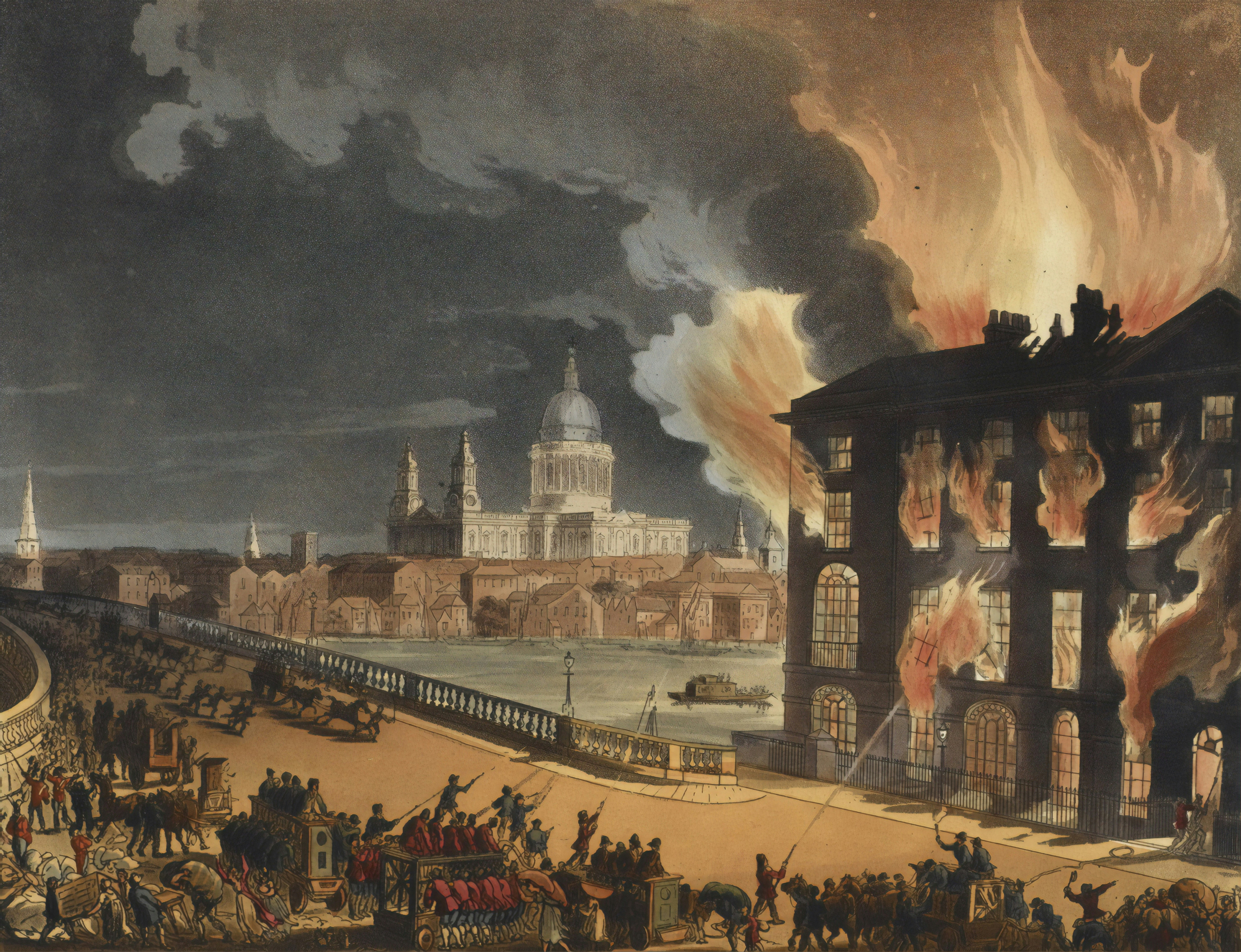
Jane Austen was born more than 100 years after the Great London Fire of 1666, but the changes in the city had an impact on her life. Read on to find out more.
Did you know that the modern concept of property insurance was a direct result of the Great London Fire of 1666? When I discovered this tidbit, it suddenly opened the doors for me of a P&P variation where a similar fire occurs.
How would a substantial part of London burning down affect the market town of Hertfordshire? What about Darcy, the Bingleys, and the Gardiners? Where would they go? What if Elizabeth had been visiting her aunt and uncle on Gracechurch Street when it occurred?
That is the premise of my “Ashes and Understanding.” But before I could really delve into that, I needed to understand more about the Great London Fire and its lasting impact on the city. But even more, I wanted to know if those events had any impact on Jane Austen herself, even though she was born a century later.
At first glance, it might seem that the Great Fire of London, which tore through the heart of the city in 1666, has little to do with Jane Austen, who was born in 1775. After all, Austen’s novels are famously grounded in the genteel country life of the English landed gentry, far removed from the smoke and rubble of seventeenth-century catastrophe. But while the flames never licked at her own doorstep, the long shadow of the Great Fire subtly shaped the world she inherited—its architecture, urban planning, insurance systems, and social hierarchies—and, by extension, the cultural backdrop of her fiction.

A Changed City: London After the Fire
The London Jane Austen would have known as a young woman—through visits, letters, and stories—was a city fundamentally reshaped by the events of 1666. The Great Fire did not merely burn; it cleared the way for reconstruction on an unprecedented scale. In the century following the blaze, London was reborn in brick and stone, with wider streets, stately buildings, and new approaches to fire safety and city planning.
By Austen’s time, Christopher Wren’s architectural influence still dominated the cityscape, from the imposing dome of St. Paul’s Cathedral to the elegant churches dotting the city. These were not relics of Austen’s own age, but symbols of England’s resilience and evolving identity—ideas that would have resonated with a writer so attuned to questions of stability, tradition, and transformation.
Although Austen’s novels never take readers directly into London’s historical core (her characters tend to linger in Mayfair drawing rooms or make fleeting references to the city), the physical and social landscape they inhabit was, in part, a legacy of the post-Fire rebuilding.
Fire, Insurance, and the Economy of Property
Perhaps more significantly for Austen, the Great Fire changed how England thought about risk, property, and economic security—concepts that feature heavily in her fiction. In the wake of the devastation, the first fire insurance companies emerged, providing protection to homeowners and businesses. The concept of insuring one’s property, investments, or even lives eventually became central to the financial stability of the middle and upper classes.
In Sense and Sensibility, for example, the Dashwood family’s sudden fall in fortune after the father’s death is a stark reminder of how precarious wealth could be in a system without strong safety nets. Similarly, the entail in Pride and Prejudice, which prevents the Bennet daughters from inheriting their father’s estate, reflects a world where wealth and security could disappear with frightening ease. While Austen doesn’t mention insurance directly, the systems and anxieties put in place after the Great Fire linger beneath the surface, quietly influencing how her characters pursue marriage, manage property, and safeguard their futures.
A Moral and Religious Symbol
In Austen’s time, the Great Fire of London had also taken on a moral dimension in the popular imagination. Many 18th- and early 19th-century writers viewed the fire as divine punishment—first for the sins of the city, and later, in more Enlightened thought, as a test that led to regeneration and improvement. This narrative—of destruction followed by renewal—is echoed subtly in Austen’s own moral landscapes.
Her novels often present social and emotional upheaval as a necessary precursor to personal growth and societal harmony. Consider Elizabeth Bennet’s fiery pride, which must be burned away before she can see Darcy clearly, or Emma Woodhouse’s self-conceit, which must be humbled before she can find real happiness. In this way, Austen participates in the long British literary tradition of using disruption as a metaphor for personal and moral transformation—a tradition shaped, at least in part, by events like the Great Fire.
A Lasting Literary Echo
Though she never dramatized the Great Fire directly, Austen’s world was filled with its echoes. London had become a symbol of both opportunity and risk—a place where fortunes could be made or lost, where reputations were forged in scandal or in brilliance. For Austen’s characters, London is often the site of danger and glamour in equal measure: Lydia Bennet elopes to London, Colonel Brandon seeks medical aid there, and Willoughby finds both ruin and temporary escape in its fashionable neighborhoods.
It’s worth noting, too, that Austen was writing during a time of renewed national anxiety about war, fire, and invasion. The Napoleonic Wars brought the threat of destruction once again to British shores. The memory of the Great Fire, enshrined in literature and public monuments, served as both a warning and a reminder of endurance.
So, did the Great Fire of London directly impact Jane Austen? Not in the literal, biographical sense. She didn’t flee its flames or rebuild from its ashes. But the world she inherited—its architecture, financial institutions, cultural fears, and moral frameworks—had been irrevocably shaped by that four-day inferno in 1666. Austen’s characters may dwell in drawing rooms and country manors, but the fire’s legacy lingers in the very fabric of their world: in the weight of property, the specter of ruin, and the promise of renewal.
In that sense, the fire touched Jane Austen more than history may first suggest—not with smoke and heat, but with consequence.
What do you think?


Leave a Reply