
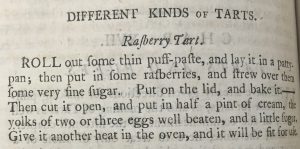

In summer months, fruit desserts are always colorful and delicious, and one of my favorites is the tart, making me ponder its history and how available they were during the Regency. They were often found on the table for special days and included among the desserts, though I did not find them listed in the staple desserts expected for afternoon tea in High Tea and Afternoon Tea in the Age of Austen by Vic and What Is the Difference Between Afternoon Tea and High Tea? by Elaine Lemm. High Tea, perhaps, but not for the everyday 4:00 afternoon tea.

Unlike a pie, it is not a typical “roll the crust, fill, bake, and cool.” There are many steps to making just the right puffy crust, baking and then baking again, a second adding of butter, a carefully prepared cream and more. And then the cook had only as much freedom as what was available for the season. Lemon tarts were popular. And we can see that aside from the poppin (apple) tart, the cookbook also suggested apricots. Orange tarts, taffy tarts, raspberry, and blackberry, or any combination of these, also were listed.

But it was the puff pastry that truly made the tart a savory treat. The cookbook A New System of Domestic Cookery by Rundell, M. E. shares the secret:
“Rich Puff Paste – (Rundell, 1822)
Weigh an equal quantity of butter with as much fine flour as you judge necessary; mix a little of the former with the latter, and wet it with as little water as will make into a stiff paste. Roll it out, and put all the butter over it in slices, turn in the ends, and roll it thin: do this twice, and touch it no more than can be avoided. The butter may be added at twice; and to those who are not accustomed to make paste, it may be better to do so.”
From eighteen step recipes to guidelines, I have learned that the tart was not a pastry easily perfected by the cook. But when mastered, it truly is a perfect treat.
Sources for Tart Treats
Boermans, Mary-Ann “Taffety Tarts: How Folger manuscript recipes helped a 17th-century pastry make it into the Oxford English Dictionary” Folger Shakespeare Library, March 26, 2019
Taffety Tarts: How a 17th-century pastry made it into the OED (folger.edu)
Cowan, Louise “READY, SET, BAKE: RECIPES FROM THE 18TH AND 19TH CENTURY” Special Collections, August 24, 2016 Ready, Set, Bake: Recipes from the 18th and 19th Century – Collections – Special Collections (reading.ac.uk)
Rundell, M. E. (1822) A New System of Domestic Cookery. New Edition. London: John Murray [RESERVE–641.0973-RUN]
Kettilby, M (1719) A Collection of above Three Hundred Receipts in Cookery, Physick and Surgery. London; Richard Wilkin [RESERVE–641.5942-KET]
Vic “High Tea and Afternoon Tea in the Age of Austen” Jane Austen’s World, September 22, 2020 High Tea and Afternoon Tea in the Age of Austen | Jane Austen’s World (janeaustensworld.com)
Lemm, Elaine “What Is the Difference Between Afternoon Tea and High Tea?” The Spruce Eats, Updated August 30, 2023 Difference Between Afternoon Tea and High Tea (thespruceeats.com)


Leave a Reply