
How do you rate the books you read?
This is a widely contested topic among readers, whether it’s on Booktok, Facebook, or another platform where people discuss their opinions on the books they read.
Some people won’t leave a rating or review if they feel the book merits less than four or five stars.
Other people won’t rate higher than four stars unless they feel the book was absolutely amazing and incredible.
And still others are a mix between the two, leaving ratings and reviews however they feel, being generous with one stars and five stars alike.
The purpose of this article is NOT to convince you that you should start giving out tons of four and five stars to all the books you read.
As an author, that’s not my place.
Sure, I’d love it if every JAFF book I’d written started getting four and five stars – but just like I don’t love every book I’ve ever read, I also don’t expect every reader to love my books.
We all have things that bother us: certain tropes, typos, the style of writing. It’s also extremely disappointing to pay money for a book (unless, of course, you use Kindle Unlimited!), only for it to not be what you expected.
And I learned the hard way that even though it’s an extremely common practice to use a book’s epilogue as a reader magnet for your newsletter, JAFF readers really hate it, and it will sour the book for them.
So this post isn’t about trying to convince you to rate books higher. Instead, it’s to inform you about one simple thing:
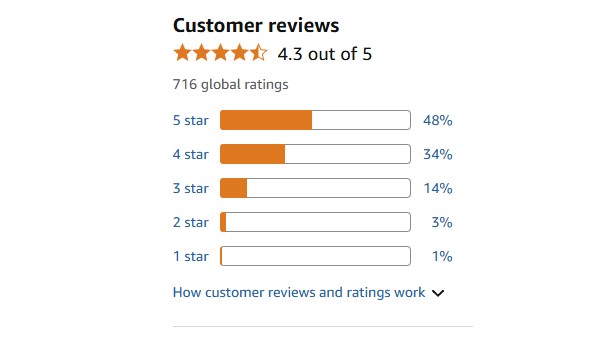
Amazon does NOT take the average of stars when it calculates a book’s rating.
You would think that if a book had a five-star rating and a one-star rating, they would average out to be three stars…. but they don’t.
About six weeks ago, I published my book “A Dear, Sweet Girl,” and I had the epilogue be the freebie for signing up for my newsletter. As you may have seen, it didn’t go well. Sure, I may have gotten 300x the number of signups that I usually do, but it also made a LOT of people angry, and they expressed that anger by leaving 1-star reviews on Amazon.
Now, I’ve had my fair share of bad reviews from my books. Someone doesn’t like the JAFF trope I wrote, or they found more typos than they’d like. But I don’t really read negative reviews anymore, because, to be honest, all they do is make me want to curl into a ball and cry, and quit writing altogether.
But the one thing that stood out the most from all these one-star reviews (other than I should never leave out the epilogue again, lol) was that the math didn’t make sense.
Now, I got my degree in math. I was a middle school math teacher for several years before developing Crohn’s, having kids, and staying home to homeschool them and take care of my health. I love numbers, probably more than I love reading, and with just a few ratings and most of them being so low (which hadn’t happened before), I quickly could see that the average didn’t work out.
So it caused me to do a deep-dive into how Amazon calculates star ratings and reviews. It’s NOT just the average, believe it or not.
There’s actually two different types of giving your opinon on a book:
- Ratings: those that are just a star, and
- Reviews: those that have a star and a typed review.
Ratings that have a review attached are weighted more heavily. Additionally, if you are a “verified purchaser” of the book (meaning Amazon sees that you actually purchased or borrowed the book), then your star has more value as well.
According to Amazon’s website, here’s how those ratings are calculated:
Amazon calculates a product’s star rating using machine-learned models instead of a simple average.
These models consider factors such as how recent the rating or review is and verified purchase status. They use multiple criteria that establish the authenticity of the feedback. The system continues to learn and improve over time.
We do not consider customer ratings without an Amazon Verified Purchase status in a product’s overall star rating until a customer adds more details in the form of text, image, or video.
If you want to read more in-depth about how Amazon’s ratings and reviews work, check out this article here.
I bring this all up just to let everyone know that your ratings and reviews DO matter. It takes a lot more to recover from poor reviews, and a 4-star rating may not be worth what you think it is, especially when compared to a 1-star review.
What do you think? How do you rate the books that you read? Do you also leave a review? How do you decide between the star values?


Leave a Reply to Gianna ThomasCancel reply