
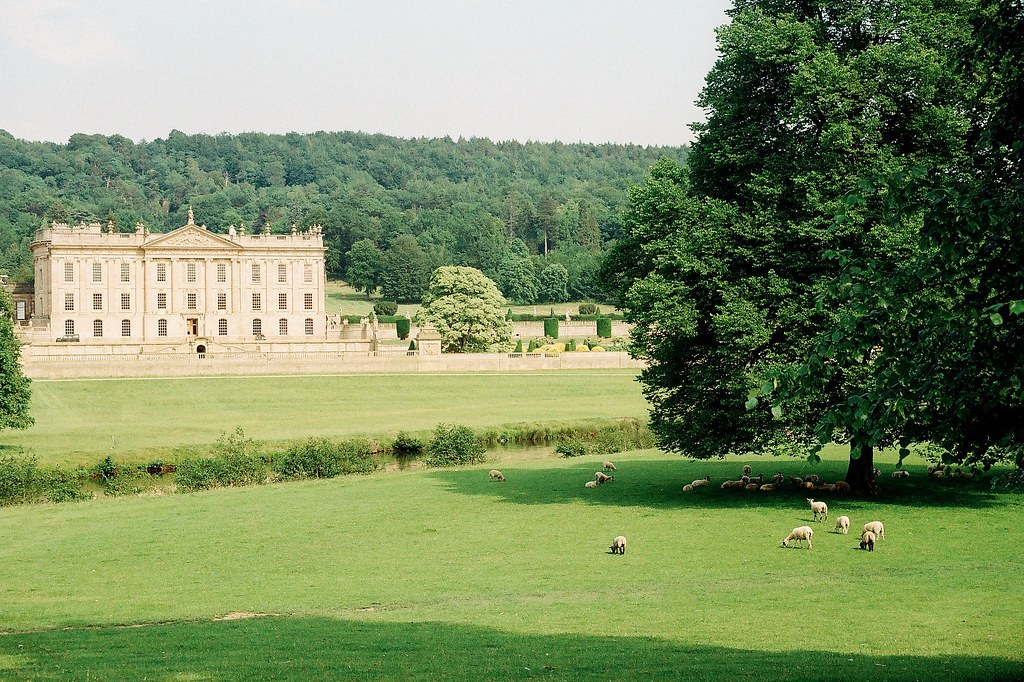

Pemberley as imagined by Pride & Prejudice 2005
Elizabeth is not mercenary, the tour at Pemberley did not sway her in regards to wealth, but it did provide a very important character reference about Mr. Darcy. I’ve already discussed the contents of the house in Part 1 and the real importance of the portrait. In this section, I’ll argue that what impresses Elizabeth about Pemberley is not the wealth, but what is done with it.
By the time Elizabeth views Pemberley, she is not unfamiliar with great houses. We know her opinion of the luxurious Rosings (she wasn’t impressed). On the way to Derbyshire, we’re told:
It is not the object of this work to give a description of Derbyshire, nor of any of the remarkable places through which their route thither lay—Oxford, Blenheim, Warwick, Kenilworth, Birmingham, etc., are sufficiently known.
According to my David Shapard annotated edition of Pride & Prejudice, some of these “remarkable places” were most likely famous houses, such as Chatsworth, “the palatial home of the Dukes of Devonshire“. So unlike Fanny Price in Mansfield Park, who has lived in one great house and viewed exactly one more, Elizabeth is no stranger to magnificent houses. So what is so impressive about Pemberley?
To put it simply: Mr. Darcy has good taste.
It was a large, handsome stone building, standing well on rising ground, and backed by a ridge of high woody hills; and in front a stream of some natural importance was swelled into greater, but without any artificial appearance. Its banks were neither formal nor falsely adorned. Elizabeth was delighted. She had never seen a place for which nature had done more, or where natural beauty had been so little counteracted by an awkward taste. They were all of them warm in their admiration; and at that moment she felt that to be mistress of Pemberley might be something!
To put this quote in other words, Mr. Darcy hasn’t ruined the natural beauty of his estate.


(I have my problems with the 2005 adaptation of Pride & Prejudice, but I’ve always loved this look and laugh from Elizabeth when she sees Pemberley. I thought it captured the feeling of the book well)
Every disposition of the ground was good; and she looked on the whole scene, the river, the trees scattered on its banks, and the winding of the valley, as far as she could trace it, with delight. As they passed into other rooms, these objects were taking different positions; but from every window there were beauties to be seen. The rooms were lofty and handsome, and their furniture suitable to the fortune of their proprietor; but Elizabeth saw, with admiration of his taste, that it was neither gaudy nor uselessly fine,—with less of splendour, and more real elegance, than the furniture of Rosings.
I’m guessing that unlike Rosings, there were no chimmney-piece alone that cost eight hundred pounds!
They had now entered a beautiful walk by the side of the water, and every step was bringing forward a nobler fall of ground, or a finer reach of the woods to which they were approaching

Now at this point, Elizabeth’s admiration of Pemberley is somewhat overshadowed by her anxiety over meeting Mr. Darcy again, but the park (ten miles round!) is beautiful as well. The message isn’t exactly that he’s wealthy, it’s that he hasn’t ruined the nature that he’s inherited. He is a good steward of what he owns. Compare this to the foolish Mr. Rushworth in Mansfield Park, who cannot be a good landlord or manager.
This theme is repeated in Austen’s works. Catherine Morland in Northanger Abbey is very little impressed by General Tilney’s modern and (we can guess) ostentatious renovations to Northanger Abbey. She would have preferred to see history preserved. She is also far more delighted by Henry’s more modest parsonage. Emma admires that Mr. Knightley has preserved the old style of Donwell Abbey:
The considerable slope, at nearly the foot of which the Abbey stood, gradually acquired a steeper form beyond its grounds; and at half a mile distant was a bank of considerable abruptness and grandeur, well clothed with wood;—and at the bottom of this bank, favourably placed and sheltered, rose the Abbey Mill Farm, with meadows in front, and the river making a close and handsome curve around it.
It was a sweet view—sweet to the eye and the mind. English verdure, English culture, English comfort, seen under a sun bright, without being oppressive.
It gives me the impression that Jane Austen was most likely to agree with Mary Crawford’s opinion of most great houses, which we find in Mansfield Park:
“That she should be tired now, however, gives me no surprise; for there is nothing in the course of one’s duties so fatiguing as what we have been doing this morning: seeing a great house, dawdling from one room to another, straining one’s eyes and one’s attention, hearing what one does not understand, admiring what one does not care for. It is generally allowed to be the greatest bore in the world, and Miss Price has found it so, though she did not know it.”
The attraction of Pemberley is not that it displays Mr. Darcy’s wealth, but that it gives important insight into his character, taste, and history. Elizabeth has for too long relied on her first impression of his character. During her tour of Derbyshire, she learns not that she was completely wrong, Mr. Darcy is indeed arrogant and snobbish, but that she hasn’t understood the entire picture. Pemberley is a glowing reference for its owner, and that is why Elizabeth isn’t entirely joking when she says he mind changed when she saw the house!
More:
Why the Tour of Pemberley Matters (part 1)
Darcy Smiles a Lot Actually (even before Pemberley)
How well could Caroline Bingley expect to marry?
Could Mr. Bennet have Saved Enough for Decent Fortunes on his Income?


Leave a Reply