
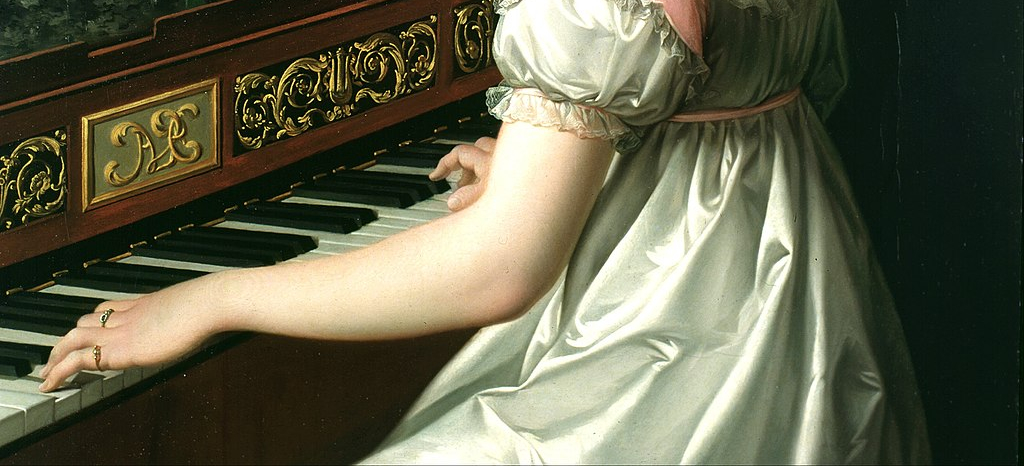
I’ve been thinking a bit about pianos of late.
I am in the final stages of editing a non-JAFF Regency Romance that is coming out in mid-May. In this story, my heroine is exceptionally skilled at the pianoforte, which is what first draws the hero to her. This, of course, led to a bit of research on the instrument and what she would have played. Further, there have been questions and discussion recently on some social media sites about pianos and related keyboard instruments, and I thought a quick survey of popular parlour instruments might be interesting.
My interest in historical instruments goes back to when I was a music student at university. I played in a Classical (i.e. Mozart-era) orchestra while doing my performance degree at McGill, and later, as a music history major, studied Baroque performance practice. For several years, I played with a Baroque orchestra on period instruments, and we recorded four CDs for an international label. While I’m not a keyboard player (I can manage Chopsticks, and that’s about it), I do know a bit about music and instruments in general.

Here is a quick survey of what you might find while wandering through the halls of a great house during the Regency Era.
Clavichord

The clavichord was invented in the Middle Ages, around the year 1300. Due to its relatively compact size and sweet sound, it was popular for several centuries and a great house with some history might well have a clavichord lurking around some lesser-used parlour, or up in an attic somewhere.
The clavichord produces its sound when iron or brass strings are struck with small metal blades, connected to the keys on the keyboard. The vibrations are transmitted through the bridge, the support keeping the strings taut, and to the soundboard.
Historically used as a practice instrument, the clavichord is very quiet. There is a joke among musicians that says that a clavichord is so quiet, you can’t hear it if there are other instruments in the room, even if they’re not being played.
Clavichords also have a much smaller ranger than a modern piano—likely not more than four or maybe five octaves, although later 18th-century models might have extended up to six octaves. For comparison, a modern piano has eight full octaves.
Still, it’s a nice instrument for a small drawing room or a bedroom, and the clavichord never really went out of fashion, although its popularity did wane as newer and louder instruments appeared on the musical scene.
Here’s a video with some sound clips that might be of interest.
Virginal

One of the more popular instruments of the Renaissance is the virginal. It is related to the harpsichord, and is possibly the oldest instrument in the harpsichord family. Like the clavichord, when you press a key on the keyboard, a mechanism causes one of the instrument’s strings to vibrate. But unlike the clavichord, here the string is plucked rather than struck. The instrument’s name likely comes from the wooden dowels or rods (virga) that rest on the ends of the keys to hold the plucking mechanism.
Virginals are usually rectangular or oblong instruments, with one string per note, and whose strings run more or less parallel to the keyboard, along the long side of the case. Early instruments did not have legs, but rather, sat on tables.
Virginals were particularly popular in England in the 16th and 17th centuries, and the name was often applied to any sort of harpsichord. The cases were frequently elaborately decorated, making them objets d’art as well as instruments. These instruments fell out of use by the end of the 18th century; still it would not be impossible for a virginal to be lurking in some out-of-the-way room in a great house.
This is what a virginal sounds like.
Harpsichord

The harpsichord was the most popular keyboard instrument of the Baroque period (roughly 1600-1750). It was used as a solo instrument, with a vast amount of virtuosic music composed for it, as well as being a key component in almost all ensembles, as part of the basso continuo. Here is a Bach harpsichord concerto to get you in the mood. You can see how effective it is as a solo instrument—and how much louder than a clavichord!
Like the virginal, the harpsichord produces sound when the pressed key engages a mechanism (plectrum) that plucks the associated string, resulting in a twangy sound, rather like a plucked guitar string. Unlike most clavichords and virginals, harpsichords generally have two or more sets of strings, each with different tonal qualities. There is a separate keyboard for each register, as you can see on the video.
By the middle of the 18th century, however, the harpsichord faced a competition from the newcomers to the musical scene—the fortepiano and pianoforte.
Fortepiano

The big change in keyboard instruments come around the year 1700, when Italian musician Bartolomeo Cristofori (1655-1731) switched the plucking mechanism of a hardpsichord with a hammer that struck the strings at different intensities, depending on how hard the key was pressed by the player. He called this instrument a clavicembalo col piano e forte, meaning a harpsichord that plays soft and loud. This new instrument could, indeed, play the full range of volume, from pp (very quiet) to ff (very loud), and musicians and composers quickly took to the instrument, with its vastly extended range, both dynamic and expressive.
These early percussive keyboard instruments generally became known as fortepianos, but they are essentially early pianos. This was the instrument for which Classical-era composers wrote their music: Haydn, Mozart, young Beethoven and Schubert. These were generally wood-framed instruments, as opposed to the metal frames of the later pianoforte, and thin harpsichord-like strings were struck by leather-covered hammers.
The sound is very expressive, and softer and with less sustain than a modern piano. They were generally about six octaves, although this range was constantly being pushed and expanded through the early 19th century. Fortepianos often had devices to change the resonance of the instrument, either pedals, or knee levers, or hand-stops.
This is the instrument that would most likely have been found in a typical Regency parlour. When you imagine Mary Bennet playing her concertos, she’s likely sitting at one of these.
Here is some more information on the fortepiano, and you can hear it as well.
Pianoforte

Although we now refer to the earlier instrument as a fortepiano and the more modern one as a pianoforte (or piano), they are essentially the same instrument, and the names were used interchangeably.
The big dividing line in terms of contemporary usage is simply how large, modern, and strong the instruments are. The range expanded from an average of five and half octaves to six, then seven, and eventually eight octaves, and the introduction of a metal frame allowed for much larger instruments and greater string tension (about four times that of a fortepiano), which in turn allowed for louder dynamics. The hammers grew larger and moved from leather-covered to felt-covered, and the sustain became longer. The development of pedals allowed for greater expressive possibilities as well. You need a much stronger touch to play a piano than a fortepiano because of the heavier hammer mechanism.
By the late 1820s, most new instruments would be considered pianofortes, or modern pianos.
All the big Romantic keyboard music was composed with this in mind. This music post-dates the Regency era by a few years, but here is a well-loved piece for piano, Chopin’s Fantasy-Impromptu Op.66, composed in 1834.
So now you’re all experts, and when you see Marianne Dashwood sitting down to a large modern concert grand piano, you can give the side-eye to your companion, and say, “well, actually….”


Leave a Reply