
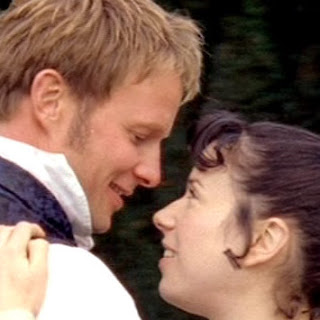
We’ve talked about Tom Lefroy, Jane’s short-lived flirtation. Then we discussed Jane’s mysterious seaside love which appeared to be something deeper, although the identity of the man remains a mystery. This month, we’ll look at Jane’s marriage proposal from a wealthy, future estate holder.

Wikimedia Commons
In 1802, Jane and Cassandra travelled from their home in Bath to Manydown House, near Steventon, to visit their good friends. While there, Jane received an offer of marriage from their friends’ younger brother, Harris Bigg-Wither. Bigg-Wither was 21-years-old, and Jane was nearly 27.
Jane accepted, a decision that made economic sense. Bigg-Wither was to inherit Manydown, and Jane would become the mistress of a manor surrounded by 1500 acres of parklands and 400 acres of plantations. This would help her parents, who did not have much money, and it would relieve her brothers from having to support Jane and Cassandra after her parents’ deaths.
The next morning, however, Jane broke off the engagement, and she and Cassandra fled back to Bath. What happened during that night between the acceptance and rejection? Jane and Cassandra shared a room, so I can imagine the two sisters talking about the proposal and Jane wrestling with this decision.

People are fascinated by Jane’s refusal of this proposal, and there’s much speculation about why she accepted and then refused Bigg-Wither. Was he a pompous jerk, but the money was momentarily enticing? Did he just catch her by surprise? Did she feel obligated because she loved his sisters so much? (They forgave her and later rekindled the friendship.) Whatever the reason, Austen did not seem to regret it. Catherine Hubback (1818–1877), Austen’s niece, wrote, “I gathered from the letters that it was in a momentary fit of self-delusion that she accepted Mr. Withers’ proposal, and that when it was all settled eventually, and the negative decisively given she was much relieved—I think the affair vexed her a good deal—but I am sure she had no attachment to him.”
Thanks, Catherine, for clearing it up: Jane refused Bigg-Wither because she did not believe she could love him. Still, this was a big decision, and the reasons were probably nuanced. I think this rejection wasn’t only about Bigg-Wither. (Can you picture Jane saying, “It’s not you! It’s me.”) I’m going to propose the theory that, despite writing about marriage and love with such feeling, Austen had already found two loves in her life that were more important to her than marriage.
Her sister
Cassandra became engaged to Reverend Thomas Fowle in 1794. It was a secret engagement because the couple had no money, and Fowle hoped to make his money at sea and return to marry Cassandra. Sadly, he died of yellow fever in 1797, and Cassandra went into full mourning, never to marry.
That’s a terrible story, and in the midst of it is Jane, with a sister in mourning, considering a marriage proposal to Bigg-Wither. Jane and Cassandra had shared a room almost all their lives, and when they were apart, they wrote to each other constantly. Maybe trading life with a beloved sister for Bigg-Wither just wasn’t that appealing.
After Austen’s death, Cassandra wrote, “I have lost a treasure, such a sister, such a friend as never can have been surpassed. She was the sun of my life, the gilder of every pleasure, the soother of every sorrow; I had not a thought concealed from her, and it is as if I had lost a part of myself.”
Isn’t that beautiful? What a special bond they shared. I’m not sure I would have married Bigg-Wither either. (And, come on. Jane Bigg-Wither? Just, no.)

Her writing
Before her proposal, Jane had written her first three novels, and afterwards, she penned her last three and saw four of her six novels published. By contrast, Anne Howe Frith, the woman Bigg-Wither eventually married, bore ten children—a different life, for sure. If Jane feared she would not be able to write after marrying Bigg-Wither, she was right.
What a huge decision for Austen—to forgo financial security, hoping instead to make her own money through her writing, even though she had not yet published a novel when she refused Bigg-Wither. It must have been hard to buck society’s expectations, and it was perhaps her dual love of her sister and her writing that made it possible for her to make this choice. If she’d been alone, would she have made the same decision?
And what of her one great seaside love that we read about last month? Catherine Hubback wrote, “There is no doubt she admired him extremely, and perhaps regretted parting, but she always said her books were her children, and supplied her sufficient interest for happiness.”
Maybe Austen had a crush on Tom Lefroy. Maybe she was in love with that mysterious seaside man. And maybe she did wish for the financial security Bigg-Wither offered. But her books were her babies and her sister her best friend. We always think that Austen missed out by not finding true love, but I see now that’s short sighted. I think Austen would have called herself lucky to have found not one but two great loves in her life.
What do you think? Do you have the lingering feeling that Austen longed for love and marriage, or do you imagine she lived a fulfilling life, seeing her books published and read?
Here are the other two posts in this series: Was Jane Ever in Love (Part 1: Tom Lefroy) and Was Jane Ever in Love (Part 2: The Mysterious, Seaside Romance).
I found this site interesting when writing this post: Why Jane Austen Never Married.
Other posts to check out:
Mr. Darcy, What’s Your Sign?: Austen Characters and Their Zodiac Signs
Modern Magazine Covers Reimagined with Regency Headlines


Leave a Reply to Kirstin OdegaardCancel reply