
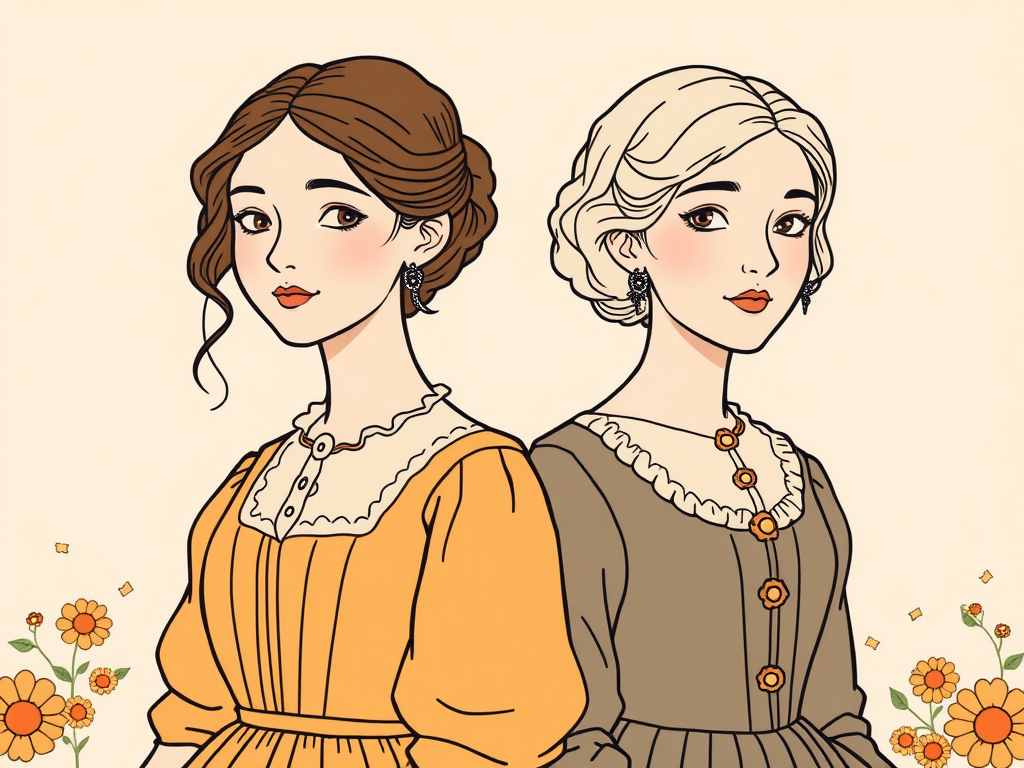
Our Poor Tempted Heroes (and Their Patient True Loves)
If you love Mansfield Park but wish Fanny Price had a little more agency, Agnes Grey might be your next read. For my current series of posts, I was trying to think of a Georgette Heyer novel that reminded me of Mansfield Park, but I decided I was trying too hard to shove a square peg in a round hole. Particularly when the Bronte’s downtrodden heroines are there to choose from!
Jane Austen and Anne Brontë were very different writers, of course, but these two novels share a lot—quiet, moral heroines, social class difficulties, and most notably, a hero who nearly falls for the wrong woman. Both Edmund Bertram in Mansfield Park and Edward Weston in Agnes Grey are good men, but both get caught up with charming women without much character. And for readers who just want to shake the hero and say, “Come on, she’s terrible for you!”—you’re not alone.

The Heroine: Fanny vs. Agnes
Fanny Price and Agnes Grey are cut from similar cloth I think they would have been friends, except that both are so retiring and introverted, it would have taken a long time for them to get acquainted!
Both have little money and even less influence. They are quiet, observant, and often underestimated. Fanny grows up dependent on her wealthy relatives at Mansfield Park, constantly reminded of her lower status, while Agnes works as a governess for wealthy families who treat her with condescension at best and cruelty at worst.

The difference? Agnes is more outspoken than Fanny. While Fanny endures mistreatment in silence, Agnes gets in a few well-placed barbs—especially toward Rosalie Murray, the shallow beauty who flirts shamelessly with Edward Weston. Agnes is still restrained (this is Anne Brontë, after all, not Charlotte), but she has a little more bite than Fanny.
The Hero: Edmund vs. Edward
And here we get to the frustrating part. Both Edmund Bertram and Edward Weston are genuinely kind, responsible men—just completely blind when it comes to women. Edmund falls for the charming but self-absorbed Mary Crawford, while Edward is drawn to the flirtatious and vain Rosalie Murray. Both Mary and Rosalie are beautiful, socially adept, and skilled in the art of leading men on. And in both cases, our poor heroines—Fanny and Agnes—have to watch in agony as the men they love fall under the spell of women who clearly don’t deserve them.

Edmund’s fascination with Mary is particularly painful because Fanny is in love with him the entire time. She sees Mary’s faults—her disregard for principles or other’s feelings, her willingness to manipulate—but Edmund is completely taken in. Even when Mary laughs off his family’s values and openly wishes for his older brother’s death (so Edmund can inherit), he still tries to justify her behavior. It takes a full-blown scandal for him to wake up.
(Now, I will say, I have a major soft spot for Mary Crawford. I gave her a whole book, actually! I feel like she was intelligent enough and had enough innate kindness that she was very redeemable. In my story, Edmund’s rejection made her reflect on her life, and getting a glimpse into the Darcy/Fitzwilliam family made her want to be someone better and different.)

Anyway, Edward Weston’s situation is a little different. He’s not in love with Rosalie Murray the way Edmund is with Mary Crawford, but he does spend far too much time in her company, believing her to be sweet and innocent when she is anything but. Rosalie enjoys making men fall for her—especially men she has no intention of marrying. Agnes, like Fanny, sees it all unfold but can’t do anything about it. She just has to wait for Edward to realize that Rosalie is toying with him.
Rosalie is far less redeemable and actually malicious toward Agnes. When she eventually marries a wealthy but unpleasant husband, she immediately regrets it and tries (unsuccessfully) to draw Edward back into her life. At least Mary Crawford had some genuine affection for Edmund and Fanny—Rosalie only cares about keeping herself entertained.
The Ending
In Mansfield Park, Edmund finally realizes his mistake when Mary Crawford reacts to her brother’s scandal in a completely cynical way. Only then does he turn to Fanny, recognizing that she is the right choice for him. It’s not the most passionate love story, but for Fanny, it’s enough, apparently.
In Agnes Grey, Edward Weston isn’t quite as blind as Edmund—he eventually sees through Rosalie before making any huge mistakes. But he still takes his time before recognizing that Agnes is the woman he truly values. Theirs is a quiet romance, much like Fanny and Edmund’s, but we get a little more closure!

Final Thoughts
If you haven’t yet read Agnes Grey, and if you enjoy a story about steadfast heroines, flawed but ultimately decent guys, and a slow-burning romance that rewards patience, give it a shot.
Just be prepared to yell, “She’s not the one for you!” at least a few times along the way.
Thanks for reading!
Corrie

Leave a Reply