
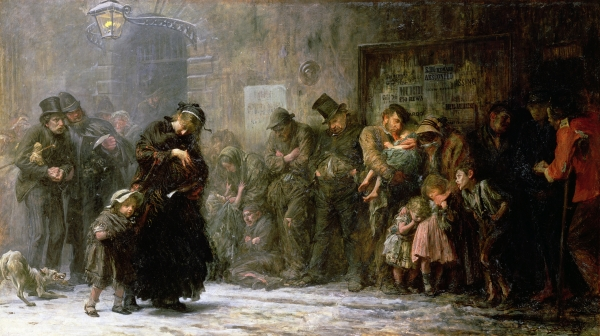
Genteel poverty, which is being experienced by the Bates (Emma), the Dashwoods (Sense & Sensibility), possibly the Prices (Mansfield Park, I don’t know if they fully qualify as gentry), and the Bennet girls if they don’t marry in time (Pride & Prejudice) is different than actual poverty, which is something not really addressed in Austen’s novels. For genuine poverty in the lower classes, Elizabeth Gaskell’s Mary Barton or the works of Charles Dickens would give a better picture.


When it comes to less fortunate members of the gentry in Austen’s works, they could afford to eat, rent, clothe themselves and have at least a maid-of-all-work. An income of around £100/annum is something you can live on and importantly, they don’t have to work for that income. They are poor in comparison, not actually poor. The majority of the population of England at that time had incomes similar to or lower than the Bates and worked 12-14 hours per day for it. A governess had to work hard for an income of £20-50 plus room and board, while Elinor Dashwood would draw that much income just from her inheritance of £1000.
One of the reasons members of the gentry struggled is because they had to keep buying things that keep them in their class, such as proper clothing and food to feed visitors. For example, in the novel, the Dashwoods host the Middletons for dinner every time they dine at the park. That makes them participating members of the gentry, but it’s probably eating up a lot of their budget. It’s probably also why Mrs. Dashwood refuses to visit anyone outside of walking distance, they can’t afford to host anyone else! Mrs. Grant also does this in Mansfield Park, she hasn’t chosen to visit with the Rushworths and start this endless back and forth, so she doesn’t accompany the others to Sotherton.

The Bates, Illustration by Charles E. Brock
The Bates would have to host back as well. They don’t ever host Mr. Woodhouse because of his eccentricities, but if they are invited to dinner elsewhere, they would have to host in return. That pork that Emma sent them likely was shared with Mrs. Elton or Mrs. Cole or whomever they needed to invite back to dinner.
The only Austen character at risk of real, actual poverty, is Mrs. Smith in Persuasion. She is unable to keep even a servant and is likely selling handmaid goods to support herself:
“As soon as I could use my hands she taught me to knit, which has been a great amusement; and she put me in the way of making these little thread-cases, pin-cushions and card-racks, which you always find me so busy about, and which supply me with the means of doing a little good to one or two very poor families in this neighbourhood.” Persuasion, Ch 17
(I believe this is a polite lie, and that Mrs. Smith is using the money to pay Nurse Rooke and support herself, but to maintain her status in the gentry, she pretends the money is for charity)
Cranford by Elizabeth Gaskell is all about genteel poverty and it’s a fascinating read. Cranford is a small town mostly inhabited by spinsters and widows who mostly have incomes similar to the Bates’s, and how they all collectively pretend that they can afford to be gentry. They all do things like baking the treats for their friends themselves but pretending that their maid did it or pretending to have candles burning at night but actually rushing to light them when someone knocks on the door. They all find ways to save in other areas of their lives so they can maintain the trappings and outward appearance of gentry.


An illustrated edition of Cranford by Hugh Thompson
A quick note on “work.” Even the ultra wealthy women in this era filled their days with some sort of work. They called sewing “work” for short in Austen’s novels and there are many references to workbaskets and the characters “working” which means sewing or embroidering. Even Queen Charlotte embroidered her own gowns! Women would often bring their workbaskets on visits and would be sewing while talking with their friends.
Most genteel women would embroider, do some plain sewing either for themselves (repairing a gown) or for charity (making baby clothes for the parish etc.), decorate their house, net purses, trim bonnets, and they might do other farm-related labour, like caring for hens, their own private cows, making medicine, etc. They also usually did their own accounts for the house and managed the servants if they were the female head of the household.

A Woman Sewing, Francois Bonvin
So when I say they didn’t have to work, I mean they don’t have to go to a job where someone pays them. I’m not saying that the labour that they would do all day was not work or not important (except for Lady Bertram, she really does nothing). However, the labour they did within their homes was different from what a poorer woman would do. The difficult, skin-ruining tasks would be done by servants. However, I did learn from The Thing About Austen podcast, that laundry was such a terrible job at that time that even lower class women usually hired washer women or sent out their clothes to be laundered.
When it comes to real poverty, I have no problem with Austen not including the lower classes in her novels. That’s not what she wanted to write about and that’s fine. There are small pieces about the poor, like the case of Old Abdy in Emma, and there is certainly concern expressed for the poor and examinations of the best ways to address relieving poverty (compare Lady Catherine’s method with Emma Woodhouse’s.) Not every book has to be about everything, and Austen made serious points about the place of women in English society even if she “only” wrote about the upper class.
I do think Austen was trying to make an important argument about how family members, especially men, would neglect their duty towards poor relations, mostly women, widowed mothers, sisters, and cousins, instead of properly supporting them. This neglect and fear of neglect is part of why women had to marry, because being a spinster meant relying on the kindness of whomever would inherit your father’s house. If women in the gentry class cannot work or earn money, they are forced to rely on men. When consequences are few and greed is common, women suffer. Even if they aren’t actually poor, their situation is pitiable and entirely preventable, if only their male relatives had done their duty.
More:
How well could Caroline Bingley expect to marry?
Could Mr. Bennet have Saved Enough for Decent Fortunes on his Income?
Austen Quotes and the Problem with Wit


Leave a Reply to Jan MarieCancel reply