
Over the past few weeks I’ve been busy writing a new novel. I haven’t signed up for the official NaNoWriMo event this time, but I’m staying accountable in a small group with some friends. It’s been a great experience, since we’ve done some brainstorming as well as keeping up our word counts, and it’s a nice change from NaNo, which I’ve done for so long.
This year, however, I am not writing something Austenesque.
I know several Austen-loving authors who write non-Austen Regency novels as well as JAFF, and I’m dipping my toes into that water. I will be part of a multi-author series, launching next spring, and I’ve been having a wonderful time wandering down different lanes and seeing where they lead.
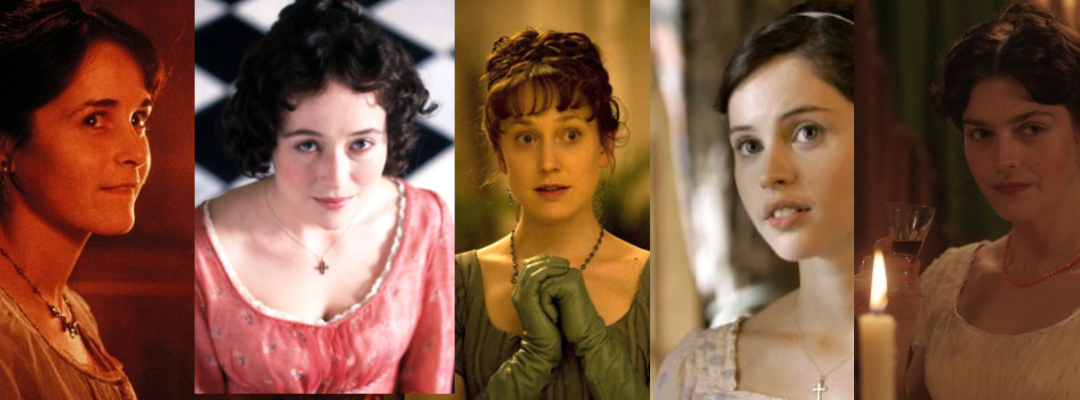
Of course, this involved creating original characters, and that raises the question: What makes a perfect Regency heroine? In other words, who do I want my main character to be? Jane Austen has given us so many wonderful characters that I would be foolish not to take a survey of her leading ladies to see what the options are.
Elizabeth Bennet

We have to start with Elizabeth Bennet. How could we not? She is, as Jane Austen wrote in a letter to her sister, “as delightful a character as ever appeared in print.” Who could not like her?
She is witty and smart, can hold her own in zingy conversations, and usually has the honesty and good sense to see though the hypocrisy that can come with social snobbery. Yes, she sometimes lets her sharp tongue get the better of her, and she’s not above letting her prejudices colour her judgement, but in general her sparkling personality and equally sparkling eyes make her a favourite among everyone she meets.
She’s also pretty, physically active, dances nicely, and plays and sings reasonably well.
Definitely good heroine material there. Really, it’s hard to do better.
Jane Bennet
Jane is one of those characters who is a bit too good to be true. She’s beautiful, kind, modest, loving, and considerate. She has a good heart and a gentle nature, and she’s always ready to see the best in everyone.
But she’s too sweet, too calm. She never stands up for hersef, and her even temper hides her feelings, even from those who think they know her well (cough, cough, Mr Bingley).
So, perhaps she’s not such a perfect heroine after all. There is such a thing as too good.
Elinor and Marianne Dashwood

These two sisters from Sense and Sensibility show us two contrasting personalities. Elinor Dashwood is pragmatic, intelligent, and kind. She strives for rationality and sense, but she also hides her emotions from the world in favour of behaving the way she believes a young lady ought. She is reserved and efficient, the perfect person to manage the household of the Dashwood ladies
In contrast, her sister Marianne is a rushing river of teenage emotion. She is very pretty, spontaneous, and full of Romantic idealism. No neat and tidy parlours for her; Marianne is all about walking out to the cliffs to take in the wild waves of a stormy sea, or dashing out the countryside in an open carriage with a handsome beau, despite the stern looks she gets. She’s a sensitive and gifted musician, and loves Romantic poetry.
What a good set of traits in these two to add to my list of possibilities.
Emma Woodhouse
Where Jane Austen believed that everyone would love Elizabeth Bennet, she was equally convinced that no one other than herself could like Emma Woodhouse, whose opinion of herself is so high, she insisted her novel be named just for her.
In many ways, Emma is like Elizabeth. She is clever and opinionated, and can be very kind and generous. Like Elizabeth, she is a competent musician but has never put in the effort to be truly excellent, and she finds pleasure in many things.
But Emma lacks Elizabeth’s self-reflection, and either by nature or by a lifetime of being told this, thinks rather too highly of herself. With her belief that she knows best, matched with a genuine desire to help, you can see why she’s the Queen Bee of Highbury, bossing people around and not always displaying the sensitivity that many people want in a heroine.
Still, there’s a lot in Emma to consider.
Jane Fairfax

Jane is Emma’s foil, so I’m including her in this list. She is reserved, like Elinor Dashwood, where Emma is more demonstrative, and is very well educated, where Emma has probably guided her governess more than was good for her, and has not yet made it through that list of books she’s always intended to read. Further, Jane Fairfax is the accomplished musician Emma wants to be, and has an elegance that draws the eye.
If Emma is an unlikeable character (according to her creator), what are we supposed to think of Jane? She seems almost too perfect… until we learn that she has a rather scandalous secret as well! She’s a young woman with hidden depths, it seems.
Anne Elliot

In many ways, Persuasion’s Anne Elliot is Jane Fairfax without Jane’s happy ending in Emma. She has an elegance of mind and a quiet beauty that set her above the common sort, but she is also not appreciated by her rather obvious family.
Unlike so many characters in Austen’s novels, Anne is not catty or mean, nor flighty or prone to over-reactions. Rather, she’s constant and rational, picks her friends for their character and not what they can do for her, and is the one everyone depends on when the going gets rough. Even Jane Austen wrote that Anne Elliot is “a heroine who is almost too good for me.”
That she’s perceptive and musical make her all the more special. It’s no secret that she’s my favourite of Austen’s characters.
Fanny Price
I have to admit, I’m not a big Fanny fan. Yes, I know a lot of people love her, and I understand their reasons, but she’s not it for me. She’s the poor cousin, ill-used and prevailed-upon, more family drudge than beloved relation.
Yes, she’s independent, sensitive, and with firm morals, but she lacks the spirit and determination I like in a character. She is timid and runs from attention, and is content to let others blunder their way into bad situations without having the strength of character to address her concerns in any way.
She lacks any accomplishments on the Darcy Scale, and never stands up for herself. She’s the anti-Elizabeth in my eyes.
That said, I’m happy to entertain all opposing thoughts on her, so feel free to tell me I’m wrong in the comments.
Catherine Morland

Okay, I have to admit I really like Catherine Morland from Northanger Abbey. She’s sweet and honest, and adorably naive. She’s a babe in the woods, and quite ill-equipped to deal with society’s games and hypocrisy.
But she’s too young. She’s really a babe. Despite being older than Marianne Dashwood (seventeen to Marianne’s sixteen), she comes across as a total innocent, where Marianne is ready to embrace the tempests of adulthood.
Still, she loves a good book (as any good heroine should) and she knows a good guy when she sees one, even if she’s a bit too quick to lay her finger on the bad guys. There’s some heroine potential in there. Even Jane Austen said so.
Conclusion
Of course, these are hardly all of Austen’s amazing women, but they’re a good sample.
What, then, about my heroine? Which of these many wonderful character traits would make the perfect Regency heroine?
She could be smart and witty, independent and kind, well-read and musical. Or she could be sensible and quiet, reserving her affections for those who really deserve them. Or she could be confident and active, letting the world know who is boss, never settling for second-best.
Of course, the one thing the perfect heroine should NOT be is perfect. Where’s the fun in that? Characters are much more interesting when they grow and change.
With all these possibilities in mind, let me introduce you to my current heroine.
Meet Sophia Bradley of Roslyn Court.

Like Fanny Price, she is the poor cousin to the wealthy Pooles, but she is loved and welcomed (by most, anyway), and is a valued member of the household. She has Elinor Dashwood’s streak of pragmatism, and she is usually the one tasked with anything that requires organised planning. She is only 21, so does not yet have Anne Elliot’s melancholic depths, but she shares her elegance of mind, and like Jane Fairfax, she is reserved, but with hidden passions that only Mr Right can set free.
And, of course, she’s musical. That, in this book, is her superpower, and it’s her entrée to society, where her unfortunate choice of parents might otherwise have barred a few doors. Her music is also what draws the attention of our hero, an army officer suffering from what now call PTSD.
Sophia’s story is still only half-written, but I’ll let you know more about it, and introduce you to Major Isaac Hollimore, closer to release time.
In the meantime, tell me about YOUR perfect Regency heroine? Who else should I ave considered from Austen’s oeuvre? What traits have I missed? What have I got wrong? I’d love to hear your thoughts on what you like to see in a character, and what you dislike!
Let’s chat.


Leave a Reply