
Bear with me as I rifle through my life’s album. By my count, I have used a half-dozen seasonal events to move various books closer to their conclusions. I am convinced my frequent turning to Christmas and Twelfth Night rise from inner truths that inform my stories.
This was not unexpected, I suppose. I am the son of a middle school teacher and a bank teller. Festivities were few and far between. For instance, my birthday is in July, seven months deep in the year, so a school birthday party with classmates was impossible. Cake and one or two friends were about it.
As such, Christmas became the high point toward which my compass pointed all year, something upon which every babe of 1953 could agree. The classic Christmas film, A Christmas Story, filled with anticipation for children and celebration for adults, was my story as a post-World War II Baby Boomer. However, my dad never won a major prize!
My parents were of a different age, shaped by the Great Depression. They husbanded resources. Stories of their childhood (often food-related as nutrition insecurity was a problem) became morality tales in the plentiful Fifties. My mother and father had relatives who lived on the land. Their cyclical lives formed William and Shirley Jacobson. The first three months of the year were dark and cold. Then came planting and tending the fields. Nervousness in advance of harvest drove autumnal activities until Halloween signaled the end of that stress.
Then and only then was the community able to breathe and take account of the previous months. First came Thanksgiving (in the USA). Throughout December, in the Swedish tradition—passed to my father from his parents Gottfried and Svea (Nelson)—celebration and preparation filled the several weeks leading up to Christmas Eve. Pepparkaker and limpa filled the house with spicy sweetness. Given the number of Swedes in our town, there was a distinct chance of a molasses shortage! Church events jostled against Christmas parties tossed by the Western Mass Model A Restorers Club. The only fête my parents ever threw was their annual Christmas Eve celebration. That meant a massive smorgasbord was the centerpiece of December 24. Bounty figuratively piled to the rafters of my childhood home.
Our house had an unheated rear entry, a traditional annex to farmhouses—although the farmland around my house was non-existent—sometimes called a mudroom. One of my earliest memories was going to the kosher deli to buy several pounds of schmaltz herring, which my father would later pickle in a crock using his mother’s recipe to make the Swedish staple sill. Only straight white vinegar: none of that cream or mustard stuff for the Jacobsons! The back hall became our walk-through refrigerator as Dad’s pickled herring aged and several gallons of apple cider hardened. More dishes were pre-cooked and stacked in the entry as Christmas Eve approached. Severe penalties awaited children who decided to race through that aisle lest an unfortunate elbow tip Mom’s mac and cheese for thirty! (1)
Another childhood trek was to Johnson’s Bakery in Springfield, Massachusetts, for all the old-country goods—cheeses, potatis korv, fiskeboller, knackebrod, lingonberry, brown beans—to create the groaning board. Finally, we ate and then, like all good Swedes, nodded through the Christmas Eve midnight service at St. Paul’s Lutheran, an Augustana Synod church. (2)
When I was little, retired ministers, one was Pastor Malmstrom, I think, would come in once a month to conduct an old Swedish-language service for the elderly Lundgrens, Nelsons, Andersons, Johnsons, and Petersons.
Returning home around one in the morning led to the pleadings of myself and my brother Peter to allow the grand opening. Not until I went into junior high school did I understand that my father’s dash into the house to turn on lights while my mother fussed over Pete and me to make sure to snap our hats and button our jackets to our noses—all the while keeping us warm in the car’s backseat—was his way of helping Santa enter a house that did not have a fireplace.

As I launched into the writing of The Gamekeeper’s Cabin in 2023 (see my Christmas anthology Holiday Visions), I found myself drifting back six decades to that childhood. The sense of wonder that frequently escaped me recently returned as the underlying truths of what Christmas meant to me again became apparent. Soon enough, those sentiments found their way into the story. I was writing not as an Austenesque author but rather as someone engaged by young children discovering that, even though they were the children of a gamekeeper and his wife, old Father Christmas knew their address.
The joy of the Tomkins children was a present unwrapped for me. As Elizabeth and William learned, innocence cannot be simulated. However, the generosity of spirit that their parents must have shown each day informed their childish wonder.
Whether Zen or Shaker, when life’s pretensions vanish, such simple gifts resonate through philosophies that guide our behavior.
So, too, were the scales of a life chasing security at the expense of the soul. Now, Christmas has once again found its place in my life. As the season approached, the brightness of my family’s spirit filled the story. I saw that the color of the Season was the pigments my family added to the canvas, one daub at a time.
Heart whole, I looked back at my earlier work and discovered how Christmas and Twelfth Night shaped my Regency vision. Beginning with my very first Austenesque Story—Miss Bennet’s First Christmas—year-end fêtes gave a platform to the cast of players. Soon, I uncovered several telling examples of Christmas and Twelfth Night in my catalog.
Unlike my other festive season scenes, The Gamekeeper’s Cabin is a complete story. Twelfth Night is only mentioned in passing in 2024’s In Westminster’s Halls. That changed with my return to the Bennet Wardrobe’s Universe for the first time since 2021.
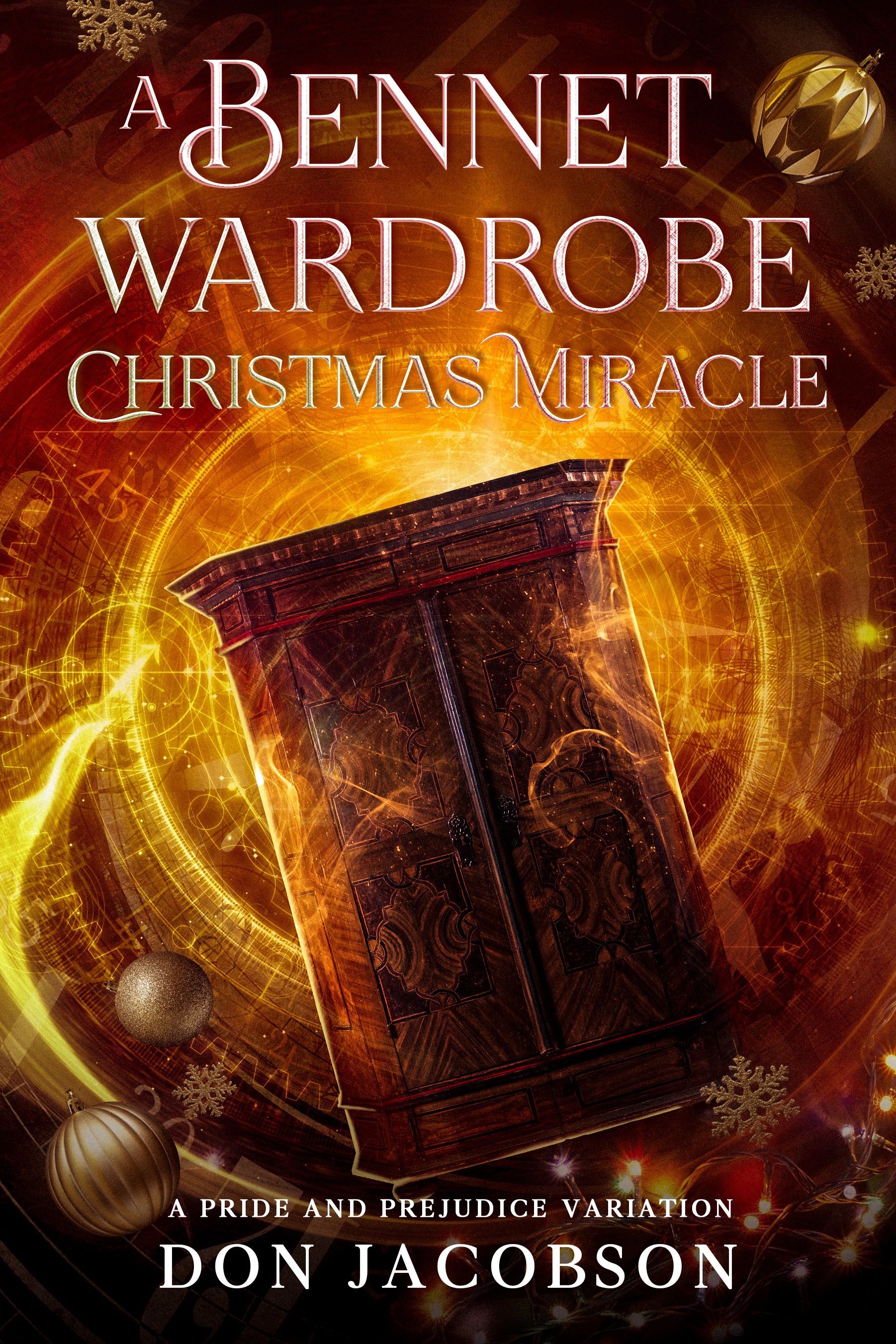
Writing A Bennet Wardrobe Christmas Miracle saw the Wardrobe Series’ themes of Home and Family come to fulfillment. If anything, this 45,000-word novel could be considered the Ninth and final book of the series, allowing us to peer into the complex ballet that features all of the Bennets. While the other volumes treated individuals as the stars—Mary, Kitty, Lizzy/Elizabeth, Lydia, and the Bennet parents—BWCM brings them together on one stage through the good offices of the Wardrobe.
Yet, Christmas is still the universal solvent emphasizing familial love that is the epitome of my saying Home is where your love lives. I hope you will find the following excerpt exemplifying that sentiment.

A Bennet Wardrobe Christmas Miracle is in preorder through November 26, 2024 when it goes live. Available in Kindle e-book, KindleUnlimited, and paperback. Audible is being undertaken and ought to be available before Christmas.
&&&&
This excerpt is ©2024 by Donald P. Jacobson. Reproduction by any means is prohibited. Published in the United States of America.
Chapter Fifteen
Selkirk’s great dining table was nowhere to be seen. Instead of the regal banquet hall, those familiar with the castle’s floorplan realized they were entering the family dining salon where a more modest—if a table set for twelve could be called humble—burnished walnut expanse rested. While there were no place cards, convention insisted that the Bennets sit opposite one another at the center, with their kin alternating man/woman from either hand.
Seasonal favorites dominated the menu, although the bill of fare had been created with Tom and Fanny in mind. Cloved ham filled the air with its exotic scent. Other dishes, though, gave a historical flair to the meal. Salmagundi salad, white soup, galantines, raised pies, and venison were Tom and Fanny’s favorites. As Longbourn’s master, he had trodden on her mistress’s prerogatives when encouraging her to include some or all when they dined in the twenty-four families. These treats were impossible in his recent past under London’s post-World War II rationing regime.
In reply to her father, Lady Kate revealed she had asked the Countess of Pemberley to borrow Alma Hill’s commonplace book. Longbourn’s century-old culinary treasures filled that tome. Honoring his hostess’s efforts, Tom, his appetite subdued after his episode, took polite bites of every dish.
Conversation diverged sharply from what was the norm at a countess’s dinner. Weather and road conditions were ignored for expansive reports on children—each one brilliant, beautiful, and accomplished if their parents were to be believed. The Bennets drank in everything, although their eyes assumed a faraway look as they tried to stare beyond horizons they would never cross, mainly when all but Lizzy and Jane spoke of offspring born sometime after…
Once a festive syllabub, stacks of rout cakes, and marzipan treats cunningly disguised as pears and apples had been reduced, Kate raised an eyebrow at her mother, who gracefully nodded. “Thomas: our dutiful daughter has ceded her right of position to me. Ladies, let us gracefully glide back into the parlor where I am certain that appropriate libations await us while these heathens crack walnuts in their bare hands, gulp from flagons of uisga beatha, and do that about which men assume we know nothing.
“But you, my husband and father of five, cannot act as if you are one of your sons’ contemporaries—excluding Lord Henry. You are under doctor’s orders.
“Mr. Benton, you are on notice: you are your brother’s keeper. He is allowed a healthy dram of port on top of the whiskey he shared with you. Under no circumstances is Mr. Bennet to smoke a cigar! His breathing is difficult enough without sticking his head in a chimney for a snootful. I may be only a baronet’s lady—Sir Thomas can explain that—but I expect the two earls to bend a knee before my wishes, or I will set loose the dogs of war: their countesses!”
Five sets of Bennet Eyes—and one sky-blue to near-purple Gardiner—hammered the men back into their seats and then, noses held high, followed like frigates in the wake of HMS Victory as their mother swept from the room.
Henry Fitzwilliam, the eleventh Earl of Matlock, raised one bushy brow at his great-grandfather. “Grandpapa, we have been served notice by Lady Bennet. Now that our mama has departed, ought we give The Founder the freedom of Selkirk?”
Richard snorted. “How did you survive to this age, old son? You met my wife, and if your Kate is anything like my Lydia, she has very distinct ideas on how men must behave even when there are no women in the room. The Duke has nothing on Lady Bennet. Neither Anglesey nor I would dare gainsay Nosey when he got his wind up. Do you imagine her daughters are different?
“Trust me, Eleven, we have our orders. God help us if one of them discovers we were playing fast and loose with our father’s health. Ours would swiftly deteriorate, and my heir is but a lad of seven, thoroughly unready to wear my coronet in the Lords.”
Benton captured the port decanter and sloshed a liberal amount into a crystal goblet he pushed before Bennet. “I am no fool, Tom. My Mary may be unique amongst her sisters in personality, but she inherited Fanny’s steel. Drink up, old man; the well will be dry for you from now on.” None rose to bring the humidor to the table, bowing to the great lady’s imperative.
Darcy’s gaze alighted on Bennet. “The room agrees that none of us would live to wake if we contravened the Queen’s directive. But we gentlemen must have some conversation.
“What did she mean that she was a baronet’s lady?”
Bennet looked at Eight who shrugged, pursed his lips, and tipped his head. “It is your story to tell, Sir Thomas. I am nothing but The Old One’s factotum. I allowed the Universe to use my hands to work its will.”
“As if the head of His Majesty’s Secret Service was anyone’s ‘nothing but….’ No, my lord, you have never been a cipher. The Old One selects the best tool for the job,” Bennet asserted.
His gaze embraced all his sons. “Sometime after my condition ran its course,” he stopped and rubbed his hand above his heart, “that particular Earl of Matlock employed a measure of his remarkable foresight to lay a legend for a certain Hertfordshire gentleman who might require it in the future.”
Bennet stopped and looked uncomfortable. “Having experienced it before, I am loath to see if The Old One will constrict my throat if I try to speak secrets that cannot be said.”
Bingley weighed in, “Keeper Mary told us about the Wardrobe and the Bennets. Lydia explained that the cabinet is the manifestation of the force that stands tall in this universe and all others.
“Mayhap it has decided that our timeline is made of such stern stuff that it can withstand a kaleidoscope of butterflies without tipping the applecart.”
“Hmph. That being the case, I can tell you what that earl,” Bennet pointed his chin at Richard, “did on my behalf.”
Timelines being delicate creatures, Bennet avoided specifics lest he provoke The Old One. He did not say that his introduction as one of the Carleton Club’s first members was to facilitate a meeting with a former prime minister to aid in the search for Lady Kate’s assassin. His description of the General Manager’s expression as he thumbed through the ledger to discover that Bennet had been paying dues for one hundred thirty years was sufficient. Tom did allow that, as a baronet, he and Fanny had sat in the choir stalls observing a princess’s wedding, although he neglected to mention which royal and why a Canadian baronet rated a prime seat. These happy occurrences he laid at Richard’s feet but also said that he did not doubt that The Old One inspired the Earl of Matlock. (3)
Bennet’s tales led others to put their oars in the water. Bingley and Darcy told a story of losing a race with a one-legged gunner. Benton related his introduction to Mr. Adams at the Boylston mansion where the old gentleman came this close to accusing Benton of being a British spy.
On a more serious note, both earls assayed their time in service but chose to talk not of war but diplomacy. Richard addressed accompanying the Duke in Vienna to dispose of Napoleon’s France. In a unique counterpoint, Henry spoke of his partnership with the Frenchman Monnet in Washington City and London, filling ships to save the Great Congress’s Frankish offspring from a Hunnish horde.
Anubis Prime sat back, his face a genial mask, drinking in the cheery tumult made by his daughters’ mates. The corner of his goblet was a stylus, idly tracing random patterns in the snowy-white expanse before him. Listening with his eyes, he sketched each of his five companions, something that had become his nature in the basements beneath the Trust in Lincoln’s Inn when he led the search for the one with Bennet Eyes who had outraged them all.
He may have seemed casually involved with his surroundings. Yet Bennet had not drifted away into unseen realms, closer now as the veil separating this reality from the next became gossamer. He allowed his companions’ stories to buoy him. The Founder had become an expert in assigning meaning to fragmentary messages, surreptitious glances, and barely suppressed sighs. From these, he could learn much.
And Thomas Bennet saw one of his sons, who held Tom’s dearest heart in his large hands, unsure and sliding behind a carefully constructed false front, his own Potemkin Village. Mask or not, Bennet could not leave this here/now without first trying to set things right.
(1) Pepparkakor are Swedish spice/ginger cookies, especially toothsome with Swedish kaffe. Limpa is Swedish rye bread. Molasses abounds in both recipes.
Sill is Swedish pickled herring.
(2)Potatis korv is a Swedish sausage made from potatoes and meat. Fiskeboller is the one thing my son Mike comes this close to refusing to make in his smorgasbords. Fish balls, dear friends, fish balls. Oh, and knackebrod is often referred to by the Swedish-impaired by its brand name: Rye-crisp, not the real deal, but close enough.
(3)The Avenger: Thomas Bennet and a Father’s Lament, Volume Six of The Bennet Wardrobe Series


Leave a Reply