
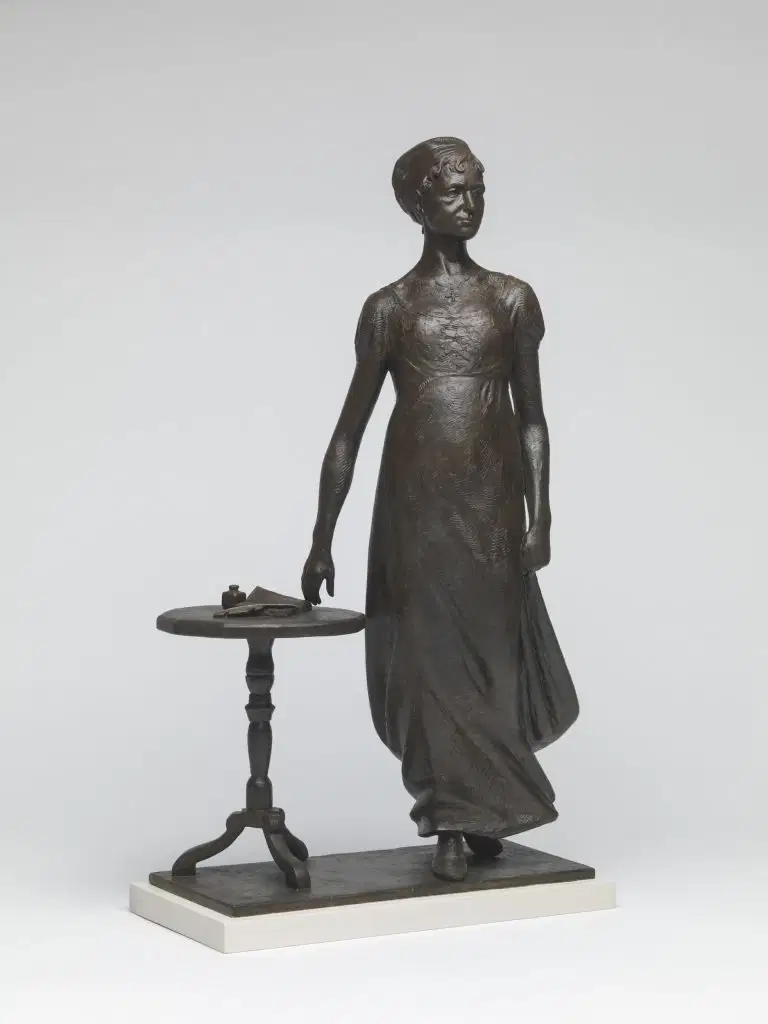
(Photo credit for title image: Maquette of Jane Austen statue by Martin Jennings. Courtesy the artist/Steve Russell Studios)
In December of 2025, Jane Austen will turn 250 years old! To commemorate the event, Winchester Cathedral has commissioned a £100,000 ($128,000) life-sized statue of the author.
Austen lived the last years of her life in Winchester and is buried in the cathedral, and the statue will stand near her memorial gravestone.
The 5 foot statue will depict Austen, looking off into the distance, her fingers grazing the table that holds her paper, quill, and ink pot.
Martin Jennings, the artist, has sculpted many authors, including Charles Dickens and George Orwell. Jennings also recently created the portrait of King Charles III used on commemorative coins. Jennings notes that the statue of Austen will be “a work of imagination.” He adds, “We don’t know very much at all about what she looked like. I want the sculpture to express her spirit.”

Winchester Cathedral probably thought people would love this idea—or at least not care much about it—but it has sparked a wealth of controversy. Here’s why:
- The statue will lead to the Disneyfication of Winchester.
Elizabeth Proudman, former chairman of the Jane Austen Society, notes that the sculpture will be erected in the Inner Close, an outdoor courtyard “where the monks had a private area.” She argues the statue will attract a crowd of tourists to this “special place.” Proudman adds, “I don’t think we want to turn it into Disneyland-on-Itchen. I don’t think the Inner Close is the place to attract a lot of lovely American tourists to come and have a selfie with Jane Austen.”
I’m American. Thank you, Elizabeth, for adding the descriptor “lovely.” I’m a little worried it’s a British euphemism for “loud and obnoxious,” but I’m sure I’m being paranoid.
Catherine Ogle, dean of Winchester Cathedral, defended the location, saying the statue will “bring additional meaning” to the space. She adds that the location was personal to Austen: “The Inner Close is close to the route [Austen] would have taken when visiting her nephews at the nearby Winchester College and her friends at No 12 The Close.”

2. Jane wouldn’t have wanted a statue.
Austen’s work was not widely read until her nephew, James Edward Austen-Leigh, published her biography over 50 years after her death. She was not famous in her lifetime, and Proudman notes that Austen was a “very private person” who “despised publicity.” Proudman concludes that Austen would not have wanted this statue.
I question this. It’s hard for us to know how Austen would feel about this statue, so any arguments of that nature are speculative and don’t feel valid. But, eh, I’ll join Proudman and speculate, anyway: Writers want to be read—so I think Austen would have wanted her books read and celebrated, and this statue does that.
3. Austen has enough monuments already.
Plans for the statue were originally announced in 2019, but the Winchester community revolted against the surplus of Austen memorials in their town, and the idea was shelved. Now that the Cathedral has resurrected its plans for the statue, similar arguments are resurfacing.
Austen’s grave was first marked by a stone inscription that mentioned her rector father and years of life and death.

Over 55 years later, her nephew raised funds to add a brass plaque that commemorated her work as an author.

The house where Austen died is also located in Winchester.

Winchester residents say they already have the stone, the plaque, and the house, and, for goodness’ sake, that’s enough Austen memorials already!
Phil Howe, founder of Hidden Britain Tours, adds that Bath is already guilty of the “hijacking of the Jane Austen brand,” and Winchester does not need to follow in its footsteps.
I hear these complaints, but as someone who’s had a lot of fun visiting Austen’s memorials, I’m all for another one.
Look, I’m just going to say it. I’d take a selfie with the statue. Also, I love Bath. LOVE it.
Oh, no. “Lovely American tourists” does mean “loud and obnoxious,” doesn’t it?
4. It’s a lot of money.
Any time £100,000 is being spent on the arts, people will question whether it should be spent a different way—or not at all.
Ogle, dean of the cathedral, says funds for the statue are coming from “a significant number of private donors and small grant providers keen to see in place the splendid and sensitive design by the acclaimed sculptor Martin Jennings. These funds are restricted by the donors to this project only.”
Got it, Ogle. A raffle drawing for one lucky winner to get In ‘n’ Out for life would be fun, but these donors want a statue of Austen made by Jennings, so that’s how the money’s being spent.
5. It should be a statute of William Walker instead.
Who’s William Walker, you ask? I did too. I wanted him to be someone we could easily dismiss, but it turns out he’s a hero. In the early 1900s, when the cathedral’s foundation was collapsing, Walker spent five years diving 20 feet into dark waters to save the historic building. At the end of each work week, he biked 70 miles home. Winchester resident Michelle T. Fox-Rousell said, “If it was not for Walker there would be no cathedral, and thus no opportunity to waste money that should be directed elsewhere.”

He sounds amazing. Thank you, Walker, for all you did. But the world has a lot of statues of white men, many of which already reside in the cathedral. Would it be okay for Winchester to add one of a woman without people crying controversy?
That’s my two cents. But I’m open to hearing people agree or disagree with me. What do you think? (And, if you were in Winchester, would you take a selfie with Jane?)

Sources I used:
U.K. Locals Fear a Jane Austen Statue Could Turn Winchester Cathedral Into ‘Disneyland
Why is this new statue of Jane Austen so controversial?
What the pictures on Austen’s grave read:
Jane Austen’s grave reads–
In Memory of JANE AUSTEN, youngest daughter of the late Revd. GEORGE AUSTEN, formerly Rector of Steventon in this County.
She departed this Life on the 18th of July 1817, aged 41, after a long illness supported with the patience and hopes of a Christian.
The benevolence of her heart, the sweetness of her temper, and the extraordinary endowments of her mind obtained the regard of all who knew her, and the warmest love of her intimate connections.
Their grief is in proportion to their affection they know their loss to be irreparable, but in their deepest affliction they are consoled by a firm though humble hope that her charity, devotion, faith, and purity have rendered her soul acceptable in the sight of her REDEEMER.
Jane Austen’s added brass plaque reads–
Jane Austen
known to many by her writings, endeared to her family by the varied charms of her Character, and ennobled by Christian Faith and Piety, was born at Steventon in the county of ?? Dec xvi mdcclxxv and buried in this Cathedral July xxiv mdcccxvii
“She openeth her mouth with wisdom and in her tongue is the law of kindness” Prov. xxxi. v. xxv


Leave a Reply to Jean TCancel reply