
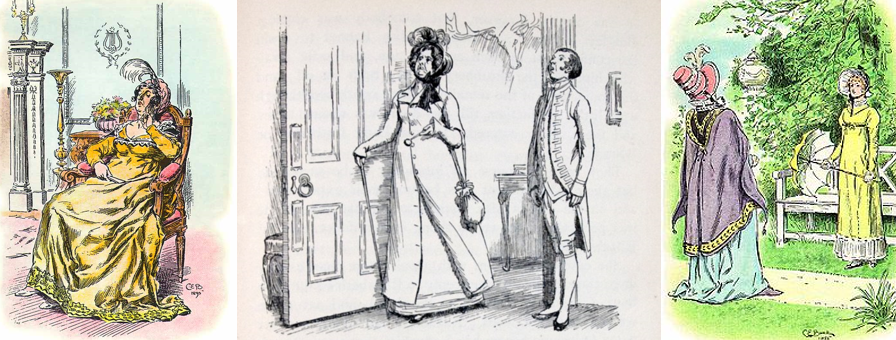

(colour illustrations: C. E. Brock illustration for the 1895 edition of Jane Austen’s novel Pride and Prejudice, centre: George Allen)
Lady Catherine de Bourgh may be an antagonist in Pride & Prejudice, but I find myself hardly able to call her a villain when I compare her to George Wickham. She is rude, self-centred, and proud. Yet, I cannot bring myself to hate her, possibly because like Caroline Bingley, she is the subject of a lot of over-villainization.
Here are a few things I have frequently seen in fan fiction and online discussion about Lady Catherine that I think are unfair:
-She has Munchausen by proxy (as in she’s making Anne ill on purpose for sympathy)
-The medicine she gives Anne is what makes Anne sick (as if she would know this given medical knowledge at the time. Bonus points if Elizabeth is somehow a better doctor)
-Mr. Darcy visits every year to run her estate because she’s that incompetent (this one is almost funny, no way she would allow that)
-Anne would be just fine if Lady Catherine wasn’t so overbearing
-Lady Catherine was delusional about the whole marriage of cousins thing (even though this was very common amoung the rich)

Now I could take the time to refute these one by one (here is an essay about Anne), but I will simply state that Jane Austen is very clear when someone is faking an illness, the narrator usually tells us directly, but Anne’s sickly constitution is never presented as anything but real. Maria Lucas is even shocked by how frail Anne de Bourgh looks. There are many possible causes of Anne’s condition and being “sickly” was a common thing in the past. I see no reason to believe that Anne was not really ill.
Instead, consider this for a moment. In Ch. 30, we hear that, “though this great lady was not in the commission of the peace of the county, she was a most active magistrate in her own parish.” This is a sad joke, because as much as (we assume), Lady Catherine owns Rosings and is one of the most powerful women in Jane Austen’s works, she has little real power. She controls a vast estate, but as a woman, she cannot be the magistrate.
She wants to be revered, but she has failed as a woman, wife, and mother in the eyes of the world. Lady Catherine has produced only one frail daughter, no male heir, no second son to take the living at Hunsford (lucky Mr. Collins). She tries to control everything in her sphere but she can’t control her nephew, she can’t force him to marry sickly Anne. She cannot make Anne well or more accomplished.
Lady Catherine’s life, from this perspective, is kind of tragic. She has achieved nearly the highest status a woman can, but she’s almost completely impotent. Her careful plans for life are completely falling apart and she lashes out. It’s nasty, but it’s not beyond compassion.

The efforts of his aunt’, illustration from ‘Pride & Prejudice’ by Jane Austen, edition published in 1894 (engraving) by Thomson, Hugh
Next, we can consider her grief. I believe that the engagement plan between Lady Anne Darcy (Mr. Darcy’s mother) and Lady Catherine was real. Marrying within a family and combining wealth was a done thing and I find it unrealistic that Lady Catherine would make this up out of whole cloth. We don’t know what Lady Anne was like, but it’s very possible that a good part of Darcy’s pride came from his mother. The plan also may have been made and Lady Anne might have died long before Anne de Bourgh became ill.
Lady Catherine holding on to the plan for her nephew and daughter to marry for so long, despite Anne’s poor health, could very realistically be because it was the dear wish of her departed sister and she has been wanting to fulfill that wish:
From their infancy, they have been intended for each other. It was the favourite wish of his mother, as well as of hers. While in their cradles we planned the union; and now, at the moment when the wishes of both sisters would be accomplished….(emphasis author’s)
Darcy does not feel bound by this wish, but that doesn’t make it less real.
Lady Catherine certainly isn’t someone I would want to meet or be related to, but I do find her sympathetic as a character. She is the mother of a sickly daughter who may not survive to marry and have children. She has a plan for her life that will never come true. She is a woman in a world that offers little real power to even the rich.
I have some sympathy for Lady Catherine.
(Also, she may have been rude about it, but she was not wrong that Lydia was way too young to be out!)
I considered the idea that Lady Catherine may have suffered from pregnancy loss in this story: Miss Anne
More:
Who is more Physically Attractive? The Hero or Villain in Each Austen Novel…
Imagining Jane Austen’s Heroines (with period portraits)
Could Mr. Bennet have Saved Enough for Decent Fortunes on his Income?
Did Mr. Darcy want his Friend Bingley to Marry His Sister?


Leave a Reply to bdellemanCancel reply