
How much irony do you see in Pride and Prejudice?
Jane Austen’s use of irony is one of her most celebrated traits, and Pride and Prejudice is full of it. But until I went deliberately looking for it, I had no idea exactly how much of it there is!
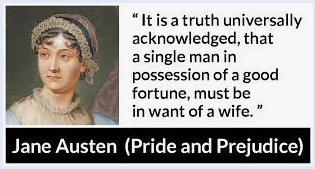
First, though, we need a working definition of irony: a major contrast between expectation and reality, when what happens is directly the opposite of what we thought was going to take place. The very first sentence of Pride and Prejudice is one of the best examples of literary irony ever:

Austen makes us laugh with this droll observation because we know that this is not true. Young men with a good fortune are not always in want of a wife, but many single young women (and ambitious families) wish that they were. Austen uses this ironic and humorous observation to set the tone for the entire novel. She is going to make fun of society and its expectations at every opportunity, and she’ll make us laugh while she does.
Mr. Collins and his pursuit of Elizabeth is another example (and it is some of Austen’s funniest writing!). Collins is so convinced of his own importance in the world (which is ironic all on its own) that he can’t see what is obvious to everyone else: Elizabeth wants nothing to do with him.

Collins awkwardly tries to court her, oblivious to her strategic attempts at avoidance. Then, when he proposes, he absolutely refuses to believe that her no really means no! Mrs. Bennet also can’t take no for an answer (which is not ironic, but quite amusing). The whole scene culminates with the ultimate ironic statement by Mr. Bennet to his favorite daughter: “Your mother says she will never speak to you again if you do not accept Mr. Collins. I will never speak to you again if you do.”

Irony is at the very heart of the novel, Elizabeth’s impressions of both Darcy and Wickham. She perceives Darcy to be proud, unpleasant, and ungentlemanly, while she believes Wickham to be downtrodden and virtuous. By the end of the novel, of course, she knows that she is wrong. Darcy is kind, generous and principled, while Wickham takes advantage of everyone around him. Yet the irony is that after Elizabeth rejects Darcy, he proves his gentlemanly nature by protecting her and her family. Just when she has come to realize Darcy’s worth, it is too late to accept him. The irony is thick (and oh so romantic)!

My favorite use of irony in the book has to be the role that Lady Catherine plays in bringing Darcy and Elizabeth together. Elizabeth and her family are exactly the kind of lower class gentry that Lady Catherine despises. They bring no wealth to a potential marriage, they are poorly behaved, and they have close connections to trade. But it is Lady Catherine who brings Darcy and Elizabeth together. They probably would never have met again after Darcy left Netherfield if Lady Catherine had not employed Mr. Collins and encouraged him to marry. But they do meet again, and the stage is set for their romance to really take off. Lady Catherine, who takes pleasure in ordering the lives of everyone around her, doesn’t see what is happening under her own nose.
Even better, towards the end of the novel Lady Catherine visits Elizabeth to ask if she is engaged to Darcy- which is ironic, since Elizabeth had already rejected him. But her verbal abuse is exactly the sort of thing that will make the headstrong Elizabeth more determined than ever to marry whomever she wants. When Lady Catherine then visits Darcy to tell him not to marry Elizabeth, she ironically gives him reason to hope as he never hoped before. After all, he knows that if Elizabeth still disliked him, she would gladly have told Lady Catherine so. Thus Lady Catherine becomes the unwitting Cupid to two lovers she wants to keep apart. They will soon reach an understanding thanks to her oblivious interference/assistance. It’s all deliciously ironic! (And the payback is so satisfying!)

There are many, many other examples of irony in Pride and Prejudice. I hope this short list makes you start thinking of other examples from the story. How many can you come up with? Please tell me in your comments below!


Leave a Reply