
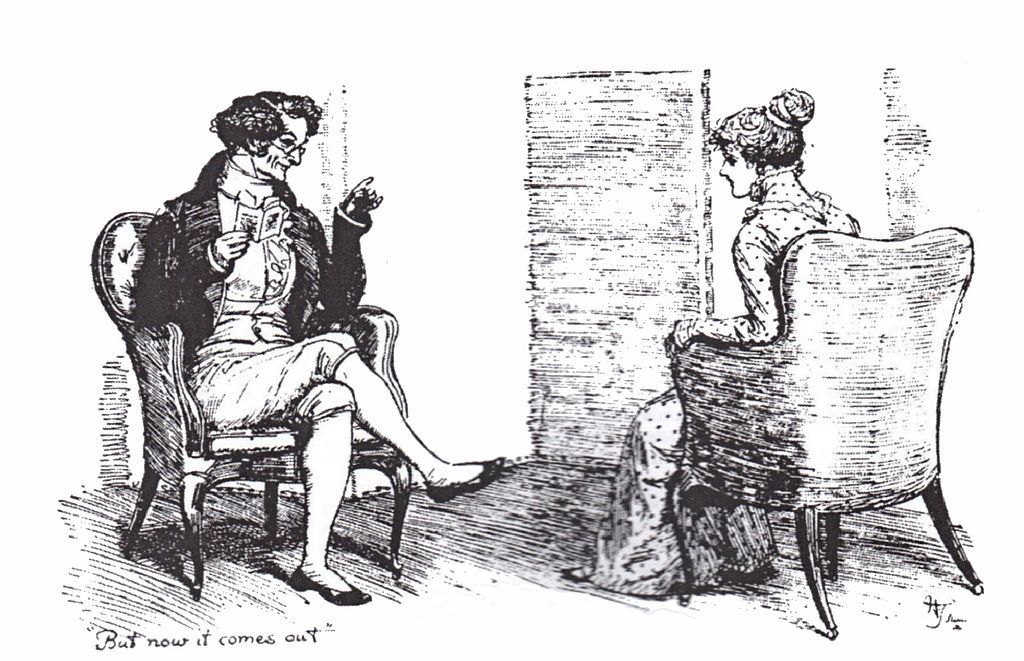
There is a conversation I have online a lot, it goes something like this:
Me: Mr. Bennet should have made sure that his daughters were properly educated and well-mannered.
Them: No, you’re being too modern. That was the mother’s job.
Me: Not according to Miss Elizabeth Bennet!

Mr. Bennet: Famously unconcerned about parenting
In fact, fathers being involved in the upbringing of their children is discussed in Northanger Abbey, Mansfield Park, Pride & Prejudice, and Persuasion, so it’s far from a modern concept to think fathers should contribute in some way to their children’s education and upbringing. Here are some direct quotes:
Writing and accounts she was taught by her father – Northanger Abbey (of Catherine Morland)
The terror of his former occasional visits to that room seemed all renewed, and she felt as if he were going to examine her again in French and English. – Mansfield Park (thought by Fanny Price about her uncle/guardian Sir Thomas, who stands in the place of her father)
As to the management of their children, his theory was much better than his wife’s, and his practice not so bad. “I could manage them very well, if it were not for Mary’s interference,” was what Anne often heard him say, and had a good deal of faith in; but when listening in turn to Mary’s reproach of “Charles spoils the children so that I cannot get them into any order,” she never had the smallest temptation to say, “Very true.” Persuasion (about Charles & Mary Musgrove as parents)
So what about Mr. Bennet?

Mr. Bennet, in the BBC adaptation of Pride & Prejudice 1995
Here is what Elizabeth Bennet and the narrator have to say about his parenting:
But she had never felt so strongly as now the disadvantages which must attend the children of so unsuitable a marriage, nor ever been so fully aware of the evils arising from so ill-judged a direction of talents; talents, which, rightly used, might at least have preserved the respectability of his daughters, even if incapable of enlarging the mind of his wife.
Her father, contented with laughing at them, would never exert himself to restrain the wild giddiness of his youngest daughters
“If you, my dear father, will not take the trouble of checking her exuberant spirits, and of teaching her that her present pursuits are not to be the business of her life, she will soon be beyond the reach of amendment.“
“…He [Wickham] might imagine, from my father’s behaviour, from his indolence and the little attention he has ever seemed to give to what was going forward in his family, that he would do as little, and think as little about it, as any father could do, in such a matter.”
Furthermore, Mr. Bennet was well aware that his wife was not intelligent or proper. It’s not clear why they never employed a governess, but Mr. Bennet ought to have insisted on one to make up for the deficiencies of his wife. A governess only cost between £20-50/year, so they could definitely afford it. Which brings us to what people seem to think is his only job: finances. Given that he’s saved absolutely nothing, he’s a failure as a father there too.
Yes, Mr. Bennet has one shining moment when he doesn’t force Elizabeth to marry Collins, but in general he is indolent and useless as a father. Unlike Sir Thomas from Mansfield Park, he doesn’t even learn anything by the end. Mr. Bennet makes one quip about how he’ll get over the feeling of guilt quickly and then makes Kitty cry over a threatened grounding, that’s it. His daughters being saved from ruin and poverty happens without him contributing anything. Mr. Darcy even avoids visiting Mr. Gardiner until Mr. Bennet has travelled back home.
Mr. Bennet may be a beloved character because he’s funny, but he was a failure of a father; even to Elizabeth, and even in the early 1800s.
More about Pride & Prejudice:
Could Mr. Bennet have Saved Enough for Decent Fortunes on his Income?
Did Mr. Darcy want his Friend Bingley to Marry His Sister?


Leave a Reply to GloryCancel reply