

My dearest friend, who has been at my side for over thirty years, would tell you that this blog was only a matter of time coming. I have spent countless hours writing her letters, at times filling notebooks. From when I was stationed overseas and she was in college, her housemates likely rolled their eyes at the hundreds of letters she received from me while I trekked across the world. I am confident I had a hand in keeping the USPS afloat. Then came the email, which meant I saved coin on postage, but it also meant that, but for the rare occasion, the art of putting pen to paper was set aside until I decided to write my first novel. I began the same way I started each story I wanted to share with her. I cannot believe I am the only one who laments the days when hours were lost thinking of those dearest to you and the pleasure of getting a letter in return, of knowing that you were equally esteemed. I dove into this topic with great anticipation, excited to learn about the tools involved but of a writer’s considerations.

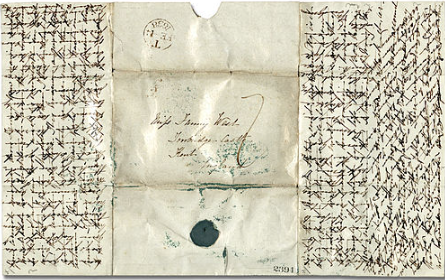
First, the paper. Does the letter’s author need 16 1/2 inches by 13 1/4 inches? Or could it be trimmed? It was important that no paper be wasted, so the author sitting down to write may pick from pieces trimmed from other letters or cut off some of the sheet they intended to use. But to use the whole sheet you chose, no matter the size, was equally important. If that meant crossing lines, circling words around other paragraphs, or more inventive ways, it was employed by those authors of letters during the Regency, times before it, and those that came after.
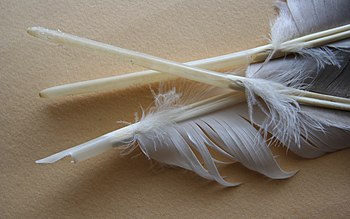
Then was the question of pencil or quill. If one chose the quill, it could not be any feather from any bird. The best quills came from the primary flight feathers of living birds. Further, left wings were a better-curved fit for the majority of the right-handed population. Conversely, right-wing feathers were better suited to those of the left-handed writers. Additionally, the quills from different birds proved different thicknesses in letter writing. Swan feathers produced thick-stroked letters, crow feathers produced thin ones, while goose feathers were the most popular.

The most commonly used ink for letter writing was made from oak galls, iron sulfate, and acacia gum. I have also come to understand that there was an equally great art of writing a letter without having a hand stained by ink by the end of it. It was not easily cleaned if spilled, nor was it easy to clean out of one’s garments. Once the letter was written, sand or a fine powder was used to dry the ink.
Folding the letter was important so no one could read any private information within. And sealing the letter, red wax being the most common, was necessary to prove the letter was unopened to the recipient.
But the most beautiful part of the letter was the addressing of the letter, being either respectful or a salutation of endearment. Each sentence required thought and consideration before it was written. It was not unheard of for people to draft the letter they intended on cheaper paper before using a more expensive sheet.

The one thing my dearest friend is ever grateful for is that the sender now pays for postage. During the Regency, the cost of a letter sent varied due to the distance it needed to be carried, the weight, and whether it was paid for on dispatch or by the recipient. Letters cost double if there were two sheets. I blush as I consider what my letters would have cost when there were ten sheets together! But it was a lovely art, and the letter received was a treasure gifted by the sender. It is also one that has been, unfortunately, lost to technology.
Sources for The Bygone Art of Letter Writing:
Grace, Maria “A Touch of Quill and Ink: Regency Letter Writing” Random Bits of Fascination October 7, 2014, A Touch of Quill and Ink: Regency Letter Writing – Random Bits of Fascination
Monajem, Barbara “Letter Writing of the Regency Era” Caroline Warfield’s Blog April 30, 2020, Letter Writing in the Regency Era – Highlighting History (carolinewarfield.com)
Author Unknown “Regency Culture and Society: Etiquette and Tips and Tricks of Letter Writing” Regency Reader Date Unknown, Regency Culture and Society: Etiquette and Tips and Tricks of Letter Writing – Regency Reader (regrom.com)
SuziLove “Letter Writing – Postal Information In Regency Period” Regency Fiction Writers The Beau Monde May 18, 2011, Letter Writing – Postal Information in Regency Period – Regency Fiction Writers (thebeaumonde.com)


Leave a Reply