
Other than Jane Austen fan fiction…

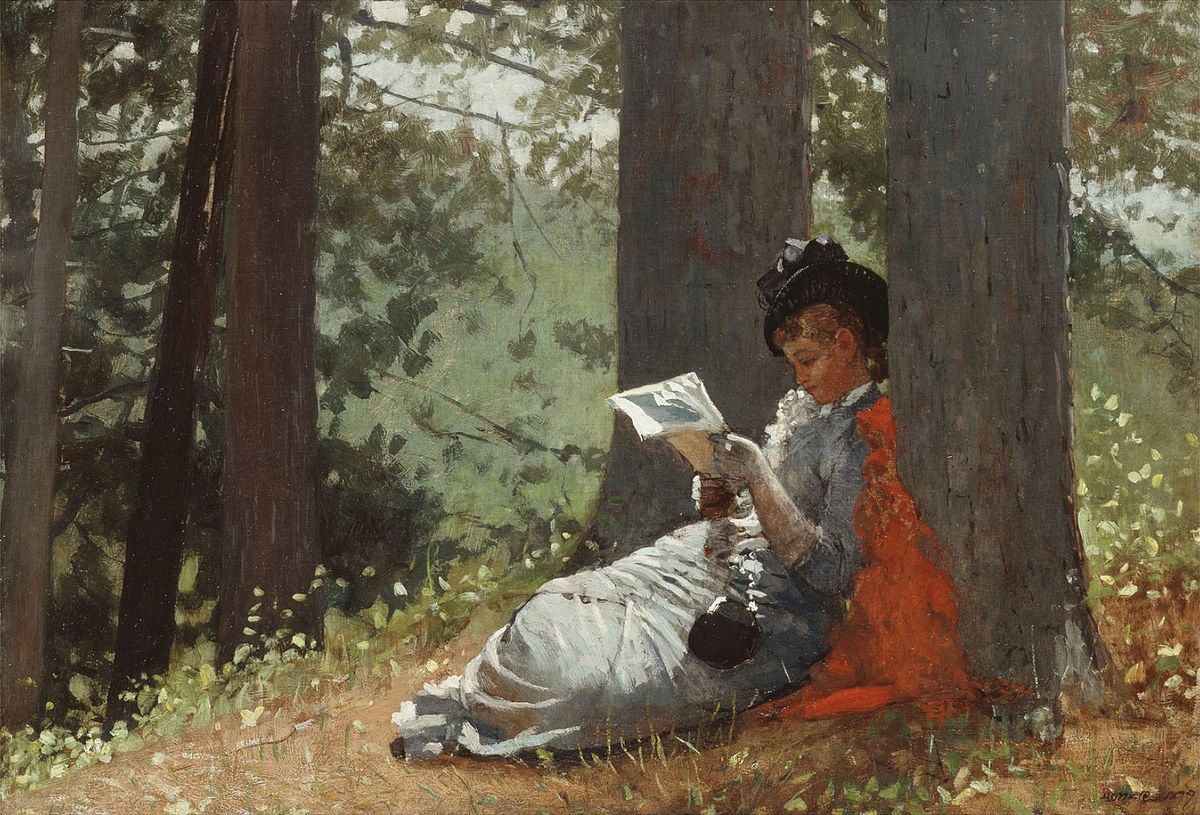
In the Meadow, Claude Monet 1876
It’s summer, which for me means sitting down outside with a good book. I’ve been exploring other, primarily female, British authors and if you’ve been asking the question, “Who has a similar style to Austen?” I may have an answer for you.
If you like the way Austen makes psychologically real characters, try Elizabeth Gaskell. I would start with Cranford, which is like a full town of Miss Bates and Mrs. Bates trying to survive at the bottom of the gentry. Some people find the overall tone sad, but I thought it was hopeful. The novel primarily tells the story of an older spinster named Miss Matty who is the daughter of the former clergyman of the town. The narrator is a young woman who observes the follies and foibles of the older widows and spinsters around her.
“I’ll not listen to reason… Reason always means what someone else has got to say.”
–Cranford, Elizabeth Gaskell
My personal favourite by Gaskell is Wives & Daughters. It is unfinished, as she died before writing the final chapter, but it feels finished. It’s a lovely story about the young daughter of a country surgeon whose father remarries and she must learn to live with her fussy stepmother (she’s like Mrs. Elton) and her mysterious stepsister (probably most similar to Marianne Dashwood, with a hint of Mary Crawford). The story covers growing up, love, and grief. It also has a very interesting plot line about gentry family that is in decline.
“I won’t say she was silly, but I think one of us was silly, and it was not me.”
–Wives & Daughters, Elizabeth Gaskell
Finally, North & South by Elizabeth Gaskell is often described as industrial revolution Pride & Prejudice, except the girl is a snob in this one! It’s about the rise of industry and how that changed society, among other things. You may have seen the 2004 miniseries. I am planning on reading more of her works soon!

George Eliot is also amazing at characterization. I’ve read Silas Marner and The Mill on the Floss so far (I know, I know, Middlemarch is on my list but both of these were shorter) and they were very good. Silas Marner is about a miserly weaver who on the same night loses his entire life savings but gains a toddler. It has a very happy, satisfying ending and feels a bit like a fairy tale. The Mill on the Floss is about the daughter of a miller, and fair warning: it’s a tragedy. Both books had excellent writing and great quotable lines.
I suppose one reason why we are seldom able to comfort our neighbours with our words is that our goodwill gets adulterated, in spite of ourselves, before it can pass our lips. We can send black puddings and pettitoes without giving them a flavour of our own egoism; but language is a stream that is almost sure to smack of a mingled soil. There was a fair proportion of kindness in Raveloe; but it was often of a beery and bungling sort, and took the shape least allied to the complimentary and hypocritical.
–Silas Marner, George Eliot
Mrs Glegg had both a front and a back parlour in her excellent house at St Ogg’s, so that she had two points of view from which she could observe the weakness of her fellow-beings, and reinforce her thankfulness for her own exceptional strength of mind.
–The Mill on the Floss, George Eliot
Oh, and if you didn’t know, George Eliot is a woman. I only found that out after purchasing Silas Marner! George Eliot wrote primarily about the middle class and Elizabeth Gaskell about the lower part of the gentry, so they weren’t writing about exactly the same level of society as Austen. Gaskell is closer to Austen in that respect.

Portrait of Mary Ann Evans, who used the pen name George Eliot
However, if you like Austen’s wit and social commentary, the only thing I have found that gets close is Oscar Wilde’s four drawing room plays, The Importance of Being Earnest, An Ideal Husband, Lady Windemere’s Fan, and A Woman of No Importance. Two of these have Hollywood adaptations with star-studded casts and they are very faithful (Cate Blachette, Reese Witherspoon, Colin Firth, etc).


A Woman of No Importance is my personal favourite, it’s like what would have happened if Marianne Dashwood had a child with Willoughby and he predictably left her to deal with it alone. In fact, it felt so much like this that I wrote a fan fiction to that effect! (called Second Meetings).
I also find Oscar Wilde to be very sympathetic to the plight of women in society. He writes mainly about the aristocracy and the top of the gentry, so a little bit higher than most of Austen’s characters. Also, if you’ve read The Picture of Dorian Grey and are wondering why in the world I’m comparing him to Austen, the plays are very different from his only novel. The tone is much lighter and satirical.
“Oh, I love London Society! It has immensely improved. It is entirely composed now of beautiful idiots and brilliant lunatics. Just what Society should be.”
“I don’t care about the London season! It is too matrimonial. People are either hunting for husbands, or hiding from them.”
–An Ideal Husband, Oscar Wilde
I know you’ve been waiting for it: people are going to suggest the Brontë sisters and I will tell you now, the right Brontë is Anne. She doesn’t write Gothic Horror she writes realistic fiction. The Tenant of Wildfell Hall tells the story of a woman who thought she could change her husband with the power of love. As Austen predicted, it doesn’t go well. It hooked me at Chapter 3 with a conversation about parenting that I could have had yesterday! Agnes Grey is about what it’s like to be a governess in the middle of the 1800s. It’s not as well written, but Anne Brontë worked as a governess herself so it’s fascinating as a semi-autobiographical, first-hand account.
“You would have us encourage our sons to prove all things by their own experience, while our daughters must not even profit by the experience of others.“
–The Tenant of Wildfell Hall, Anne Brontë
I did enjoy both Jane Eyre by Charlotte Brontë and Wuthering Heights by Emily Brontë (that’s as far as I’ve gotten into the Brontë sisters), but they are nothing like Austen! Wuthering Heights is… a generational revenge quest? Jane Eyre is the very Gothic horror that Austen satirized in Northanger Abbey, right up to the Secret Attic Wife (spoiler for a 200 year old novel). I do find a lot of parallels between Jane Eyre & Fanny Price and Henry Crawford & Edward Rochester, but I wouldn’t say that either of these novels were similar to what Austen wrote. Charlottle Brontë herself said her works were nothing like Austen’s.
If you want to try something Jane Austen read herself, the best one I’ve read so far is Belinda by Maria Edgeworth. It has a female duel! However, what I’ve learned by reading books Austen may have read is that she really was revolutionary. Novels published at her time were often a disjointed collections of stories, kind of like a modern sitcom, and characters tended not to be very fleshed out. I haven’t been able to get through The Vicar of Wakefield and I only finished Evelina because I had friends encouraging me. However, I’m glad I tried because they do give a lot of insight into what Austen was thinking when she wrote her own stories.

Girl Reading by Yli Haruni
What are you reading this summer?
More:
The Problem with Portrayals of Mr. Collins
The Unwritten Proposals in Jane Austen’s Novels
Imagining Jane Austen’s Heroines (with period portraits)
Who is more Physically Attractive? The Hero or Villain in Each Austen Novel…


Leave a Reply to bdellemanCancel reply