
#GoneWithTheWind #JaneAusten #AlwaysAusten #PrideAndPerjury
The other day on Facebook someone – let’s call her X – complained about a (non-Jane Austen) novel that she couldn’t finish, because she couldn’t like the heroine enough to “root for her”.
Some people berated X, but I’m actually a massive believer in not finishing a book. There are so many great ones out there, and so little time!!!
Also, books need to catch you at the right point in your age/experience. Here are my recommended ages (since absolutely nobody asked) for when a booklover should first approach Austen’s:
- Before they’re 20: Pride and Prejudice
- When aged between 20-25: Sense and Sensibility
- Once they’ve reached about 30: Northanger Abbey, Emma, Persuasion, Lady Susan, Mansfield Park
Of course, some people will never appreciate the last few here – and the order is significant – but we’re talking intelligent booklovers, after all!
Returning to that Facebook booklover’s page, some people supported X’s decision to quit a book because she couldn’t empathise with its protagonist.
I didn’t. Instead, I remembered arguing with a friend when I was twelve that Scarlett in Gone with the Wind was too great a character to miss, even though she was a very bad person. I was always bothered by the view that you have to “root” for a character in order to learn from or to appreciate a book.
I do, however, understand the thrill of rooting for a heroine. After all, I rooted for Pippa Longstocking. (I loved Pippa Longstocking!!!) I rooted for Anne of Green Gables. (I wanted to be Anne of Green Gables!!!!) And yes, I rooted for all of The Little Women, though for some sisters more than others. I was also crazy about Enid Blyton, The Secret Garden, The Little Princess, Ballet Shoes and all those horse-mad books like Jill’s Gymkhana (and yes, I definitely wanted to be Jill, who had not one but two ponies!!!)
But – follow me like a lizard here – I’m a grown-up reader now and capable of caring about Anna Karenina (the noted adulteress), Maria Bertram of Mansfield Park (ditto) and even the devious Lady Susan. I’m even capable of caring about Raskolnikov of Crime and Punishment, the murderer of a harmless old lady.
Please note: I’m saying that I’m capable of “caring about” these characters. I am not saying that I’m hoping to “model my behaviour on” them. I am certainly not urging my daughter at Harvard to follow Anna Karenina or Lady Susan ’s lead. Nor am I urging my readers to dump their current squeezes in favour of Henry Crawford – though, were I married to Mr Rushworth, I can see how that idea might hold some attraction. And I’m against anyone, like Raskolnikov in Crime and Punishment, committing murder.
I’m simply saying that I can “care about” these Anna Kareninas, Maria Bertrams, Lady Susans and even Raskolnikovs. I don’t have to admire them – or to see myself in their positions – to “get” where they’re coming from or to learn from their remorse (sometimes, their lack of it).
This is where I think that those readers who limit themselves to reading about people they like, admire or aspire to be – are missing out. They’re stuck at the same stage where we all were once but have mostly moved on from. As an example, let’s analyse Scarlett O’Hara of Gone with the Wind. Is she an admirable character? Um, no.

Why not?
Well, she’s hugely jealous of Melanie because Melanie marries the dishy Ashley (whom Scarlett has a lifelong crush on) – and she’s every bit as jealous and catty as Caroline Bingley was about Elizabeth Bennet – more so, even.
Secondly, her morals are lousy. She’s tries to inveigle Ashley into compromising positions even more outrageously than Maria Bertram tries with Henry Crawford. If she doesn’t wind up an adulteress like Maria – and she doesn’t – this is through no virtue of her own. Instead, it’s entirely thanks to the strong principles of her crush, Ashley Wilkes.
Thirdly, Scarlett also uses all three of her husbands and both of her sisters abominably, even stealing one sister’s fiancée in order to save the family plantation. (The plantation’s her responsibility, being a Southerner and on the losing end of the Civil War.) She even steals her sister’s fiancé by telling him – entirely untruthfully – that her sister has transferred her affections to another man. Scarlett uses lots of people – even Rhett Butler, her third husband, and nobody’s fool – whom she only marries for money.
So, you want to ask, do I admire Scarlett? No way, José.
I think she’s immoral, selfish, manipulative, self-centred, untruthful, catty, jealous, money-grubbing, outrageous and wicked.
But is she also a fantastic, vibrant, thrilling, unpredictable, and unforgettable heroine?
You bet. She keeps you reading to the very last page (from memory, page 601. Really long book – which still reads like a novella.)
And the end of Gone with the Wind is brilliantly ambiguous. Yes: it’s a HEA! – Scarlett knows herself at last! But wait, no, it isn’t – because Rhett has given up on her. In fact, the end is left open, for the reader to decide. Scarlett vows to win Rhett back, but we never learn whether or not she succeeds. Mitchell is treating her readers like the grown-ups we are.
And yes, in a very strange, very complicated, very adult way I’m also “rooting” for Scarlett – to the very end of Gone with the Wind, and beyond. She awakens a massive range of emotions in me (the average reader). This is why the book is so famous, so long-lasting – and so never-out-of-print. And reading books that arouse such complex feelings is what makes me such a fascinating writer. (No, no, I’m only joking!!!) However, and very seriously, any reader and any writer will find themselves enriched by taking on a book with layers in it, and by learning to empathise with a character far from their own.
So, if you haven’t tried to do this yet – if you’re still only willing to consider books with protagonists whom you can root for – I recommend that you give a more-textured book a try. You might not finish it… but it might just open you up a whole new fictional experience – even to a whole new fictional world.

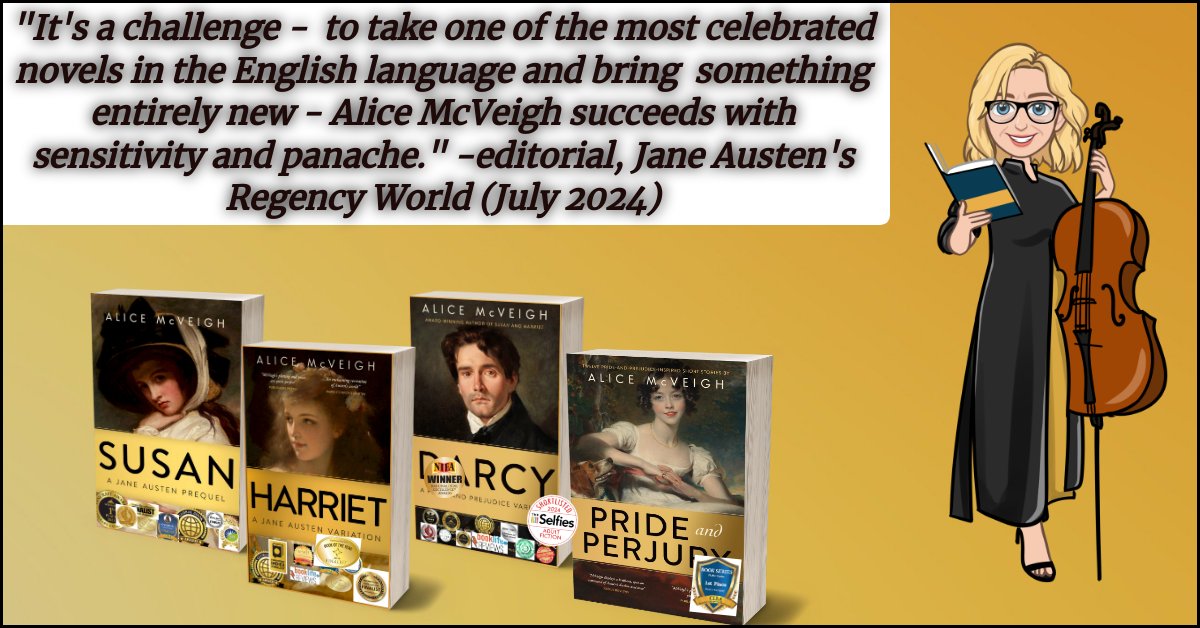
Alice McVeigh’s Pride and Perjury, six weeks old (and an Amazon category bestseller in “British historical literature” and two other categories) has just received its first editorial review. Jocoline Bury in Jane Austen’s Regency World writes:
“It’s not often that a variation on a classic work retains all the dramatic tension of the original, but this book does – and brilliantly… Employing Austen’s own coolly ironic gaze, McVeigh describes Austen’s omitted scenes with remarkable conviction…It is quite a challenge to take on one of the most celebrated novels in English literature and to bring something new to the reader’s experience, but Alice McVeigh does this with sensitivity and panache.”


Leave a Reply