
I recently received an email from an old friend who’s also a novelist, though in a very different genre.
“Hi Alice, I’m feeling low and in need of advice. Maybe everybody secretly dislikes me, but my friends and family, neighbours and acquaintances generally just don’t care about my books. They’ve sold great, and one was even a USA Today bestseller, but none of the people I know is even remotely interested. Is this normal? Am I being too thin-skinned? Have you felt this? Or is it just me?”
I sympathised with this person sooooooo much that it inspired me to address this point, and to ask permission to quote part of the email here. Here’s my response.
Hi X,
You’re dead right, they don’t, they really don’t, care about your novels. And yes, it happens almost all the time, to almost all of us. And yes, it really does hurt.
But – looked at from another angle – why should our friends and family love our books? Reading is such a personal thing! Even in my own book club (called Edgeways, because none of us can get a word in edgeways, lol) we probably disagree about books – rarely about other topics – much more than we agree.
My guess is that this happens because there’s no ‘right’ or ‘wrong’ view about books – even dependably well-written and well-edited books (we don’t mess with anything less). This is because fiction is personal, and people’s reactions to fiction are personal.
Secondly, because fiction is personal, reader reaction can be intense. Books can trigger things in our own pasts. Books can rouse fears for our future. Books can pick us up and leave us in a whole different place. I have non-Edgeways friends – brilliant, inspiring friends – who only ever pick up junk fiction (in order to escape), and friends just as clever who refuse to read anything but Pulitzer, Booker or Nobel shortlists – readers impatient of anything less challenging.
Thirdly, just because your books aren’t for them doesn’t mean that people don’t care about you. My friends love playing string quartets with me, playing tennis with me, walking their dogs with me or joining me for an Indian meal – however, their idea of a good read runs from Shakespeare and Proust to scrappily written smut with abs like writhing pythons on its cover. At these extremes, take it from one who knows, neither my contemporary fiction nor my Austenesque fiction appeals. When I first discovered this, I was devastated. Now – especially as I have more writer friends, some of whose writing just isn’t my sort – I’m ok with it.
Finally, non-writers can’t understand that, to a writer, our books – especially when new – can feel like our children, and we can possess a similar desire to protect them, even though this desire is mad. A book has no feelings: a book is a thing – to be trashed, to be cherished, whichever. A bad review will never touch it… ill-treatment will never harm it. A child – a real child – needs all the protection going. A book can take its blinking chance!… However, because non-authors don’t “get” this, they also don’t “get” how their uninterest or distaste can hurt.
To give an example, let’s return to my all-female book club, Edgeways.
One of our worst book club meetings ever was about Mansfield Park, and – natch – it was All Alice’s Fault. Since it turned out that none of my friends happened to have read it – this was decades before I wrote Austenesque fiction, btw – I proposed it and – yes, you guessed it – none of them liked it.
They had various reasons. A few, like Jane Austen’s own mother – how that must’ve stung! – detested Fanny. They found her too reserved, unrelatable, boring, preachy and nothing like Austen’s other protagonists. They couldn’t relate to her passivity, either.
Others found the book too long, ponderous and slow to get going (of course, the better you know it the more you enjoy even the introduction but yes, an author today would probably kick off when the Crawfords show up. I mean, I would, myself).
A couple of members frankly preferred Crawford to Edmund. (Though I agree, I think Austen called her shots correctly in this case. Fanny and Edmund would be great together – Fanny and Henry would not. So there’s no point wondering when Alice is going to join the “Let’s rewrite S&S so that Fanny marries Henry” JAFF clique. NOT going to happen.)
Others – eek!!!!!! – disliked Austen’s perfectly turned dialogue, her immaculately rhythmic prose. This was probably what upset me most even though, back then, I was personally only writing contemporary fiction. It struck me – a Bach fiend – as comparable to doubting Bach’s own genius. In the end I got so upset I’d have stormed off home in a temper, except that it happened to be my turn to host so we were in my house, lol. That was at least fifteen or twenty years ago, and Edgeways hasn’t risked any Austen novel since – something for which I blame myself. I really shouldn’t have taken criticism of Austen, Fanny or Mansfield Park so personally. But I was young and had yet to learn that people can love me and still dislike my books – the books that I love, as well as the books that I write.
So, since you asked, and I know it’s a big ask, I really would try not to take it personally. So many strangers love your books – what a gift that is, and what a gift you’ve got!
Remember that – and try to let your loved ones off the hook.
XXAlice
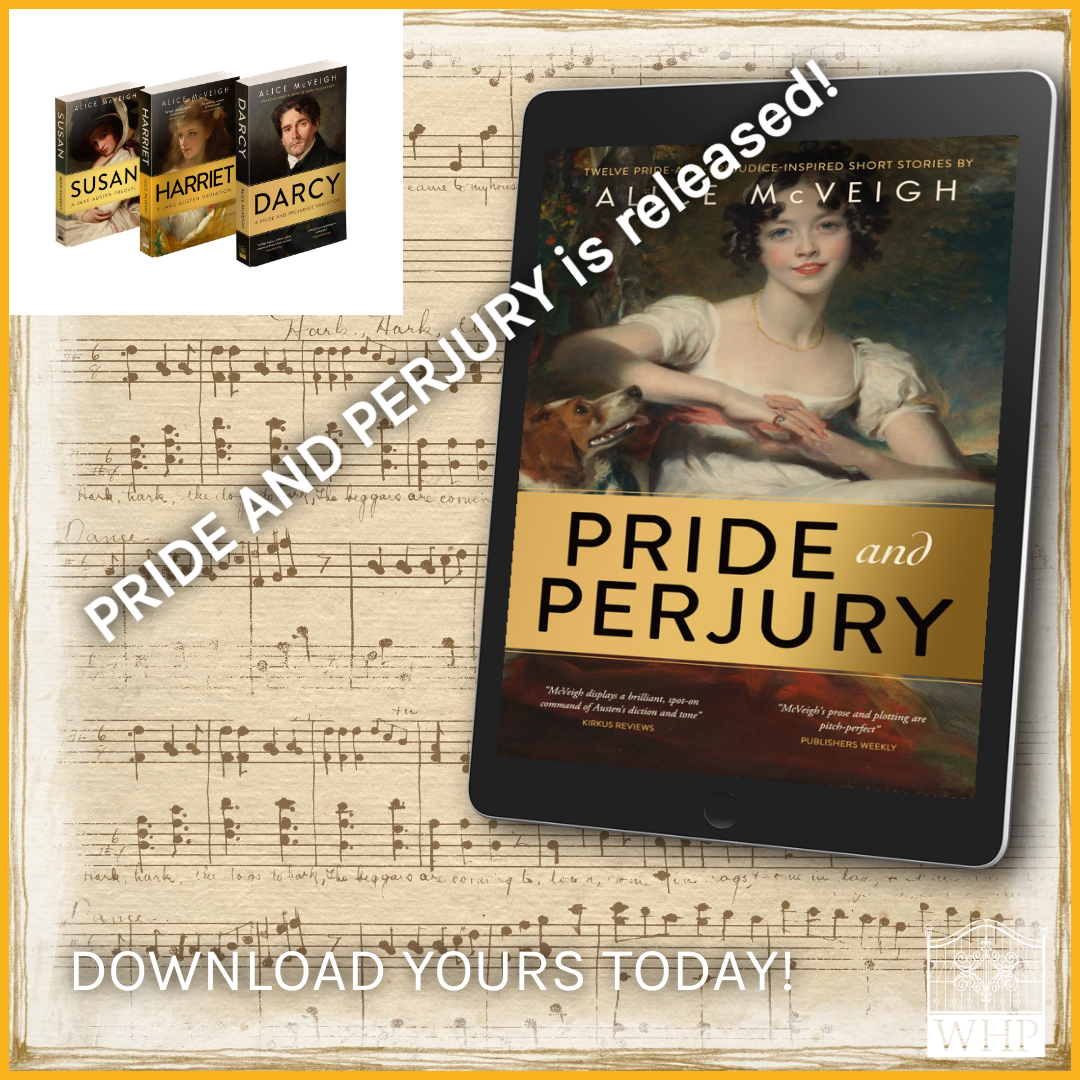
Alice McVeigh’s Pride and Perjury, a bestseller in Amazon.com’s British Short Stories, Humor and Satire and Short Story Anthology categories is currently half-price worldwide. It consists of nine short stories inspired by Pride and Prejudice, and three inspired by Emma.

Here’s a short excerpt:
‘How handsome Lord Cuthbert is!’ thought Anne de Bourgh. Really, it was almost indecent to have such shapely legs, and at such a length besides, and though Amelia teased him for the streak of silver in his dark hair (‘My brother, the badger!’) it was really most attractive… His sardonic sense of the ridiculous also appealed to her and – though the Cuthbert family was not particularly well-off – all in all, she counted herself amongst those ladies who found Lord Cuthbert’s only disagreeable quality to be his perfect indifference to herself. While he teased his sister with such style that, at times, she felt quite envious of Amelia’s having a brother… These thoughts occurred to Anne as she settled in the carriage. She did not particularly wish to return to Kent – she felt better amused in town where, in addition to more diverting society, there were plays, balls and concerts. (Despite the fatigue of attending concerts whilst tone-deaf, she enjoyed watching others in the audience and had, for the purpose, perfected an expression of charmed expectancy.)
In addition, there was not a single marriageable male in or about Hunsford, and she was beginning to fear that she was – in terms of marrying – somewhat running out of time. Although as the heiress of Rosings she must always be sought, by someone or other, she found the cackhanded attempts at flattery by elderly members of the nobility often demeaning and occasionally infuriating. As if she, who – were there a spark of justice in the world – should by this point have been mistress of Pemberley, need settle for a man old enough to be her father!
However, she had heard that the Johnsons were still in the country, and Anne quite failed to share her mother’s dissatisfaction with them. Despite their being new money, and Mr Johnson unashamedly in trade, he was so incurably sociable as to make her sojourn in Kent a far less tedious prospect than it would have been otherwise.


Leave a Reply