
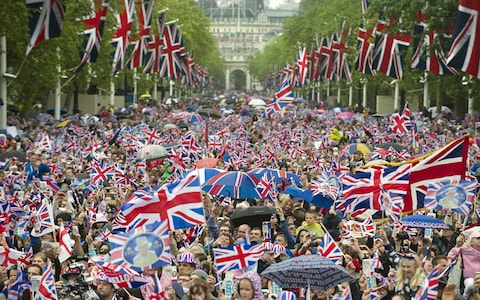
Good morrow, fair readers, and happy Flag Day to my fellow Americans. To my readers from other parts of the globe, worry not, for today is not an official holiday. In my five decades experience, Flag Day has gone from an excuse for early summer sales – as stores enticed my parents to fork over their hard-earned cash – to but two additional words on my calendar. However, this year, those words gave me a wonderful topic for today’s post: a brief history of the flag of the United Kingdom.

Have you ever wondered why the UK’s flag has the moniker, the Union Jack? It seems this is a matter of debate with some claiming “Jack” originates from the flag’s use on the jack staff – the flagstaff on the bowsprit of the sailing ships of the Royal Navy. But I personally favour the etymology which ties it to our dear old friend, King Jimmy – “Jack”, in this argument, being the shortened form of Jacobus, the Latin word for James. Whichever side of the debate you favour, “Union Jack” has been used interchangeably with “Union Flag” since its inception.
What no one can debate, is King Jimmy’s role in the creation of the flag. In 1606, as part of his endeavours to unify Great Britain, King James VI/I merged the flag of Scotland, with its St Andrew’s cross on a blue background, with the red St George’s cross of England’s flag; the result being an early variant of the modern flag.

That modern flag is 223 years old, the brainchild of King George III following the Act of Unification of Great Britain and Ireland. After the British and Irish parliaments simultaneously passed the act in 1800, King George had the St Patrick’s cross of Ireland (a red x on white) added as red stripes in the white St Andrew’s cross to the flag of the United Kingdom. (Interestingly, I noticed in my recent read of the full collection of our dear Jane Austen’s letters that she most often referred to it as the United Kingdoms – plural. I do love my bits of useless information!)

For those decrying Wales’ exclusion from the Union Jack, it appears that England’s annexation of this land of breathtaking natural beauty, rugby, and extraneous ‘y’s predates the adoption of national flags. There is a periodic effort in the UK parliament to have a Welsh dragon – a part of the Royal coat of arms since the 1400s – added to the Union Jack at the centre of the St George’s cross.
I hope you have enjoyed learning a bit about a truly grand old flag. Mayhap my nerdiness shall assist you, fair reader, in a future trivia quiz!

I would like to thank Ann Hawthorne for filling in for me last month and also thank Ms Regina Jeffers for arranging the substitution and for all her work organising this wonderful blog. Those perched upon the edge of their seats – a posture impossible for me at the moment – awaiting an update on my poor patootie, it has been four months and one nerve block since my bounce down the stairs. I can now sit for about 15-20 minutes ere I need to stand; driving remains the worst, but is slowly improving; and my dh and I have finished numerous small home improvement projects (reorganising, painting, etc.) as a means of alleviating boredom. Hopefully, I will return to normal soon.
Godspeed, dear readers, and may you have a wonderful day!


Leave a Reply to Linda A.Cancel reply