
One of the “funnest” things about writing Austenesque fiction is when supporting characters fight to the surface. I guess this comes from an inner voice telling me that the ODC from the Canonical books cannot be the only movers in the story. If we continue doing the whole JAFF Tribute Band thing, we will quickly reach a point where the work will become derivative and repetitive. Honestly, how many versions of Elizabeth Bennet can we write before we lose her essential “Lizzyness?”
Our aim is to explore Austen’s relationships in new and exciting ways. While it’s true that Austen’s works utilized supporting characters, they were often confined to specific, almost stereotypical, roles. Consider a Shakespearean spear-carrier whose sole purpose is to drop his spear and distract the leads. These characters were designed for limited contributions, but they have the potential to be so much more.
The Colonel is often called a “plot device” useful only to alert Elizabeth to Darcy’s role in the Jane/Bingley separation. Mary was to be the prosy moralist, the sanctimonious hector worthy of all of nine lines. Lydia was the object lesson of what not to become thanks to the lack of parental control. Mr. and Mrs. Bennet were diametric opposites, frequently offering comic/ironic relief. The Gardiners provide mystical refuge—and a parlor.
While I can’t presume to understand Austen’s intentions in her use of secondary characters, I believe that these characters, initially portrayed two-dimensionally in the Canon two hundred years ago, now present us with exciting opportunities. In this era of Austenesque Fiction, fifteen years after the inception of Pride and Prejudice Variations, we can use the original character sketches as a foundation to create complex, three-dimensional characters. This, to me, is the essence of Austenesque literature: building upon Austen’s narrative to create something new and compelling.
While it’s undeniably captivating to delve into the depths of characters like the ‘dour tower’ of Fitzwilliam Darcy, the impertinent miss of Elizabeth Bennet, the ethereal Jane Bennet, or the spaniel-like Charles Bingley, we mustn’t forget about the other inhabitants of their world. Austenesque fiction offers a potential universe of characters, each with untold stories.
I have seen—and I have been in the genre for nine years—a sea change in what we bring to the reading public. When I began in 2016, my first story was Miss Bennet’s First Christmas, a novella about Mary Bennet immediately after the weddings of Jane and Elizabeth. While well-received, the criticism was that Darcy and Elizabeth, ODC, were absent. Nobody went so far as to say, ‘Nobody wants to know about Mary.’ Yet, that was the undercurrent. Others said, ‘If you want your work to sell, you must do Darcy and Elizabeth stories.’
Ask Katherine Cowley about the popularity of her Mary Bennet Spy tales.
The same could go for Beth Auron’s The Colonel or Barry Richman’s Doubt Not Cousin: one a modern and the other a personality shift with high angst that emphasizes deep currents in our interpretation of a soldier. Both challenged readers to set aside their desire to only see Austen’s characters in a drawing room engaged in snappy repartee.
Could we have accepted Elizabeth as the Dragon Sage in 2016?
My second outing was the first volume in the Bennet Wardrobe Series, The Keeper: Mary Bennet’s Extraordinary Journey. Writing my truth and not cloning Austen required exploring other characters. The third book, Of Fortune’s Reversal, removed Elizabeth and Darcy entirely from the story and focused on Kitty Bennet and Colonel Fitzwilliam. Can you see a trend?
Not until my eleventh book in 2020—In Plain Sight—did I address ODC in a standalone capacity.
The one unifying feature was that each of these books turned Austen’s supporting characters into leads.
But there is more. As I write, other secondary characters rise, demanding my attention. I have yet to try to fit them together into a single work. The names will be familiar to readers of my work.
Edward Benton (Radical priest)
Caroline Bingley Johnson (Yup!)
Cornelius & Hetty Johnson (freed from bondage by the Johnsons)
General Sir Richard Fitzwilliam (M of British Intelligence)
Annie Reynolds/Wilson (maid and operative)
Sergeant Henry Wilson (Fitzwilliam’s Mastiff)
Coxswain Michael Tomkins (sailor)
Sarah Small/Tomkins (maid)
James Foote (Fitzwilliam’s Cobra)
Admiral Alfred Croft (Not a buffoon)
Sir Walter Elliot (Self-centered but loving father)
Junius Winters (an Austrian lordling slime)
Marius von Winterlich (W’s are evil, in this case, SS evil)
Wadkins (always a villain)
All of these come from the whole cloth that rests in the background of my Austenesque stories. A few—Admiral Croft and Caroline Johnson—are my contemplations of how these specific Austen characters might have developed if their backstories had been explored in greater detail.
Caroline, for instance, had a crux moment when she suffered a nervous breakdown at the double wedding. Four years later, she emigrated to America for a fresh start. Her story appears first in Volume One of The Wardrobe and then comes to full fruition in Volume Eight.
The others, though, are necessary adjuncts to move the plot forward. All too often, enemies of the realm also turn out to be Darcy’s and Elizabeth’s foes—as in my upcoming In Westminster’s Halls.
I frequently write lengthy character sketches to understand how and why they work in my novels—see Volume Two of the Wardrobe, Henry Fitzwilliam’s War. Even if I only use limited traits, I still need to have a whole person standing before me.
One example—a young man who appears in several of my works—is James the Footman from Longbourn. He evolves into an assassin working for Fitzwilliam. His core traits are incredible loyalty and his ability to be unseen by anyone he is tracking. He takes that servant’s invisibility and brings it to play on the colonel’s behalf.
While writing In Westminster’s Halls, I needed to see James, now known as James Foote. The clarifying event in his life was the attempt on Mr. Bennet’s own. Why did that cause him to change his name and accept the colonel’s offer? To answer that, I had to go back twelve years to James’s youth.
See below for James Foote’s story from In Westminster’s Halls.

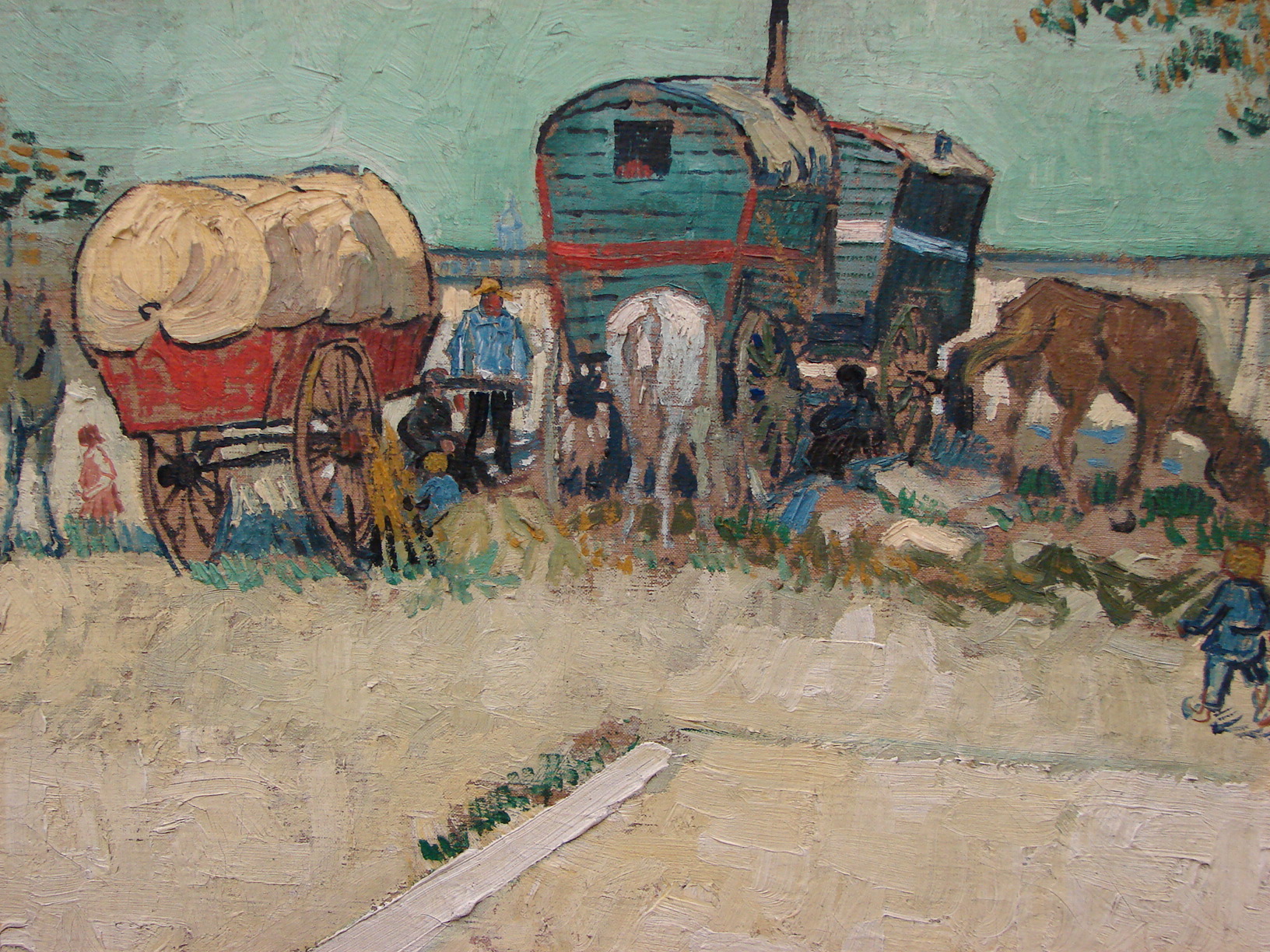
Vincent van Gogh, CC BY-SA 3.0 <https://creativecommons.org/licenses/by-sa/3.0>, via Wikimedia Commons
***
This excerpt is © 2024 by Donald P. Jacobson. Reproduction is prohibited.
The Story of James the Footman
James whispered down the hall. The gentleman—Mr. Darcy, he assumed because James now knew Colonel Fitzwilliam on sight—gave no indication he was aware he was followed. After everything that had happened in the past few days, the young footman had taken it upon himself to step in when Mr. Bennet no longer could protect the young mistresses. Sarah, the maid, was half of the umbrella over Miss Jane’s and Miss Elizabeth’s heads, but she had a good heart and could not see the evil James knew to surround them. Even at her fiercest, the young servant could only hope to claw at an attacker long enough for help. And, as good as the folks in service at Darcy House were, the Longbourn footman could not trust unknown servants to care for his ladies. Their father was already in the hands of the Almighty Father and, after that, the wild-eyed Scotsman Campbell.
We all know it. That carriage coming hard on the Master was no accident. Didn’t see it myself but thank the good Lord that Tommy Tomlinson was to hand and tied off the Master’s leg before he bled out. Tomlinson said that the Master was going on about how he was pushed into the street!
James put his natural and trained talents to work as Mr. Darcy led him down the hall toward where Miss Elizabeth sat. The footman did what he always had done, ghost through his surroundings whether by day or night. He never wondered at his ability to go unnoticed, even when people looked directly at him.
’Twas as if light bent away from James and allowed the world to fill in the void. Young Jamie had always been the perfect servant, invisible in his betters’ presence and only seen when needed. A bland face beneath light brown hair atop a whip-slender body would impress little if one looked directly at him. Turn away—even halfway—and he would disappear. Mrs. Hill, a woman of astonishing acuity—she might have been one of the great verse casters in another life—frequently exclaimed about James, “There’s more’n a touch o’ fairy in ye, boy! Ye might as well be smoke, young Jimmy, for yon breeze’ll mak’ee—and Cook’s bakery—vanish!”
***
It had always been thus. His earliest memories were of a dark-haired woman—his mother?—who had made him feel warm and safe as she fed him porridge from a pot hanging from a crane over a crackling fire. They were outdoors. A wagon, its sideboards gaily colored, glimmered in the firelight. Horses stamped and snorted off to the side as they grazed in the failing daylight.
Another recollection elbowed in, one more frightening, and scraped his soul raw. Men on horseback pounded into their circle, stabbing and cutting at the woman and another, a man: his father? He, the child, had been abed beneath the caravan of many colors. But the attackers did not see him—maybe they did not look, so busy they were ransacking his wheeled home.
Then they left.
He recalled sadness as he crawled from his hidey-hole. A young child could not understand why the woman and man would not wake up. As an adult, he knew why, and every step he took into his future was colored by the knowledge that joy’s end often was unexpected. He had hidden that little boy behind a cold, unyielding wall, refusing to open his heart. He vanished beneath his cloak, shutting himself away—even now, he was cautious about whom he cared for.
A crack in that barrier soon appeared through which care had flowed unbidden. It was a biblical sort of love, not romantic but beneficence: the type that betters were reminded to shower upon lessers. Few could accomplish it without descending into condescension. But one did: Thomas Bennet of Longbourn.
When John Coachman had finally cornered the young lad hiding in the barn some days later, he called his master into the mews between the kitchen and the paddock. If the burly driver had not restrained him by seat and scruff, the youngster would have dashed away—but not before emptying his cache of apples and rolls hidden in a hollowed fruit tree beyond the paddock.
Mr. Bennet had knelt before the boy and gently lifted his chin until their eyes met. The hazel pools calmed all of James’s fidgeting. They never shifted from James, even though the gentleman spoke to his captor. “I see you have found the source of Mrs. Bennet’s complaints, although I doubt if bread loaves growing legs were the center of her attention. ’Twas when Mrs. Hill meekly explained that there were no additional lemon bars at teatime that my lady raised Longbourn’s roof.
“I am less sure if she was concerned that Miss Jane and Miss Elizabeth would faint from hunger—eight and six-year-olds can be a bother when peckish—or if she wanted another sweet treat.
“Now you have captured our thief, but given the food missing from our larder, I must profess surprise. This youngster is nothing but rag and bone—and no little amount of Longbourn loam as dressing. He must be like one of Mr. Watt’s engines, a voracious consumer of fuel.”
Then he grew serious, not forbidding, and spoke of momentous events above a child’s level as adults often do. “That campsite Gould found in the back of Haye Park’s woodlands: Roma, wasn’t it? Two bodies—a man and a woman, no? Butchered they were. My wife loudly worried that all at Longbourn would be murdered in our beds.
“Lucas turned up a child’s bedroll beneath the wagon, but no little one. There is no market for children, only expense. No, I think whoever was under that caravan must have belonged to the dead couple and successfully evaded the marauders.
“We always profess fear of the other, and Roma nomads are all that, but, John, they are no different from us. I saw their campsite after Lucas had arranged for the husband and wife to be buried. Oh, yes, I am sure they were a couple wed in their way and from love, if I am not mistaken. Although the wagon was turned upside down—those animals must have believed the rumors of Roma gold—I could see it was a beloved home just as much as your cottage or my Longbourn. A family lived and loved there just as we cherish ours in our homes.”
Bennet snorted. The sound made James jump. The older man made gentle clucking sounds to settle the child. “Hmmpf: I must write to the Lord Lieutenant to send the militia here to eradicate these vicious bandits. All too many of our neighbors would ask them also to suppress those foreign to our society but do little harm except in the minds of our town’s chinwags!
“The criminals have not been daring enough to attack one of the manor houses, but traffic on the Hertford Road has seen some robberies. Why they turned to killing, I know not. Perhaps they thought we would not care about the vagabonds’ fates.”
Mr. Bennet’s hand moved from James’s chin to cheek, but his eyes never wavered. In a fatherly tone, speaking as if to one of his girls, he asked the simplest of questions: “What is your name, child?”
The language did not come as easily to James then as it did now, but he had learned enough in his young life to understand that he need not fear the man before him. Trust bloomed and pushed away days of loneliness. “Jaume.”
“Just Jaume? Hmmm, you’re too young to remember a last name, I would wager, although you will have plenty of time to decide.” Bennet mused. “Your parents must have come from that corner of Spain called Catalonia or perhaps Navarre.”
He paused before he, priestlike, placed a baptismal hand on the boy’s chest. “You will always be Jaume here in your heart. You will never forget. John will never forget. I will never forget.
“But, Jaume, your name’s foreignness can be used by those less tolerable to place you outside our community. In these troubled times, it will be difficult enough to be lesser born without a name proclaiming your foreign antecedents.”
Bennet stood and placed his hands on Jaume’s shoulders. “Jaume, you are now of Longbourn. Here will be your home and people. We cannot replace what you have lost, but perhaps we can help you grow into a man your parents would have recognized and be proud to name their son.
“However, I must take that first step for you on this long road of life. In the corner of the world from which you sprang, there is a pilgrim’s route, O Camiño de Santiago, that we call the Way of St. James. For more than eight centuries, those who seek the deepest communion in our faith have gone to Roncesvalles to begin their 500-mile trek from the mountains to the great basilica near the Atlantic.
“You, like these seekers, must strive to leave behind who you were for who you will become. Because you have slept under my roof—well, at least my stable’s—and have eaten my food, I claim the right of the host to confer your new name. ’Tis different but the same.
“Yesterday, you were Jaume. Today, you will be James.
“Take my blessing, young James, and know that your home will always be with me wherever I am.”
He bent and kissed the dirty mop atop the newly minted James. Then he wryly smiled at the coachman. “My old playmate: you well know that my lady wife would never allow this lad under our roof like one of our own as much as she desires a boy child.
“May I prevail upon our ancient comradeship? You and your good wife have two just out of leading strings and one more on the way. Could you find it in your heart to ask her if you could stand as godparents to this orphaned child? Bring him up in the ways of Longbourn. We will send him to dame school along with your brood so that someday he can become useful here or elsewhere if he chooses.”
From that day forward, James would be Mr. Bennet’s liege boy and man, vowing to protect with his life Longbourn and all who called it home.
5 responses to “Side Characters Are Not Side Stories”
Lovely excerpt. I like some of the side characters and their stories. Thank you for sharing.
Thank you. James Foote has been a part of many of my stories–In PlainSight, Sailor’s Rest, The Grail. He stands silently beside his friend and partner, Sergeant Henry Wilson.
Great post! I like the side characters too! It was nice to read James’s story.
Excellent excerpt, Don. Mr. Bennet’s comments to Jaume brought me to tears. I look forward to reading more of James’ adventures.
Young James grows into Mr. Foote, Fitzwilliam’s Cobras. He appears in The Grail: The Saving of Elizabeth Darcy, and The Sailor’s Rest.