
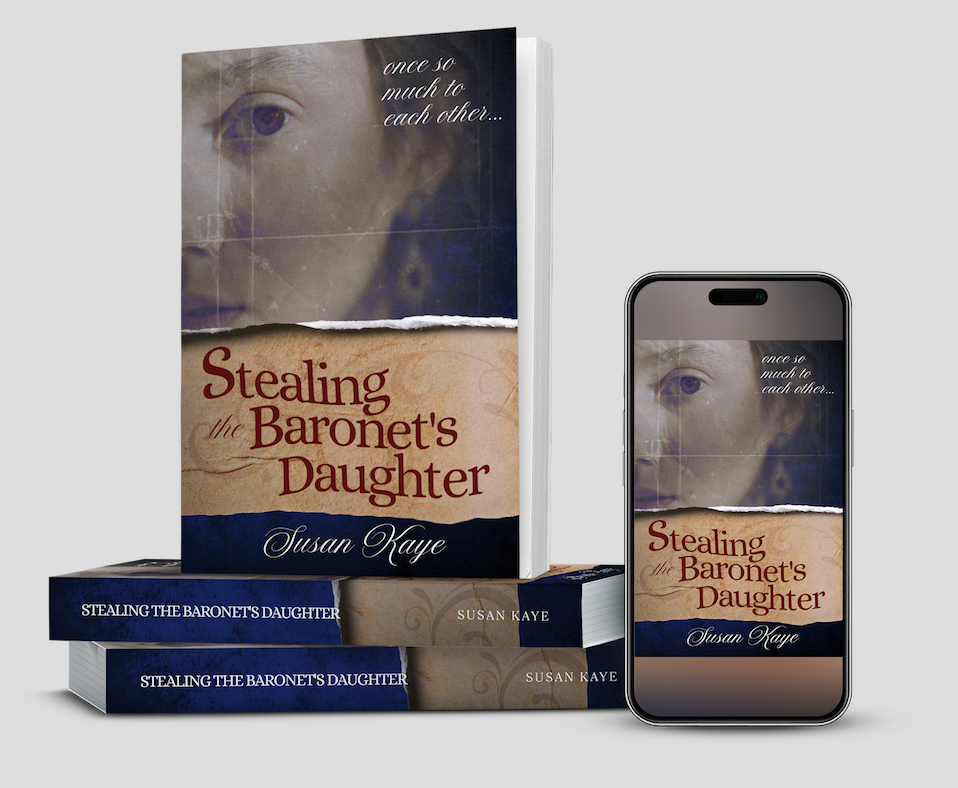
Susan Kaye, a friend of the Always Austen blog, is back today to share a bit on her latest book, Stealing the Baronet’s Daughter.
There are days I look at what I’m writing about Anne and Frederick, and I wonder why I never try writing about any of the other Austen couples. Even the secondary couples might give me something new to do. However, the feelings don’t last and in short order, I’m back with Anne and Frederick again. And I am rather proud to say that I’ve gotten several books out in the past eighteen months, so I am not likely to shift my focus any time soon.
I know many people in the fandom don’t like the way Austen writes how Captain Wentworth returned to Somerset and treated Anne with a cold propriety. Read anger. I agree he’s thoughtless. However, he has a good portion of hurt and rejection he’s still dealing with.
In a FB post, someone said that he lived the life he wanted to and so should have gotten over the hurt and treated her better. I smiled. Years ago, I was writing an emotional scene and, out of the blue, remembered a somewhat similar experience. Mark and I were in high school. He was the brother of a friend. One day, we somehow wound up in a quiet hallway during lunch. Being an emotional coward, I didn’t look at him but could just see his battered high tops out of the corner of my eye. I told him I liked him. Not loved, just liked. There was a long silence, and then the shoes walked away. I can’t even remember what I did that particular day, but remembering the exchange, I cried. I was in my 40s, married happily for over 20 years, and hadn’t thought about Mark for decades. But there I was, a heaving, blubbering mess. We can never discount deeply our heart will bury hurt.
And I give him the benefit of the doubt because Anne Elliot was likely the first woman Frederick had ever loved. And, maybe more importantly, she was likely the first person he had ever told his hopes of wealth and success to. A young man who is beginning to taste success is a delicate thing. The bravado they present to the world is strong, but the true self is fragile. In the rural countryside of Somerset, to have found a woman he even wanted to tell was probably the headiest thing in the world.
And then she accepted his proposal.
Eureka!
As a gentleman is expected to do, the captain went to Sir Walter: “A short period of exquisite felicity followed, and but a short one. Troubles soon arose. Sir Walter, on being applied to, without actually withholding his consent, or saying it should never be, gave it all the negative of great astonishment, great coldness, great silence, and a professed resolution of doing nothing for his daughter. He thought it a very degrading alliance; and Lady Russell, though with more tempered and pardonable pride, received it as a most unfortunate one.”
I think Austen says it best.
And then, Anne agrees with everything her father said.
We know that did not think anything of the kind. We know Anne was heartbroken and conflicted. And vulnerable emotionally to her family. We know that Lady Russell worked on her and, I think, scared her to death with stories of poverty and insecurity. Of officers killed. Or worse, injured. This would leave a wife to struggle with only half pay through a life of decrepitude. Or until her husband finally did die. Read the chapters of Mansfield Park in which Fanny goes home to visit her family. She finds a father disinterested and given to drink. Her mother was overwhelmed with children and domestic life. Fanny’s siblings were ill-mannered and undisciplined. The family was in chaos. I think this is the sort of striking prophecy Lady Russell spun for Anne.
At 22, he could only think to give her a piece of his mind, shake the dust of Somerset from his shoes, and leave. All she could do was mourn.
Anyway, I don’t think he consciously pursues either of the Musgrove girls. At first. I think he was swept up in the Musgrove family. He has lived his life aboard ship for months at a time. The wooden world is a man’s world. The niceties are few and women change the tone of everything. He comes to Somerset expecting to visit his sister for a few days and move on to visit his brother in Shropshire. He did not expect to meet and be love-bombed by the big raucous Musgrove family. They are naturally gregarious and he’s a stranger in a strange land. Add to that he had a connection with them through their wayward son, Richard, and it’s a mix that feeds on itself.
Henrietta and Louisa’s presence was incidental at first. I think he viewed them as friendly young ladies and little else. As time went on, he gave a more intimate connection some thought and probably decided to let the chips fall where they may. In the Gravel Walk, after The Letter, he tells Anne he tried at times to attach himself to Louisa, but it was impossible. Angry pride was the motivating force behind the attempts and that would be a guarantee of failure even if she did reciprocate the feeling. There would be no genuine feelings of love to catch and grow naturally.
Here’s what I imagine:
“Will there be anything else, sir?” The footman assigned to make him presentable stood back, admiring his handiwork. There was not much on the man’s part to do in truth. A captain’s dress uniform was more than enough to make even a middling fellow superior in country company. And Wentworth was not middling.
“No, Harkness, you may go.” The man disappeared silently. This was the evening he would use charm and his naval presence to begin a courtship of Miss Louisa Musgrove.
I may as well, he thought. She is of a good family, speaks her mind, and holds no radical opinions. She seems persuadable but not too much. No bad thing for a young wife. Wentworth had intended pursuing his suit the week before but had been forced into Anne Elliot’s presence one morning and then had to rescue her from her naughty nephew. For some reason, rather than annoy him, the incident had made him see in true and gaudy colors her vulnerability. But that was done and tonight he would do something for himself.
Later, the Musgroves welcomed him with their usual enthusiasm. “The girls are taking their time upstairs, Captain. But the party from the cottage is in the sitting room. Go on through,” Mrs. Musgrove said. He thanked her and followed Charles’s voice to the other room.
The younger Musgrove couple was going on about go to Bath in the winter months. Charles was against and his wife for it. No one else was in the room. No, that was not true. A splash of pea green stood by Miss Musgrove’s harp in the far corner of the room. A sweet cord sounded. Anne admired the instrument and plucked the strings again.
His plans concerning Miss Louisa would have to wait for another day.
(I may have gone overboard with the comment about the uniform. However, those blue and gold babies are … wow.)
The Walk to Winthrop opens a few doors. And enlightened him about Anne’s romantic life over the past eight years. “Was this for me?” is the question he asks himself after learning Anne turned down a very worthy proposal from Charles Musgrove. I think he resisted taking hope from her refusal because the simplest explanation was that Anne, once again, succumbed to Lady Russell’s persuasion. Louisa says that her father and mother believe that to be the case. Over the years, Wentworth had likely developed an emotional habit of unconsciously blaming Anne for all his romantic pain.
At this point in Frederick’s life, his social life, when on land, is ever-expanding. He is a prime matrimonial target for every sister, daughter, and niece of fellow officers, admirals, and the odd wealthy merchant that he would meet when ashore. Staying at sea and pursuing prize was far better for a man with a conflicted heart. To take the news of Anne’s refusal too much to heart would leave him exposed and emotionally vulnerable to hope.
All of this angst made me consider how things might have gone if Wentworth and Anne met earlier, closer to the break-up. And being me, I could not help fiddling with the story.
I’ve enclosed an excerpt from my latest book, Stealing the Baronet’s Daughter. (This is a pretty ham-handed segue to a sales pitch, but I’m in the heart of the Midwest and the storms are unpredictable this time of year. I have to pitch while the pitching’s good!)
In this scene, Frederick and Anne meet when he is trying to capture a ship smuggling gun powder. Anne and her family, thinking the ship is a regular passenger ship, are sailing to Ireland to try to make peace with the Dalrymple side of the family.
“After leaving the Elliots, Wentworth went below deck and paced before his captive’s door. No matter how she had treated him, she was of the weaker sex. He steadied himself before meeting Miss Anne Elliot again. He then entered the room and silently dismissed the guard so that he could study her unobserved.
She tilted her head, listening. She knew she was not alone. Her stiff, confined movements telegraphed fear. His resentment lessened as he studied her. The woman he had once loved more than anything was bound, blind, and completely helpless. All her suffering was by his command.
She tried to remove the hood. The knot was basic and flimsy, but she would never reach it behind her neck. Panic set in, and she stood.
He slammed the door to get her attention. In an instant, he was before her. “And where do you think you’re going?” She was confused and let out a yelp of surprise. The voice was Anne’s.
He wanted to either keep her ignorant of his identity altogether, which he could do by not allowing her to view his face. Or, if he did reveal himself, he wanted her to understand his motives were not criminal, but ultimately ones that would bring him recognition and promotion.
She stumbled back and started to fall. He reached out and held her. They were so close it was impossible not to smell the musk of her fear nearly obliterating the scent of lavender that touched his nose now and then. Rough skin caught on the material of her dress as his ungloved hand moved down her back and stopped at her waist. The pitching ship brought her closer against him. It had been a time since he had the funds to buy some affection from one of Plymouth’s finer knocking shops and the feel of any woman pressed against him was delightful. But this was Annie. He could not cheapen her that way.
The fear of an uncertain outcome of the chaos unfolding above disappeared as they swayed together in a perplexing sort of dance. He could bear it no longer and he stood her upright, pulled the chair back with his toe, and sat her in the chair. He stood before her, touching her legs with his. If he walked away now, she would never know it was him. She might think her sister wrong in her identification of him. Her fingers dug into her thighs and grasped the material of her dress. He had to relieve her distress. “Stand up,” he said. Again, she was against him. This time, her hands were between them.
“Please, sir, please remove this hood. I can’t breathe. Please.” Her voice was lovely, regardless of the circumstances. His hand moved up her back. Reaching beneath the hood, the coarse baize was a sharp contrast to the softness of her. His fingers grazed her neck, and then he slowly removed it.
The ship swung violently, and she was in his arms once again. Annie, dear Annie.”
Thank you for giving me a chance to hopefully persuade you the Frederick Wentworth isn’t so much a cad as he is a hurt and flawed hero. Much like the rest of us.
Take care—Susan Kaye
Stealing the Baronet’s Daughter is available on Amazon:
KINDLE: https://www.amazon.com//dp/B0CWFNF8QH/
PAPERBACK: https://www.amazon.com/dp/B0CY57ZTV4

Under the guise of a common passenger ship, the Baron’s Bride glide across the icy Irish Sea. But hidden below its decks lies a nefarious secret: a trove of gunpowder, stolen from the King’s docks, and bound for smugglers and the black market. Anne Elliot is accompanying her pompous father Sir Walter and haughty sister Elizabeth. Their hope is this Christmas voyage will mend familial ties. But their hollow hearts yearn only for status, not love. Anne’s only refuge from the cold weather and family is observing the working life of the ship. And occasionally wondering about a sailor she once loved.
Just hours from their destination, an old but fast ship appears out of the misty dusk. Captain Frederick Wentworth, Anne’s former love, has a plan that involves retaking the powder from smugglers, rooting them out and thereby gaining the good opinions of his Royal Navy masters.
When they are just close enough to board, Wentworth recognizes Anne. Their soured engagement made her the one woman in the world he hoped he would never meet again. He has to board Baron’s Bride to find information and now the added burden to keep her safe if possible.
The surprise raid turns deadly and after a harrowing escape, Anne must entrust her life to Frederick as they brave treacherous seas and smugglers’ reprisals. Despite old wounds, the flames of love are coaxed back to life. When Wentworth falls into enemy hands, only Anne can save him from the gallows. Together they must rekindle their trust and love to survive.


Leave a Reply