
Good morrow, fair readers. I wish everyone a pleasant spring – or autumn for our fellow Janeites in the southern hemisphere.

It’s not every day I commiserate with my characters… well, at least since leaving the Amish community a decade and a half ago. Occasionally, when I play adult dress up in my Regency gowns, I have sympathised with the ladies of two centuries past. Empire gowns and their underpinnings are generally more comfortable than ladies’ wear from other periods, but I think the bodices overly hamper upper body movement. Young ladies of the time had little choice but to restrict themselves dreadfully homogenous and passive pastimes as reading, needlework, penmanship, watercolours, and the piano-forte. (As much as we love the tree-climbing Lizzy – I, too, am guilty because I want her to have freedom as fitting her canon independence, but as I think about those gowns: ‘twould be impossible to climb without tearing out the back seams of the bodice.)
Since February, however, I have quite commiserated with our dear boy in Mistaken Premise.
For, my dear readers, the graceful belle that I am not, fell, quite forcibly, upon my inadequately padded seating apparatus – notwithstanding the obscene number on the physician’s scale – at the top of my staircase and proceeded to bounce down each step – a la Daffy Duck in a Bugs Bunny cartoon.

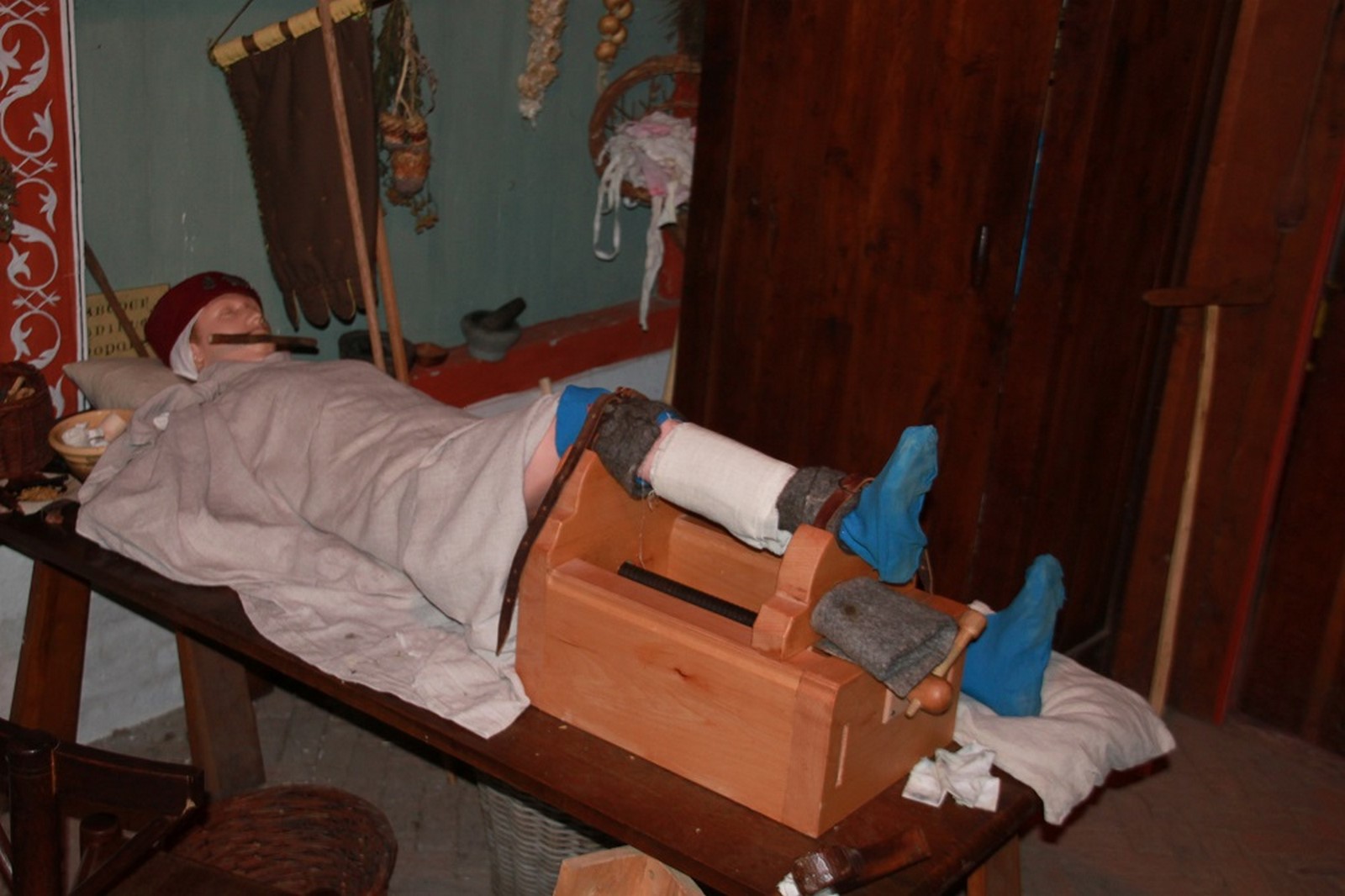
Now, our dear gallant Darcy being confined to bed for months on end whilst his broken legs reknit themselves is unsurprising in the day and age when many physicians refused to touch their patients – lest they be considered tradesmen, losing their distinction as gentlemen, and when slicing open a vein of an ill patient, to expose them to further infection and rob them of their blood, was the first line therapy for everything from a common cold to gunshot wounds. In fact, it makes a degree of sense: they did not have our modern casting techniques. Whereas I was stunned to discover that traction devices dated back to before the Renaissance (or the revival of learning as it was known in the Regency), we can all admit a strips of cloth wrapped around sticks would be insufficient to protect a healing bone, especially a leg bone. I further learned that Europe did not import the plaster cast from Turkey until the 1790s! Even then, this cast could not be applied until any open wounds had healed and the swelling had abated; additionally, since the plaster was poured into a wooden frame, around the broken limb, these casts were heavy and unwieldy. (Bandages dipped in the plaster, then wrapped around the broken limb was a brain child of a Victorian era doctor.

Yet, even with all the advancement of modern medicine, in the year of our Lord 2024 (to borrow my youngest son’s phrase) the only “cure” for a broken pertookis (as my third dear child calls my predicament) is laying in bed for multiple weeks before the medical professionals will even consider further investigation.
<Sigh> At least I have my Kindle and my JAFF friends to keep me company during my weeks of lying upon my left side with a pillow between my knees. (Happy flashbacks to complicated pregnancies and my initial discovery of Jane Austen.) And I have been able to mosey to the kitchen for sandwiches and cup after cup of the blessed beverage, otherwise known as tea. I likewise joined the family for our eclipse picnic (with Sun Chips and Moon Pies), standing for the duration.

I apologise to all my wonderful dear readers who responded to my recent blogs – sitting is nigh impossible currently, my laptop only triples the torture. I know not how much longer I shall be out of commission, but mayhap with this new tablet (a very recent purchase because my Kindle died, likely from overuse), I shall check in online a bit more frequently.
Godspeed!
References re the history of broken bones:


Leave a Reply to GloryCancel reply