
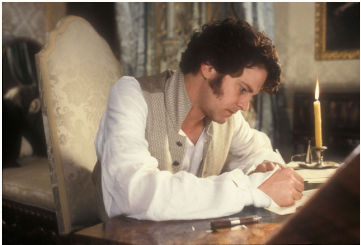
The importance of self-knowledge or self-discovery in Jane Austen’s novels is not likely to be contested as it is a feature, perhaps THE feature that appears in all of them to one degree or another. My personal favorite novel, Pride and Prejudice, has as its hinge the incident of Darcy’s ill-fated proposal at Rosings which results in the letter upon which the possibility of a future together rests. We all cherish the scene: the letter is hand delivered after agonizing minutes of waiting, Elizabeth accepts it with great reluctance, she reads it with anger and denial at its contents; but then, gradually, in a wonderful display of fairness of mind, accepts much of its contents as true. Then comes the shocking admission that before reading this letter, “she never knew herself.”

How many of us would take such a turn in our own writing—to build up an enchanting heroine that every reader will adore and then, frankly, cut her off at the knees! Elizabeth must re-evaluate her entire life and character and embark on a careful restructuring that must carefully examine every impulse, truism, and judgment she has relied upon in the past. With new eyes, then, she looks at her family, friends, acquaintances and, ultimately, Darcy himself, notably when she views Pemberley for the first time.
But, let us examine Darcy’s letter. Is there evidence that he, too, has had a “never knew myself” moment and could that realization have influenced the composition and wording of his letter? We know he was confronted by Elizabeth at Hunsford with her excoriating summary of his actions and character and when he leaves the parsonage, we have no notion how this will affect him. If his “distain for the feelings of others” is unassailable, if his opinion of himself is impervious to criticism of those socially below him, this will be the end of the story. And his last words to Elizabeth (before his words of departure) seem to indicate that this is so.
But the letter shows us that something has happened during the night of struggle writing his letter. He is not yet the Darcy of the second proposal, but he is not the man of Hunsford either. It is here that I greatly appreciate Austen’s deft touch in portraying men, especially men who DO know themselves or come to do so in the course of her novels. They are still decidedly MEN. They may be chastened men or enlightened men, but they are not feminized. So, Darcy still speaks the truth about Elizabeth’s family, but it is measured and calm. His entrusting of his sister’s story to her shows his expectation of and respect for Elizabeth’s integrity and understanding. The broaching of both topics evinces a readiness to shoulder some of the blame in their outcomes but does not retreat from what he genuinely believes or believed is right. Eventually this beginning bears fruit and impels Darcy to rescue Lydia Bennet if he can and save the reputations of the Bennet family, and all on the condition that none of them are to know and with no expectation that he will ever see Elizabeth again. Not only has Darcy come to know himself, but his letter and latter actions show that he has thought long and hard on what he discovered.
Contrast this with the moment of self-discovery afforded Henry Crawford in Mansfield Park when he attempts to make Fanny think better of him by helping her brother William to obtain an officer’s commission in the Navy. Here, I will quote a passage from Jane Austen: An Illustrated Treasury, by Rebecca Dickson that goes right to the issue.
While getting to know William better, Henry briefly recognizes that William’s character is stronger than his own. This scene in the novel, easily overlooked, is important.
[p.89-90]

But this sudden exposure to the range of his deficiencies,
“The glory of heroism, of usefulness, of exertion, of endurance, made his own habits of selfish indulgence appear in shameful contrast; and he wished he had been a William Price… instead of what he was!” Mansfield Park
does not result in active self-knowledge. He “wished” to be a better man but was not conflicted enough to reform his life and become worthy of Fanny Price or some other woman worth pleasing. Rather he takes Fanny’s refusal of his suit as an excuse to seduce Maria Betram Rushworth (thus proving to all and to himself “what he was”) and sending the Betram family into humiliation and chaos.
We see the centrality of self-knowledge In Emma after the picnic at Box Hill, in Sense and Sensibility in Marianne when she almost dies, in Northanger Abbey when Henry explains to Catherine what her fantasizing has done, and the self-discoveries of Anne and Fredick in Persuasion that will finally allow them to admit their faults and come together in marriage.
Successful change resulting from new self-knowledge is an important factor in the enduring quality and love for Jane Austen’s work because it affords a hopeful outlook on the workings of the future and the possibility of truly knowing “true love.”


Leave a Reply