
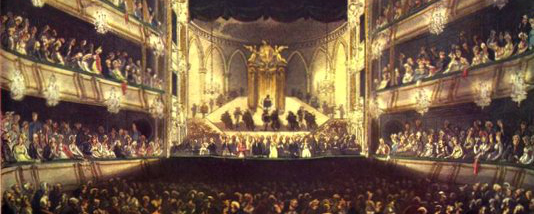
As I look ahead in my calendar, I’m delighted to see how full it is with concerts, plays, and performances of all descriptions. We have tickets to a couple of symphony concerts, a performance of Verdi’s Requiem, an opera, and in a couple of weeks, a world premiere of a dance version of Hamlet, staged by Robert Lepage, which I’m sure I’ll either love or hate. We’re also going to several plays, and I just confirmed my subscription for the symphony for the 24/25 season.
Yes, I love live performances. No surprise there!
This got me wondering about the arts scene in the early years of the 19th century. We read and write about Mr Darcy and his box at the theatre, but what, exactly, was he going to see?
Concert programs from the early 1800s aren’t as thick on the ground as one might think, and performance spaces weren’t always as “official” and regular as the ones we think of today. Of course, there were the big theatres, such as Drury Lane and Covent Garden, but music performances were often held in other venues.

The Concert Room at the King’s Theatre, Haymarket, was a popular place for musical performances, as were several taverns across the city. These places, rather than being he slightly seedy gin-joints we think of now, were often elegant spaces which hosted lavish banquets of other social events, including musical performances. Furthermore, a lot of music happened not in public performance spaces, but in private homes where musical evenings, often with first-rate performers, were part of the social scene.

(British Museum)
Still, some concert programs do survive, and they are fascinating to look at.
Some performances were rather restrained in their offerings. For example, here is an advertisement for a concert at the Festino Rooms, Hanover Square, from 1791. The only pieces on offer are three of the string quartets from Joseph Haydn’s Op. 64 set, and reportedly “performed under his direction.” That would have been quite a thing to hear!

Here is part of one of the quartets from that collection, Op. 64 no 5, known as ‘The Lark.’ Whether it was one of the three chosen, I don’t know, but I hope you enjoy listening to what might have sounded in that concert room.
Other concerts were busier. This next program, from almost exactly 233 years ago (March 18, 1791), boasted an overture, an aria, a flute concerto, another aria, and a string quartet. And that was just the first part. The second part offered a symphony, an aria, a bassoon concerto, a duet, and a “full piece,” with none other than Mr Haydn himself at the harpsichord. This concert began at eight. One can only imagine what time the audience members crawled home!

These concerts and many others like them demonstrated the eagerness of well-off Londoners for excellent music, but it wasn’t until January of 1813 that the first permanent musical ensemble was created: The Philharmonic Society. It’s purpose was “to promote the performance, in the most perfect manner possible of the best and most approved instrumental music.” In other words, it was a high-quality professional and permanent musical ensemble with a subscription series. dedicated to the highest quality of and regular performances of large-scale instrumental music.

The first performance of this new society, given on March 8, 1813 and conducted by the same Mr Salomon who sponsored Haydn two decades before, was also no lightweight affair. The evening’s entertainments included an overture, a string quartet, a vocal quartet, a serenade, and a full Beethoven symphony, and that just before intermission. Afterwards, the audience was treated to another symphony (this one by Haydn), an opera chorus, a string quintet, and another final piece by Haydn.
Here is a recording of the chorus that was performed in the second part, ‘Placido e’ il mar’ from Idomeneo by Mozart.
We don’t know which Beethoven symphony was on the program, but by the date, it must have been one of the first six. Let’s imagine for a moment it was the beautiful third, the Eroica, which I wrote about in a different place a while ago. Here is the heartbreaking second movement, a funeral march for an unnamed hero.
Can you imagine Mr and Mrs Darcy alighting from their carriage to attend such a performance? Perhaps Mr and Mrs Wentworth were in the same audience; we know Anne was a music lover, as was Elizabeth. I love to imagine them all as keen patrons of the arts, who enjoyed a good concert just as much as I do.
Are you a concert-goer? What do you enjoy? Jazz, or a good play? I’d love to hear about it all.


Leave a Reply